

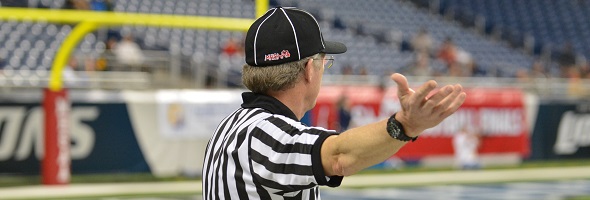
Be the Referee: Trick Plays
November 19, 2015
This week, MHSAA assistant director Mark Uyl explains which trick plays in football are allowed, and not allowed, under high school rules.
Be The Referee is a series of short messages designed to help educate people on the rules of different sports, to help them better understand the art of officiating, and to recruit officials.
Below is this week's segment - Trick Plays - Listen
In some of the biggest football games of the year, often times a trick play can be the difference between winning and losing.
Many types of these trick plays are perfectly legal – the halfback pass, the hook and ladder, or the double pass with the first pass being backward behind the line of scrimmage and the second pass going forward. There are several types of trick plays, however, that are prohibited by rule.
One is the old fumblerooski play, where a team intentionally fumbles near the center and a lineman picks up the ball and advances. A second type that is illegal is whenever you’re using substitutions or pretended substitutions to free up a receiver or player standing out along the sidelines.
Past editions:
Nov. 12: 7-Person Football Mechanics - Listen
Nov. 5: Make the Call: Personal Fouls - Listen
Oct. 29: Officials Demographics - Listen
Oct. 15: Make the Call: Intentional Grounding - Listen
Oct. 8: Playoff Selection - Listen
Oct. 1: Kick Returns - Listen
Sept. 24: Concussions - Listen
Sept. 17: Automatic First Downs - Listen
Sept. 10: Correcting a Down - Listen
Sept 3: Spearing - Listen
Aug. 27: Missed Field Goal - Listen
Be the Referee: Defensive Holding
By
Paige Winne
MHSAA Director of Brand Management
October 6, 2026
Be The Referee is a series of short messages designed to help educate people on the rules of different sports, to help them better understand the art of officiating, and to recruit officials.
Below is this week's segment – Defensive Holding - Listen
Team A has the ball on their own 20-yard line and its 4th-and-15. They decide to go for it. The quarterback drops back to pass and is sacked at his 15-yard line, a five-yard loss.
But during the play, Team B – the defense – is flagged for holding an eligible wide receiver.
How is the penalty administered?
- Is it 4th-and-5 from Team A’s 30?
- Is it 4th-and-10 from Team A’s 25?
- Is it 1st-and-10 from Team A’s 30?
- Or is it 1st-and-10 from Team A’s 25?
If you said it is 4th-and-5 from Team A’s 30 – you are correct.
Defensive holding is a 10-yard penalty from the previous spot – which was the 20-yard line. Team A now has possession at the 30, needing to get to the 35 for first down.
Previous 2026-27 editions
Sept. 29: Minimum Number of Volleyball Players - Listen
Sept 22: Soccer Changes - Listen
Sept: 15: Dead Ball Penalty - Listen
Sept. 8: Libero Ejected - Listen
Sept. 1: Soccer Foul After Shot on Goal - Listen
Aug. 25: Fumble Out of Bounds - Listen