

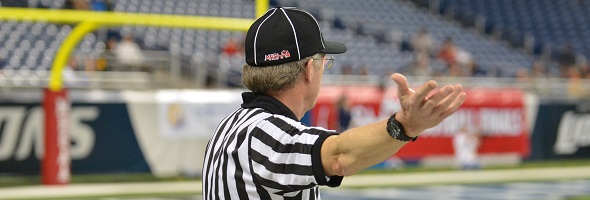
Be the Referee: Uncatchable Pass
October 30, 2014
This week, MHSAA assistant director Mark Uyl explains the differences between high school and college and pro rules when it comes to an uncatachable pass.
"Be the Referee" is designed to help educate people on the rules of different sports, to help them better understand the art of officiating and to recruit officials. The segment can be heard on Mondays, Wednesdays and Fridays during the school year on The Drive With Jack Ebling on WVFN-AM, East Lansing.
Below is this week's segment - Uncatchable Pass - Listen
Today we’re going to talk about one of the most misunderstood rules at the high school level, and that deals with the uncatchable pass.
All of us have sat in front of our televisions on Saturday or Sunday and seen the long pass get thrown, followed immediately by the throwing of the flag. As the officials discuss what happened, the referee invariably clicks on the microphone and announces that there is no foul for pass interference because the pass was uncatchable.
At the high school level, that is not a factor in deciding whether or not pass interference has occurred. The ball does not have to be catchable, and if the contact is ruled as pass interference, that foul stands, regardless of the quality of the pass.
Past editions
Oct. 22 - Preparation for Officials - Listen
Oct. 15 - Automatic First Downs - Listen
Oct. 8 - Officials & Injuries - Listen
Oct. 1 - Overtime - Listen
Sept. 25 - Field Goals - Listen
Sept. 18 - Tackle Box - Listen
Sept. 11 - Pass Interference - Listen
Aug. 25 - Targeting - Listen
What's My Why: Official Kari Seitz
August 19, 2026
Kari Seitz, Mill Valley (Calif.)
Kari Seitz – the closing speaker at July’s Officiate Michigan Day in Grand Rapids – was one of the top American professional soccer referees and one of the most experienced female referees in the world. She is currently the vice president of refereeing for US Soccer and formerly served as the FIFA head of refereeing.
She worked four FIFA Women's World Cup tournaments (1999, 2003, 2007, and 2011), as well as three Olympic soccer tournaments (2004, 2008, and 2012), and is the only referee – man or woman – to officiate that many of both. Kari was inducted into the National Soccer Hall of Fame in 2026 and is a graduate of Brighton High School and Michigan State University.
So I was a soccer player, played soccer since I was 6. And at some point, I joined an all-girls travel team – that never happened. This was a long time ago.
Our coach required us together, every person on the team, to take the (officiating) course. Now, I believe he didn’t know anything about soccer. He was one of those parents who was reading it from a book and just cared about his kids. So he forced us all to take the referee course, and that altered the path of my life.
“What’s My Why” is a weekly feature telling the stories of MHSAA-registered officials in their own words. If you’re an MHSAA official and would like to share your reason why, please submit a 15 to 45-second video, taken horizontally, to director of officials Sam Davis at [email protected].
What's My Why
Aug. 13: Mike Pereira, Sacramento, Calif. - Watch
Aug. 5: Dino Paganelli, Wyoming - Watch
Aug. 3: Stacy Smith, Caledonia - Watch
July 22: Jason Nickleby, Lake Elmo, Minn. - Watch
July 15: Sam Davis, Lansing - Watch
July 9: Candace Cox, Quincy - Watch
July 1: Robert Williams, Redford - Watch
June 24: Will Godfrey, Jackson - Watch
June 19: Jarrett Skorup, Midland - Watch
June 12: Brady Driver, Sturgis - Watch
June 8: Cindy Tyzo, West Bloomfield - Watch
June 3: Jeff Spedoske, DeWitt - Watch
June 1: Mike Carrier, Commerce Township - Watch
May 27: Stan Wright, Warren - Watch
May 26: Murray Rose, Zeeland - Watch
May 22: Mike VanLaan, Alto - Watch
May 18: Clint Abbott, Newaygo - Watch