

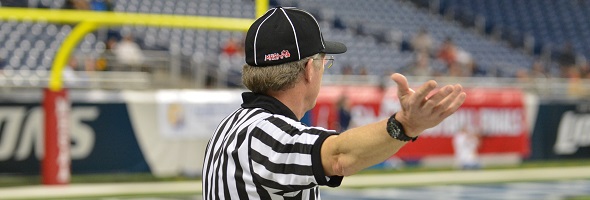
Be the Referee - Unique Kickoff Option
September 27, 2018
This week, MHSAA officials coordinator Sam Davis explains a little-known option unique to high school football regarding kickoffs.
Be The Referee is a series of short messages designed to help educate people on the rules of different sports, to help them better understand the art of officiating, and to recruit officials.
Below is this week's segment – Unique Kickoff Option - Listen
Here’s a football rule you may not know about or have ever seen applied.
After a touchdown or a field goal, the opponent of the scoring team may designate which team kicks off. That’s right! The team just allowing the points can decide who will kick off.
Now why would a team want to do that? Strategically, a team may elect to pin the other team deep in its own end with its own kicker late in a close game rather than risk successfully receiving an onside kick.
Though it is not often used by teams, it is a very clever way to manage the game. I’m sure the national rules makers had other reasons, but now you know about a unique rule that’s unique to high school football.
Past editions
September 20: Uncatchable Pass - Listen
September 13: Soccer Rules Change - Listen
September 6: You Make the Call: Face Guarding - Listen
August 30: 40-Second Play Clock - Listen
August 23: Football Rules Changes - Listen
What's My Why: Official Jenna Schroeder
September 9, 2026
Jenna Schroeder, Berkley
Jenna Schroeder has been an NBA referee since 2020 and previously worked in the NBA-G League. Prior to officiating, she played basketball at Oakland University and Saginaw Valley State University.
She was an MHSAA-registered basketball official in 2003-04, 2005-06, and then from 2010-18, and also officiated girls lacrosse for four seasons. She's Clio's all-time leading girls basketball scorer and participated in the MHSAA Officials Legacy Program.
I got into it because I played basketball my entire life. I graduated college in 2009, during the housing crisis and no job prospects, so I tried refereeing and got bit by the bug and I’ve been obsessed with it ever since then.
“What’s My Why” is a weekly feature telling the stories of MHSAA-registered officials in their own words. If you’re an MHSAA official and would like to share your reason why, please submit a 15 to 45-second video, taken horizontally, to director of officials Sam Davis at [email protected].
What's My Why
Sept. 2: Joey Crawford, Newton Square, Pa. - Watch
Aug. 26: Ron Torbert, Hanover, Md. - Watch
Aug. 19: Kari Seitz, Mill Valley, Calif. - Watch
Aug. 13: Mike Pereira, Sacramento, Calif. - Watch
Aug. 5: Dino Paganelli, Wyoming - Watch
Aug. 3: Stacy Smith, Caledonia - Watch
July 22: Jason Nickleby, Lake Elmo, Minn. - Watch
July 15: Sam Davis, Lansing - Watch
July 9: Candace Cox, Quincy - Watch
July 1: Robert Williams, Redford - Watch
June 24: Will Godfrey, Jackson - Watch
June 19: Jarrett Skorup, Midland - Watch
June 12: Brady Driver, Sturgis - Watch
June 8: Cindy Tyzo, West Bloomfield - Watch
June 3: Jeff Spedoske, DeWitt - Watch
June 1: Mike Carrier, Commerce Township - Watch
May 27: Stan Wright, Warren - Watch
May 26: Murray Rose, Zeeland - Watch
May 22: Mike VanLaan, Alto - Watch
May 18: Clint Abbott, Newaygo - Watch