

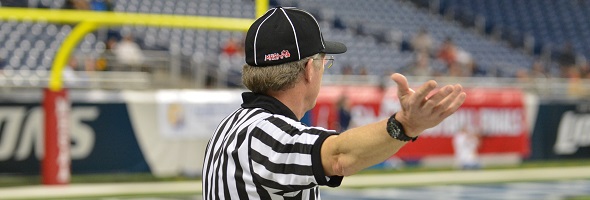
Be the Referee: Untimed Down
October 13, 2016
This week, MHSAA assistant director Mark Uyl discusses untimed downs in football, a hot topic given a scenario involving one of our in-state universities earlier this season.
Be The Referee is a series of short messages designed to help educate people on the rules of different sports, to help them better understand the art of officiating, and to recruit officials.
Below is this week's segment – Untimed Down - Listen
A few weeks back, the Central Michigan-Oklahoma State football game generated a lot of conversation about the playing rules when any period gets extended with an untimed down.
Many times announcers will wrongly talk about an accepted defensive penalty, that it then means the offense gets one more snap. Under high school rules, whenever there’s an accepted penalty on the last play of the period, there is one untimed down. The only exceptions to this – just like the college rules – are those penalties which also bring about a loss of down.
NOTE: Penalties which bring about a loss of down are: Intentional Grounding, Illegally Handing Ball Forward, Illegal Forward Pass and Illegal Touching.
Past editions
October 6: Soccer Penalty Kick Change - Listen
Sept. 29: Preparation for Officials - Listen
Sept 22: You Make the Call: Returning Kickoffs - Listen
Sept. 15: Concussions - Listen
Sept 8: Equipment Covering the Knees - Listen
Sept. 1: Play Clock Experiment - Listen
Aug. 25: Clipping in the Free Blocking Zone - Listen
What's My Why: Official Jenna Schroeder
September 9, 2026
Jenna Schroeder, Berkley
Jenna Schroeder has been an NBA referee since 2020 and previously worked in the NBA-G League. Prior to officiating, she played basketball at Oakland University and Saginaw Valley State University.
She was an MHSAA-registered basketball official in 2003-04, 2005-06, and then from 2010-18, and also officiated girls lacrosse for four seasons. She's Clio's all-time leading girls basketball scorer and participated in the MHSAA Officials Legacy Program.
I got into it because I played basketball my entire life. I graduated college in 2009, during the housing crisis and no job prospects, so I tried refereeing and got bit by the bug and I’ve been obsessed with it ever since then.
“What’s My Why” is a weekly feature telling the stories of MHSAA-registered officials in their own words. If you’re an MHSAA official and would like to share your reason why, please submit a 15 to 45-second video, taken horizontally, to director of officials Sam Davis at [email protected].
What's My Why
Sept. 2: Joey Crawford, Newton Square, Pa. - Watch
Aug. 26: Ron Torbert, Hanover, Md. - Watch
Aug. 19: Kari Seitz, Mill Valley, Calif. - Watch
Aug. 13: Mike Pereira, Sacramento, Calif. - Watch
Aug. 5: Dino Paganelli, Wyoming - Watch
Aug. 3: Stacy Smith, Caledonia - Watch
July 22: Jason Nickleby, Lake Elmo, Minn. - Watch
July 15: Sam Davis, Lansing - Watch
July 9: Candace Cox, Quincy - Watch
July 1: Robert Williams, Redford - Watch
June 24: Will Godfrey, Jackson - Watch
June 19: Jarrett Skorup, Midland - Watch
June 12: Brady Driver, Sturgis - Watch
June 8: Cindy Tyzo, West Bloomfield - Watch
June 3: Jeff Spedoske, DeWitt - Watch
June 1: Mike Carrier, Commerce Township - Watch
May 27: Stan Wright, Warren - Watch
May 26: Murray Rose, Zeeland - Watch
May 22: Mike VanLaan, Alto - Watch
May 18: Clint Abbott, Newaygo - Watch