

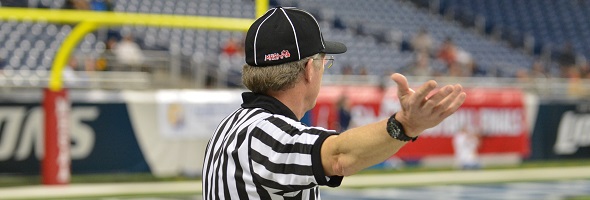
Be the Referee: What Officials Don't Do
October 11, 2018
This week, MHSAA officials coordinator Sam Davis discusses some of the things that do not fall under officials' many game-day responsibilities.
Be The Referee is a series of short messages designed to help educate people on the rules of different sports, to help them better understand the art of officiating, and to recruit officials.
Below is this week's segment – What Officials Don't Do - Listen
Game officials at all levels have a lot of responsibilities. But there are some critical things that take place at local high school games where officials don’t have the authority that some folks think they do.
Let’s start with injuries – specifically concussions. Concussion management starts and ends with the local school. If an official suspects a concussion – or any injury – all he or she can do is notify the coach of the team. The school makes the decision about whether or not a player stays in the game.
We often get calls about whether or not an official is responsible for enforcing MHSAA Handbook rules. Again, it’s up to the school, which agrees to follow and enforce the rules when joining the Association. Even if the official suspects an ineligible player is in the game, it’s not his or her role to enforce that rule. It’s all on the school.
Past editions
October 4: Always 1st-and-Goal - Listen
September 27: Unique Kickoff Option - Listen
September 20: Uncatchable Pass - Listen
September 13: Soccer Rules Change - Listen
September 6: You Make the Call: Face Guarding - Listen
August 30: 40-Second Play Clock - Listen
August 23: Football Rules Changes - Listen
Be the Referee: Untimed Down
October 13, 2016
This week, MHSAA assistant director Mark Uyl discusses untimed downs in football, a hot topic given a scenario involving one of our in-state universities earlier this season.
Be The Referee is a series of short messages designed to help educate people on the rules of different sports, to help them better understand the art of officiating, and to recruit officials.
Below is this week's segment – Untimed Down - Listen
A few weeks back, the Central Michigan-Oklahoma State football game generated a lot of conversation about the playing rules when any period gets extended with an untimed down.
Many times announcers will wrongly talk about an accepted defensive penalty, that it then means the offense gets one more snap. Under high school rules, whenever there’s an accepted penalty on the last play of the period, there is one untimed down. The only exceptions to this – just like the college rules – are those penalties which also bring about a loss of down.
NOTE: Penalties which bring about a loss of down are: Intentional Grounding, Illegally Handing Ball Forward, Illegal Forward Pass and Illegal Touching.
Past editions
October 6: Soccer Penalty Kick Change - Listen
Sept. 29: Preparation for Officials - Listen
Sept 22: You Make the Call: Returning Kickoffs - Listen
Sept. 15: Concussions - Listen
Sept 8: Equipment Covering the Knees - Listen
Sept. 1: Play Clock Experiment - Listen
Aug. 25: Clipping in the Free Blocking Zone - Listen