


Beyond Fairness
April 11, 2017
One of the lessons I learned decades ago when I was employed at the National Federation of State High School Associations (NFHS) is that sometimes the playing rules are not fair.
The NFHS is the publisher of playing rules for most high school sports, and its rule books govern competition for most of the contests for most of the high schools in the U.S.
But the NFHS doesn’t publish the most fair rules. On purpose.
The rules for the high school level attempt to do much more than promote competitive equity, or a balance between offense and defense; they also attempt – without compromising participant health and safety – to simplify the administration of the game.
Unlike Major League Baseball, where umpires officiate full-time, and professional basketball, football and ice hockey where they officiate nearly full-time, the officials at the high school level are part-timers. They have other jobs. This is their avocation, not their vocation.
So the NFHS develops and publishes rules that minimize exceptions to the rules. In football, for example, there are fewer variables for determining the spot where penalties are enforced.
At the high school level, the rule makers intend that the rules be – for players, coaches and officials alike – quicker to learn, simpler to remember, and easier to apply during the heat of contests.
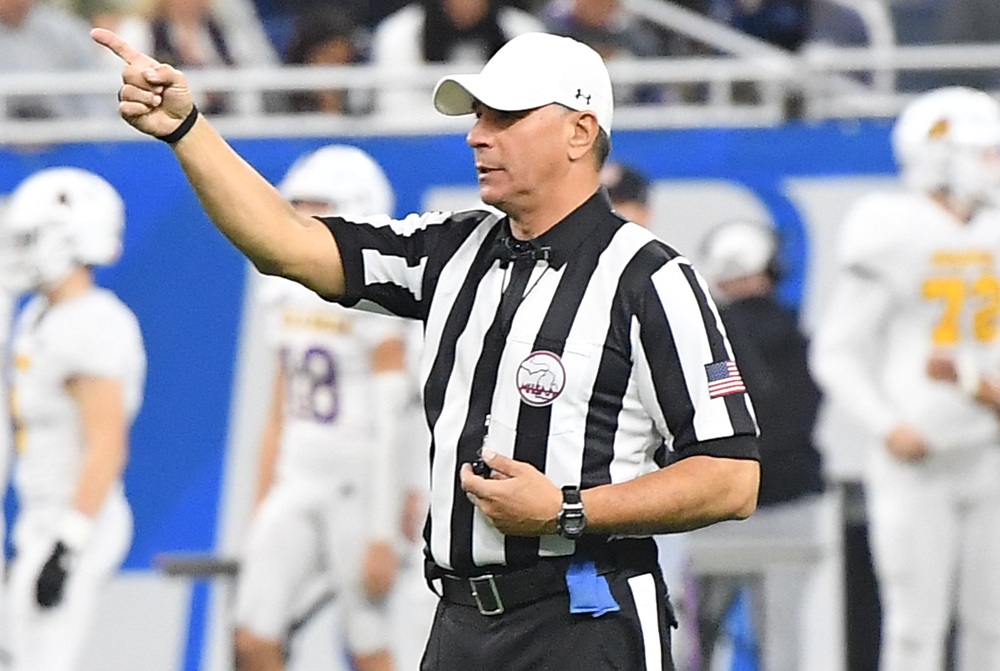
Be the Referee: Dead Ball Penalty
By
Paige Winne
MHSAA Director of Brand Management
September 15, 2026
Be The Referee is a series of short messages designed to help educate people on the rules of different sports, to help them better understand the art of officiating, and to recruit officials.
Below is this week's segment – Dead Ball Penalty - Listen
We’ve got 4th-and-10 on the football field today. Team A has the ball on their own 40 and is going for it.
The quarterback scrambles and is pushed out of bounds at the 49-yard line, one yard short of a first down.
A defensive player from Team B hits the quarterback after he’s been pushed out of bounds and is flagged for a dead-ball personal foul. Where should the ball be marked and who has possession?
Is it 1st-and-10 for Team A at Team B’s 36-yard line? Or does the defense get the ball, 1st-and-10 for Team B at their own 36?
If you said Team B’s ball, you are correct. The personal foul was a dead-ball penalty that is enforced after the change of possession.
Previous 2026-27 editions
Sept. 8: Libero Ejected - Listen
Sept. 1: Soccer Foul After Shot on Goal - Listen
Aug. 25: Fumble Out of Bounds - Listen