

Former Cardinal Mooney Coach Earns Breslin Return as Official
By
Paul Costanzo
Special for MHSAA.com
March 31, 2022
Jim McAndrews felt anxious and excited both times he was on the floor during basketball Finals weekend at the Breslin Center.
 But those feelings were a bit different as an assistant coach at Marine City Cardinal Mooney in 2010 than they were as a referee this year.
“It was different because I was worried about myself (as a referee) versus having to worry about high school kids and not making a mistake to screw it up for them (as a coach),” McAndrews said. “This was a little less pressure than that. With refereeing, you kind of just worry about yourself.”
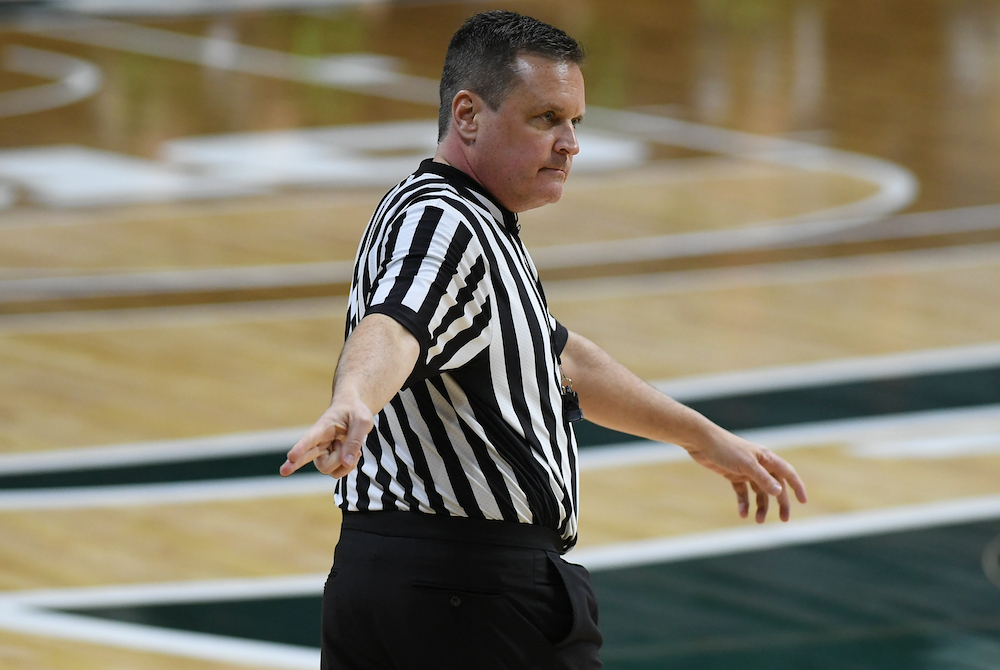
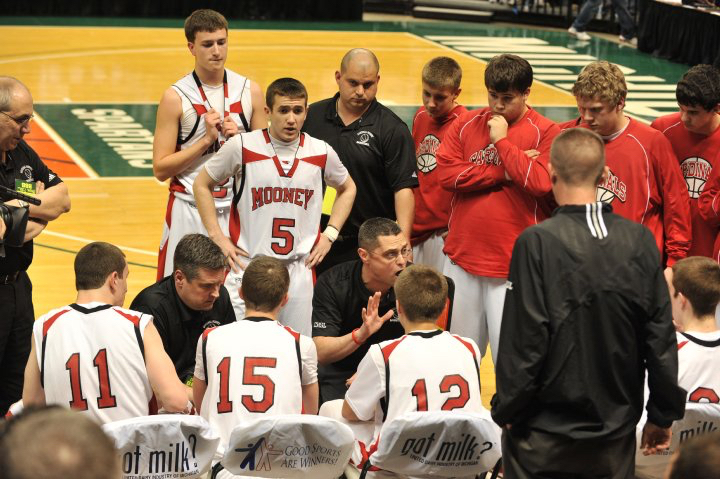
McAndrews served as the head official in the Division 2 Girls Semifinal between Grand Rapids West Catholic and Detroit Country Day on March 18. That Breslin appearance came 12 years after he was an assistant for his brother, Mike McAndrews, during Mooney’s runner-up run in Class D boys in 2010.
He also coached with his sister, Susan Everhart, who led the Mooney girls to the Semifinals in 2008 and a runner-up finish in 2009. Those tournaments ended at Eastern Michigan University, but all of them gave him a rare look at the experience from two very different angles.
“I wasn’t walking in blindly,” McAndrew said. “I think what helps me in my officiating duties is having been there and knowing what the coaches are expecting and what they need. I think that helps me to communicate things to them. Being (at Breslin as a coach) and seeing that helped.”
McAndrews has been reffing since leaving his brother’s staff in 2011. That ended a long run in coaching which started in 1989 when he was an assistant coach at Mooney under Dave Jackson. After one season in that role, he took over the program and coached the Cardinals for a decade. That included coaching his brother, who he would later coach with for another eight years.
It didn’t even take a full season for him to get back on the court, albeit in a different role, after leaving the coaching ranks.
“I missed the game,” Jim McAndrews said. “Refereeing gives you an opportunity to get your competitive juices going a little bit. You get a little exercise, and the relationships you get to make are amazing. There’s nothing like being in the gym and talking hoops with other like-minded people: junkies. Basketball junkies. It’s a community, and it’s a really good community. We all want good stuff for the kids, and we want to help out. Plus, I enjoy seeing the local talent.”
 McAndrews, whose full-time job is in automotive supply sales, refs mostly in the Metro Detroit area and the Thumb, working games in the Catholic League, Macomb Area Conference and Blue Water Area Conference.
Being a referee has not only allowed him to stay in the game and the high school basketball community, but it’s also introduced him to new people who have the same love for the game.
“This community really is special,” he said. “We’re not in it to get rich. We’re in it because we’re passionate about the game.”
This year’s Semifinal was his first, and he was joined on the court by Jerry Armstrong and Douglas Richardson. It was the trio’s first time together.
“That can be part of the challenge,” McAndrews said. “You have to be able to adapt to other people’s way of doing things that you’ve never met before. That’s part of it. It’s about officiating the game as well as challenging yourself.”
Another challenge of refereeing during Finals weekend is the increase of eyes on the game, and the extra pressure that can bring.
“In this particular case, it was my first time (reffing) on TV,” McAndrews said. “There’s commentators with replays, and there are different responsibilities in regard to timeouts. There was a little anxiety. I said to my partners that I’m just going to try to smile, be in the moment and enjoy it, because it’s been a crazy couple years. But your peers are watching, other referees are watching, and they’ll let you know if you miss something.”
The game went off without any issues, and the experience ended up being even better than McAndrews expected, as his kids were able to be on the court with him.
“It was fantastic,” he said. “I can’t think of a better word for it. My family was able to get involved, and we had first-class accommodations. My kids were able to be the ball boy and the water guy for me, so this wasn’t just for me. We were very appreciative of it all, and it was really, really fun.”
 Paul Costanzo served as a sportswriter at The Port Huron Times Herald from 2006-15, including three years as lead sportswriter, and prior to that as sports editor at the Hillsdale Daily News from 2005-06. He can be reached at [email protected] with story ideas for Genesee, Lapeer, St. Clair, Sanilac, Huron, Tuscola, Saginaw, Bay, Arenac, Midland and Gladwin counties.
PHOTOS (Top) Jim McAndrews works this season’s Division 2 Semifinals between Grand Rapids West Catholic and Detroit Country Day. (Middle) McAndrews, kneeling lower left, serves as an assistant coach during Cardinal Mooney’s run to Breslin in 2010. (Top photo by Hockey Weekly Action Photos; middle courtesy the McAndrews family.)
Legacies Live on in Matson's Work
By
Geoff Kimmerly
MHSAA.com senior editor
March 26, 2015
Hugh Matson was a sophomore on the 1951 Newaygo team that made the school's first trip to the MHSAA Boys Basketball Semifinals.
His team faced Dimondale in an auxiliary gym at Michigan State University’s Jenison Field House, but fell 56-54 in overtime when Dimondale scored the first basket of what was then a sudden-death extra period.
He watched the Class D championship game with some disappointment, knowing his team had come so close to playing on Jenison's main floor. But another highlight of that weekend has stuck with Matson, who has given back to high school sports as a teacher, coach, athletic director and official for more than 50 years.
After Matson and his team arrived in Lansing and checked into downtown’s Olds Hotel, they were directed to another room where they were welcomed by MHSAA executive director Charles E. Forsythe. It’s a memory Matson has enjoyed recalling recently – on Saturday, he will receive the honor bearing Forysthe’s name.
Matson will receive the 38th Charles E. Forsythe Award, for his long and various contributions to education athletics, during the first-quarter break of Saturday’s Class A Boys Basketball Final at the Breslin Center.
"That's very important to me. He was the big name in athletic administration when I got into it as an athletic director," Matson said. "He was known all over the United States as one of the great athletic directors, and I really feel honored. I'm humbled by it, naturally."
Forsythe was the MHSAA’s first full-time and longest-serving chief executive. Forsythe Award recipients are selected each year by the MHSAA Representative Council, based on an individual's outstanding contribution to the interscholastic athletics community.
Matson, 79, has deep roots in education. His mother Velma – who died in January at 104 years of age – was a longtime educator in Newaygo and with his father Francis established a scholarship for graduating seniors still awarded today. Hugh Matson took his first teaching job in 1957, at Mattawan, then followed older brothers Bill and Max to Saginaw Township Community Schools, teaching and coaching at Saginaw MacArthur High school from 1962-71 and then Saginaw Eisenhower from 1971-88.
Matson served as head varsity football and track and field coach at Mattawan and as head track and field coach at both MacArthur and Eisenhower, in addition to serving as an assistant football coach at both schools. He also became the first and only athletic director in Eisenhower’s history – holding that position from the school’s first day until the end of the 1987-88 school year, when he became co-athletic director of the new Saginaw Heritage High School, which was created from a merger of MacArthur and Eisenhower. Matson served as the sole full-time athletic director of Heritage for 1996-97 before retiring.
“Hugh has been dedicated to improving athletics in Michigan for more than 50 years, and his contributions stretch over every aspect of our games and beyond the Saginaw area,” MHSAA Executive Director John E. “Jack” Roberts said. “He showed leadership not only in his community for many years but at the statewide level among his colleagues, and continues his involvement as a valued official. We’re glad to honor Hugh Matson with the Forsythe Award.”
Matson has been a member of the Michigan Interscholastic Athletic Administrators Association (MIAAA) since 1970 and served as its president during the 1989-90 school year. He also was a member of the National Interscholastic Athletic Administrators Association (NIAAA) for three decades and has been a member of the Association of Track Officials of Michigan (ATOM) since 1993. Matson received distinguished service awards from both the MIAAA and ATOM and served as a representative and speaker for the MIAAA at regional conferences in Iowa and Wisconsin and to the NIAAA Leadership Forum in 1987.
 During his time as athletic director, Matson hosted MHSAA Districts or Regionals for seven sports. He’s been an MHSAA registered official since 1970 and has officiated 25 MHSAA Regionals in either cross country or track and field and 12 MHSAA Finals. He also has officiated cross country and track and field at the Division I, II and III and NAIA collegiate levels.
“Hugh was excellent with students, parents and staff during his 42 years as a teacher and coach at Eisenhower and Heritage High School. He is extremely positive with the kids as an official,” said current Saginaw Heritage athletic director Peter Ryan, also a member of the MHSAA Representative Council. “Hugh has been dedicated to improving athletics in the state of Michigan, and his passion for athletic officiating is contagious.”
“I still think I have the energy for it, and I enjoy it a lot,” Matson said. “Every day before I go to a track meet, my (wife Jackie) says, ‘Have fun.’ And she says when I come home, ‘Did you have fun?’ And yeah, I have fun. Working with younger people also, it keeps me youthful.”
Matson received his bachelor’s degree in physical education with minors in English and history in 1957 from Western Michigan University. He taught English and history at Mattawan, and then English and physical education during his three tenures as part of Saginaw Township Community Schools. In addition to his mother and brothers, Matson’s sister Joelyn also worked in education, recently retiring from the University of Toledo.
Past recipients of the Charles E. Forsythe Award
1978 - Brick Fowler, Port Huron; Paul Smarks, Warren
1979 - Earl Messner, Reed City; Howard Beatty, Saginaw
1980 - Max Carey, Freesoil
1981 - Steven Sluka, Grand Haven; Samuel Madden, Detroit
1982 - Ernest Buckholz, Mt. Clemens; T. Arthur Treloar, Petoskey
1983 - Leroy Dues, Detroit; Richard Maher, Sturgis
1984 - William Hart, Marquette; Donald Stamats, Caro
1985 - John Cotton, Farmington; Robert James, Warren
1986 - William Robinson, Detroit; Irving Soderland, Norway
1987 - Jack Streidl, Plainwell; Wayne Hellenga, Decatur
1988 - Jack Johnson, Dearborn; Alan Williams, North Adams
1989 - Walter Bazylewicz, Berkley; Dennis Kiley, Jackson
1990 - Webster Morrison, Pickford; Herbert Quade, Benton Harbor
1991 - Clifford Buckmaster, Petoskey; Donald Domke, Northville
1992 - William Maskill, Kalamazoo; Thomas G. McShannock, Muskegon
1993 - Roy A. Allen Jr., Detroit; John Duncan, Cedarville
1994 - Kermit Ambrose, Royal Oak
1995 - Bob Perry, Lowell
1996 - Charles H. Jones, Royal Oak
1997 - Michael A. Foster, Richland; Robert G. Grimes, Battle Creek
1998 - Lofton C. Greene, River Rouge; Joseph J. Todey, Essexville
1999 - Bernie Larson, Battle Creek
2000 - Blake Hagman, Kalamazoo; Jerry Cvengros, Escanaba
2001 - Norm Johnson, Bangor; George Lovich, Canton
2002 - John Fundukian, Novi
2003 - Ken Semelsberger, Port Huron
2004 - Marco Marcet, Frankenmuth
2005 - Jim Feldkamp, Troy
2006 - Dan McShannock, Midland; Dail Prucka, Monroe
2007 - Keith Eldred, Williamston; Tom Hickman, Spring Lake
2008 - Jamie Gent, Haslett; William Newkirk, Sanford-Meridian
2009 - Paul Ellinger, Cheboygan
2010 - Rudy Godefroidt, Hemlock; Mike Boyd, Waterford
2011 - Eric C. Federico, Trenton
2012 - Bill Mick, Midland
2013 - Jim Gilmore, Tecumseh; Dave Hutton, Grandville
2014 - Dan Flynn, Escanaba
The MHSAA is a private, not-for-profit corporation of voluntary membership by more than 1,400 public and private senior high schools and junior high/middle schools which exists to develop common rules for athletic eligibility and competition. No government funds or tax dollars support the MHSAA, which was the first such association nationally to not accept membership dues or tournament entry fees from schools. Member schools which enforce these rules are permitted to participate in MHSAA tournaments, which attract more than 1.4 million spectators each year.
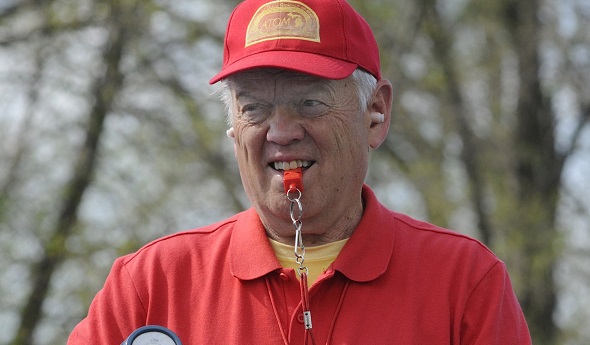
PHOTOS: (Top) Hugh Matson continues as an MHSAA official and has worked at all levels of college as well. (Middle) Matson accepts his induction into the Saginaw Sports Hall of Fame in 2014. (Photos courtesy of Saginaw Heritage High School.)