

Fruit Belt 'Interacts' to Recruit Officials
August 27, 2014
By Rob Kaminski
MHSAA benchmarks editor
The MHSAA always is seeking creative ideas for recruiting some of the most important people in high school athletics – officials to preside over the games.
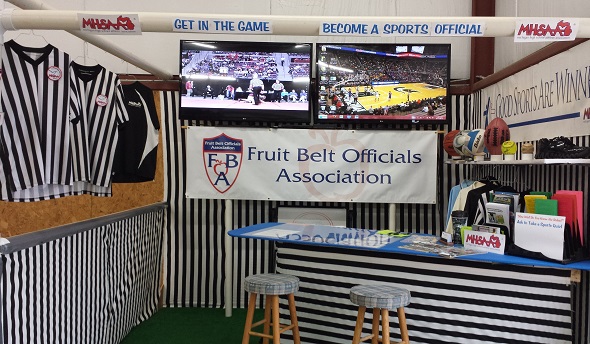
The Fruit Belt Officials Association once again hosted an interactive recruitment booth at the Berrien County Youth Fair, staffed by volunteers from the membership.
Freddy Krieger, who coordinated the project for the FBOA, says the outreach effort enabled the group to connect with people outside the athletic community who otherwise likely wouldn’t have known the organization existed.
“There are a lot of people in our area who said, ‘I always wanted to (officiate), but I didn’t know how to start,’” he said. “I heard it from people when I manned the booth myself.”
A longtime basketball official, Krieger, who has also worked soccer and baseball, believes it’s vital that officials associations actively search for new members, rather than waiting for prospects to come to them.
“The average age of officials in the state of Michigan is 48,” he says. “There are a number of us in the association who say, ‘We’ve got to replace ourselves.’”
The display includes flat screen TV monitors with video loop of games in a variety of sports, “Ask the Official” opportunities for the public to find answers to their rules questions, FBOA and MHSAA logos, and an “interest box” where prospective officials can leave contact information.
The booth attracted 43 individuals who totaled 71 officiating preferences in six sports. Krieger reported that a year ago the booth cultivated 108 prospective officials – 23 interested for basketball, 22 baseball, 17 softball, 16 football, 13 volleyball, seven wrestling and 10 soccer prospects.
All prospects are invited to the FBOA general meeting in September, and contact information is forwarded to sport-specific trainers and contact people who diligently follow up to involve them in orientation, training, and integration as officials in various sports.
Individuals from previous years also are re-invited.
“Sometimes it takes a year or two – or even three – to get someone to make the kind of commitment it takes to become integrated into our avocation and submit to the required training,” Krieger said.
Be the Referee: Non-Glare Helmets
May 7, 2015
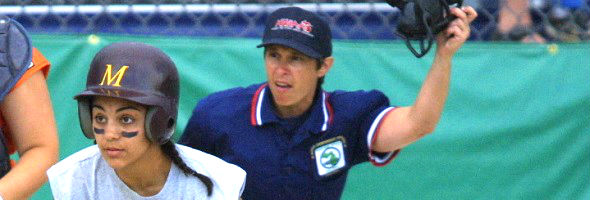
This week, MHSAA assistant director Mark Uyl explains why high-glare helmets are prohibited for softball and baseball.
Be The Referee is a series of short messages designed to help educate people on the rules of different sports, to help them better understand the art of officiating, and to recruit officials.
Below is this week's segment - Non-Glare Helmets - Listen
A new rule change this year in high school baseball and high school softball deals with helmets.
As many of us sat around over the holidays watching various college football bowl games, we saw what we often call the “Oregon Effect” – teams wearing a very shiny, high gloss helmet to try and catch a kid’s attention with the wow factor.
In both baseball and softball, these high glare-high gloss helmets can be a safety issue, where the sun can reflect off a batter’s or baserunner’s helmet, or even a catcher’s helmet, which could create a safety issue for those kids playing defense. These high gloss helmets are no longer legal starting with this season.
Past editions
April 27 - Vern L. Norris Award - Listen
March 23 - Deciding the Game - Listen
March 16 - Block/Charge Call - Listen
March 9 - Dive on the Floor - Listen
March 2 - Primary Areas - Listen
Feb. 23 - Too Much TV - Listen
Feb. 16 - Video Clip Library - Listen
Feb. 9 - Cheer Safety - Listen
Feb. 2 - Basketball PA Announcers - Listen
Jan. 26 - Wrestling Health Concerns - Listen
Jan. 19 - Basketball Physical Contact - Listen
Jan. 12 - Video Review Part 2 - Listen
Dec. 29 - Video Review Part 1 - Listen
Dec. 17 - Registration Part 2 - Listen
Dec. 10 - Registration Part 1 - Listen
Dec. 3 - Legacy Program - Listen
Nov. 26 - Sideline Management - Listen
Nov. 19 - 7-Person Mechanics - Listen
Nov. 12 - Blocking Below the Waist - Listen
Nov. 5 - Tournament Selection - Listen
Oct. 29 - Uncatchable Pass - Listen
Oct. 22 - Preparation for Officials - Listen
Oct. 15 - Automatic First Downs - Listen
Oct. 8 - Officials & Injuries - Listen
Oct. 1 - Overtime - Listen
Sept. 25 - Field Goals - Listen
Sept. 18 - Tackle Box - Listen
Sept. 11 - Pass Interference - Listen
Aug. 25 - Targeting - Listen