


Good News in Officials Recruitment, Hockey
May 22, 2018
By Geoff Kimmerly
Second Half editor
The MHSAA continues to explore ways to interest and invite potential officials to join the ranks of those who play massive roles in administrating our games all over the state.
A few recent efforts have produced excellent results and ideas for the future.
On Saturday, longtime officials Brian Morley and Bruce Moore, along with the Bay Metro Officials Association, hosted at Grand Blanc High School a free clinic for those interested in becoming basketball referees.
 The MHSAA also set up a table at the event and provided free registration for attendees – and 31 signed up with the MHSAA on the spot. The Association’s in-person presence at the clinic also gave attendees an opportunity to ask questions and learn more about the next steps after taking part in the training.
All 31 will be first-time basketball officials, and most registered to officiate for the first time in any sport.
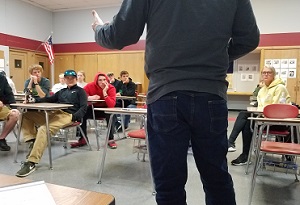
More great steps came April 29 as the Jackson Area Officials Association introduced the avocation to more than 30 aspiring officials at a meeting that also was designed for anyone interested in becoming an MHSAA basketball official.
Bill Walker, an organizer of the event and official for more than a decade in his area, said eligible Legacy Officials at the meeting were assigned mentors, and all attendees committed to attend a June clinic at Jackson College. Those leaving the area for college this fall were provided with officiating contacts in the communities where they will be attending school.
The upcoming clinic, free of charge and organized by Walker and Jackson College women’s basketball coach Heather Brown, will provide “real game” work for attendees as they receive training and mentoring.
Michigan Center coach and teacher Lisa Haynes and officials Jason Smith and Chuck Sprang also play instrumental roles in the JAOA recruiting effort.
O-K honors with new hockey divisions
This is older news in the Grand Rapids area, but definitely worth a statewide mention. The Ottawa-Kent Conference traditionally has named its hockey divisions Tier 1, Tier 2 and Tier 3, but has selected names to honor past contributors beginning with the 2018-19 season.
One division will be named after Ron Baum, a longtime coach at East Kentwood and the second winningest in MHSAA history. Another division will be named in honor of late Grandville standout Ryan Fischer, also a member of the MHSAA Student Advisory Council, who died in his sleep the night before his team’s Division 1 Semifinal in 2014. The third will be named for late official Dave Rue, who died in 2017 after a fight with cancer and was beloved in the hockey community.
Retiring official recognized
Also in hockey, Jenison took a few minutes to pay a touching tribute to official Ray Sheahan on the ice before his final MHSAA game – he retired at the end of this winter from high school hockey after 22 years as an MHSAA registered official.
Sheehan also has been involved in mentoring officials at various youth levels in the Grand Rapids area with an impact reaching far past high school rinks. Check out the tribute below:
PHOTO: Aspiring basketball officials listen in during a meeting with the Jackson Area Officials Association on April 29. (Photo courtesy of the JAOA.)
West Michigan Mourns Longtime Mentor
By
Geoff Kimmerly
MHSAA.com senior editor
June 25, 2019
As quickly as June has come to an end, summer soon will give way to another highly-anticipated football season in the Grand Rapids area – but also one that undoubtedly will feel like someone is missing for the many officials who learned from Carl Paganelli.
The longtime high school, college and professional official died May 21 at age 82 after fighting cancer, and was laid to rest May 29 in Wyoming, near Grand Rapids, where he lived most of his life.
Paganelli’s most high-profile on-field work likely came during his time in the former USFL, World Football League and Arena Football League. More of his 58 years in the game came as supervisor of officials in the Mid-American Conference, Arena League and during the initial campaign of the XFL. His three sons Carl Jr., Perry and Dino all have gone on to officiate in NFL Super Bowls.
Those impressive notes were mentioned most when Carl Sr. died. But his influence on the high school game was similarly substantial and should continue through those he mentored during nearly 60 years as part of the West Michigan Officials Association – which referred to him as “one of the founding fathers of officiating in West Michigan” in announcing his passing.
Paganelli was an MHSAA registered official for 36 football seasons through fall 1998, and also for 24 basketball seasons through winter 1987-88. Also during the 1990s, Caledonia native Mark Uyl began a multi-sport officiating career that would carry him in part to two baseball College World Series. He got to know Paganelli well through wearing the stripes and while also serving as athletic director at his alma mater and then Middleville Thornapple Kellogg on the way to becoming an MHSAA assistant and now executive director.
“Carl was one of the greatest officiating mentors that there’s ever been, and what made Carl most unique in that area was the fact he would go out and watch a junior high game Thursday in Grand Rapids, see a new official, and give that official the same time and care and detail that he would when he was supervisor of officials for the MAC or evaluating NFL officials,” Uyl said.
“To him, an official was an official. He was there, and he wanted to help you get better.”
As noted in his obituary, Paganelli was considered the “godfather of Grand Rapids area officials” and has been credited by numerous NFL officials for his guidance over the years. He was inducted into the Arena Football Hall of Fame and also into the Grand Rapids Sports Hall of Fame twice – solo in 2008 and with his three sons as the “Paganelli Team” in 2018.
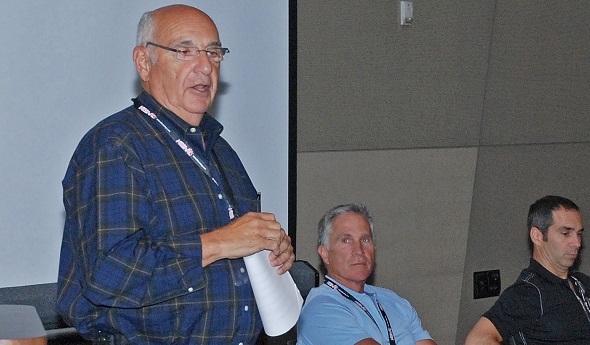
Carl Sr. with his sons was among presenters when more than 1,200 officials from across the state poured into Grand Rapids during July 2013 for the first Officiate Michigan Day. His local footprint also includes a substantial presence at Grand Rapids Community College, where the foyer of the Gerald R. Ford Fieldhouse is named after the family and a scholarship in their name is presented annually to a student-athlete. Paganelli Sr. had attended Grand Rapids Junior College in 1954 and 1955. He also served in the U.S. Navy during the Korean War, and later sat on the Wyoming City Council.
PHOTO: Carl Paganelli speaks to an audience during Officiate Michigan Day in 2013 as part of a roundtable with his three sons.