

Grand Blanc Senior Joins Officials 'Legacy'
February 15, 2017
By Lisa Paine
Swartz Creek View
HARTLAND – Michigan, not unlike most other states across the nation, is struggling with a shortage of officials for junior high and high school sports. Steve Tannar, the Kensington Lakes Activities Association assigner, says locally that Michigan High School Athletic Association registered officials are down by one third.
Looking to stem the tide, the MHSAA is reaching out to high school juniors and seniors through its Legacy Officials Program.
Jason Caine, a Grand Blanc senior, is working with his veteran partner, Shawn Waterman. Caine said he came across the program through an online application and “just wanted to give it a try.”
“I attended a clinic at Goodrich High, just the basics, and it just took off after that,” said Caine. “After the clinic I attended Rules School and the Genesee County Officials Association (GCOA). Through that, I got partnered with Shawn Waterman (a veteran MHSAA official). They mentor us and show us the basics.”
Caine is also being mentored by eight-year MHSAA official and former coach Brian Morley of Grand Blanc. Caine, who played freshman and junior varsity baseball at Grand Blanc, said he’s not a typical multi-sport athlete.
“I’m a DECA Officer at Grand Blanc,” explained Caine. “It’s a business club that presents their businesses to potential investors. Officiating is a side hobby that I want to pursue. Next year I plan on attending college and with officiating, I can take that with me wherever I go.”
Tannar said the ultimate goal of the Legacy program is to get the word out to recruit more teens like Caine.
“The main reason we are looking to grow our officials program is because we have such an officiating shortage all over the country,” said Tannar. “Not many of us are under the age of 40. The average age of our officials is mid to upper 50s. If we don’t recruit and get them working now, we’re going to be faced with a shortage of officials.”
“It really began when they switched girls basketball (to winter) and everyone tries to play triple headers on Tuesday and Friday,” explained Tannar. “I need 42 officials in one night to fill the six schools I assign for the KLAA.”
Tannar noted that in 2012 the GCOA qualified 125 officials to work in MHSAA tournaments. This year that number dropped to 84.
“Mentoring the rookie officials such as Caine is a big responsibility," said Morley, who is one of three officiating trainers in the area. He’s been officiating in the Saginaw Valley League, Flint Metro League, Genesee Area Conference and KLAA.
“This year we were in an ad for the MHSAA, and Jason was one that responded. He was looking for something other than working at McDonald’s. I told him the MHSAA has a program in place to train officials,” said Morley, who found his own path to the MHSAA officials program as an adult.
Morley also spoke to the number of officials needed.
“We figured for the Saginaw Valley plus the Thumb area and into where Steve is (KLAA), somewhere between 300 and 400 officials are needed on a given Tuesday or Friday,” Morley said.
 Officiating isn’t easy, as it’s about more than just calling the games, noted Tannar.
“The number one reason for quitting officiating is the fans and their reactions, not the coaches or players,” Tannar said.
Mark Uyl, assistant director for the MHSAA and its coordinator for officials, echoed that. He’s seen the profession take its hits over the past five years.
“The biggest challenge in officiating is it’s a thankless job,” Uyl said. “We are expected to be perfect on our first day. But you can’t play without officials, so our culture needs to rethink how we are acting as fans in the athletic arena. We are in an angrier society right now and until that trend reverses itself, we face that challenge.”
“So much of officiating is handling people, managing emotions. If we can keep getting people of all ages interested in our officiating program, we can continue to put quality officials at all levels of games – youth sports, junior high through high school and into the college games,” Uyl said.
The fans were one of Caine’s first concerns.
“It was a little nervy at first, but when I got up there, Shawn was a great partner and assured me everything was OK no matter what the outcome,” said Caine. “My background at the clinics and Rules School gave me the confidence.”
Morley explained the importance of teaming up rookies with veterans.
“That’s why this training is so important. If Jason and these others didn’t have us to learn from, lean on, fans can be brutal. Part of our training is how to combat or ignore the angry fans and block that out and do what we need to do in these games. Our job is protect our rookies in their first couple of years to help everyone handle the heat of the moment. We can’t lose someone because of the ugliness that often goes on around us,” said Morley.
The money isn’t bad either. Morley and Uyl said refs can pick up anywhere from $35 to $65 on any given night.
"Many don’t realize how good the money is in officiating,” said Uyl. “After school jobs are $9-10 dollars an hour. (Officiating), they can make $35 in one game.
Tannar said the plan is to turn up recruiting another couple of notches into the next year.
“Next year we want to get into the schools and do a presentation to an all-level program at every school. If I can get one or two kids, that gets us 40 new officials.”
Uyl is grandfathering in Legacy Official students for free, saving them money on the typical registration fees.
More clinics are planned for the Legacy Officials program in the spring and fall of 2017.
This story originally appeared in the Dec. 29, 2016, edition of the Swartz Creek View and is reprinted with permission.
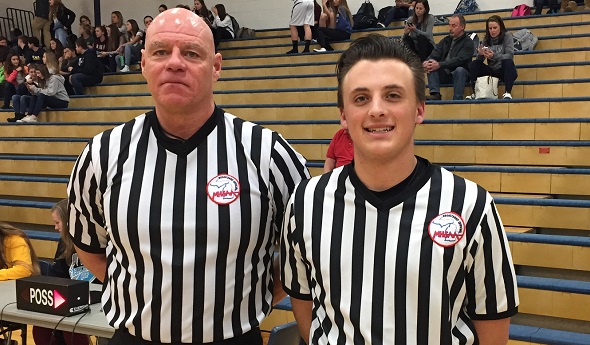
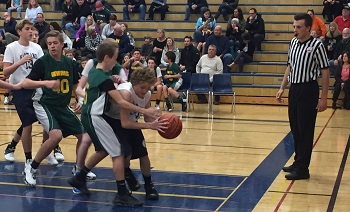
PHOTOS: (Top) Veteran official Shawn Waterman (left) stands with Grand Blanc senior Jason Caine during Caine's first game as an MHSAA referee Nov. 30. (Middle) Caine monitors the action during the junior high game in Hartland. (Photos courtesy of Steve Tannar.)
Title IX at 50: WISL Award Honors Builders of State's Girls Sports Tradition
By
Geoff Kimmerly
MHSAA.com senior editor
February 1, 2022
Michigan’s school sports history is filled with women who and have and continue to take on giant roles to advance girls athletics and the opportunities and benefits they provide.
Since 1990, the MHSAA has celebrated pioneers, advocates, voices and leaders with the Women In Sports Leadership Award.
From L’Anse’s Carol Seavoy in 1990 through St. Ignace’s Dorene Ingalls in 2021, 34 women have received the WISL Award, which most recently has been presented either during the biennial WISL Conference in Lansing or during the Girls Basketball Finals at Michigan State’s Breslin Center.
The 35th WISL Award winner will be announced in coming weeks.
Below is the list of the first 34 honorees:
1990 – Carol Seavoy, L’Anse
1991 – Diane Laffey, Harper Woods
1992 – Patricia Ashby, Scotts
1993 – Jo Lake, Grosse Pointe
1994 – Brenda Gatlin, Detroit
1995 – Jane Bennett, Ann Arbor
1996 – Cheryl Amos-Helmicki, Huntington Woods
1997 – Delores L. Elswick, Detroit
1998 – Karen S. Leinaar, Delton
1999 – Kathy McGee, Flint
2000 – Pat Richardson, Grass Lake
2001 – Suzanne Martin, East Lansing
2002 – Susan Barthold, Kentwood
2003 – Nancy Clark, Flint
2004 – Kathy Vruggink Westdorp, Grand Rapids
2005 – Barbara Redding, Capac
2006 – Melanie Miller, Lansing
2007 – Jan Sander, Warren Woods
2008 – Jane Bos, Grand Rapids
2009 – Gail Ganakas, Flint; Deb VanKuiken, Holly
2010 – Gina Mazzolini, Lansing
2011 – Ellen Pugh, West Branch; Patti Tibaldi, Traverse City
2012 – Janet Gillette, Comstock Park
2013 – Barbara Beckett, Traverse City
2014 – Teri Reyburn, DeWitt
2015 – Jean LaClair, Bronson
2016 – Betty Wroubel, Pontiac
2017 – Dottie Davis, Ann Arbor
2018 – Meg Seng, Ann Arbor
2019 – Kris Isom, Adrian
2020 – Nikki Norris, East Lansing
2021 – Dorene Ingalls, St. Ignace
Second Half's weekly Title IX Celebration posts are sponsored by Michigan Army National Guard.
Previous Title IX at 50 Spotlights
Jan. 18: Decades Later, Edwards' Legend Continues to Grow - Read
Jan. 18: Iron Mountain Completes Championship Climb - Read
Jan. 11: Harrold's Achievement Heralds Growth of Girls Wrestling - Read
Dec. 20: Competitive Cheer Gives Michigan Plenty to Cheer About - Read
Dec. 14: Evelyn's Game Had Plenty of Magic - Read
Dec. 7: Council Term Ends, But Leinaar Leaves Lasting Impact - Read
Nov. 30: Basketball Season Ready to Add to Rich Tradition - Read
Nov. 23: Marysville Builds Winning Streak Yet to be Challenged - Read
Nov. 16: Wroubel Has Championed Girls School Sports from Their Start - Read
Nov. 9: Pioneer's Joyce Legendary in Michigan, National Swim History - Read
Nov. 2: Royal Oak's Finch Leading Way on Football Field - Read
Oct. 26: Coach Clegg Sets Championship Standard at Grand Blanc - Read
Oct. 19: Rockford Girls Set Pace, Hundreds After Have Continued to Chase - Read
Oct. 12: Bedford Volleyball Pioneer Continues Blazing Record-Setting Trail - Read
Oct. 5: Warner Paved Way to Legend Status with Record Rounds - Read
Sept. 28: Taylor Kennedy Gymnasts Earn Fame as 1st Champions - Read
Sept. 21: Portage Northern Star Byington Becomes Play-by-Play Pioneer - Read
Sept. 14: Guerra/Groat Legacy Continues to Serve St. Philip Well - Read
Sept. 7: Best-Ever Conversation Must Include Leland's Glass - Read
Aug. 31: We Will Celebrate Many Who Paved the Way - Read
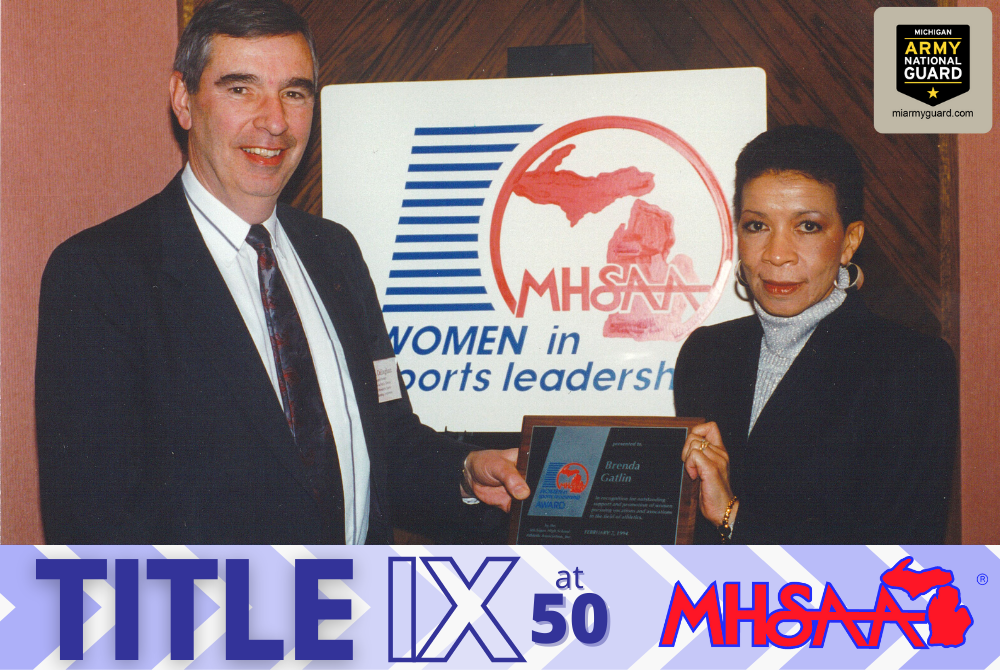
PHOTO Brenda Gatlin accepts the 1994 WISL Award from former MHSAA Representative Council president Brian Callaghan. (MHSAA file photo.)