

Grand Blanc Senior Joins Officials 'Legacy'
February 15, 2017
By Lisa Paine
Swartz Creek View
HARTLAND – Michigan, not unlike most other states across the nation, is struggling with a shortage of officials for junior high and high school sports. Steve Tannar, the Kensington Lakes Activities Association assigner, says locally that Michigan High School Athletic Association registered officials are down by one third.
Looking to stem the tide, the MHSAA is reaching out to high school juniors and seniors through its Legacy Officials Program.
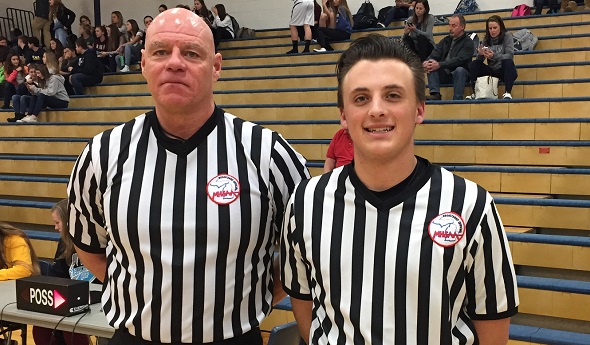
Jason Caine, a Grand Blanc senior, is working with his veteran partner, Shawn Waterman. Caine said he came across the program through an online application and “just wanted to give it a try.”
“I attended a clinic at Goodrich High, just the basics, and it just took off after that,” said Caine. “After the clinic I attended Rules School and the Genesee County Officials Association (GCOA). Through that, I got partnered with Shawn Waterman (a veteran MHSAA official). They mentor us and show us the basics.”
Caine is also being mentored by eight-year MHSAA official and former coach Brian Morley of Grand Blanc. Caine, who played freshman and junior varsity baseball at Grand Blanc, said he’s not a typical multi-sport athlete.
“I’m a DECA Officer at Grand Blanc,” explained Caine. “It’s a business club that presents their businesses to potential investors. Officiating is a side hobby that I want to pursue. Next year I plan on attending college and with officiating, I can take that with me wherever I go.”
Tannar said the ultimate goal of the Legacy program is to get the word out to recruit more teens like Caine.
“The main reason we are looking to grow our officials program is because we have such an officiating shortage all over the country,” said Tannar. “Not many of us are under the age of 40. The average age of our officials is mid to upper 50s. If we don’t recruit and get them working now, we’re going to be faced with a shortage of officials.”
“It really began when they switched girls basketball (to winter) and everyone tries to play triple headers on Tuesday and Friday,” explained Tannar. “I need 42 officials in one night to fill the six schools I assign for the KLAA.”
Tannar noted that in 2012 the GCOA qualified 125 officials to work in MHSAA tournaments. This year that number dropped to 84.
“Mentoring the rookie officials such as Caine is a big responsibility," said Morley, who is one of three officiating trainers in the area. He’s been officiating in the Saginaw Valley League, Flint Metro League, Genesee Area Conference and KLAA.
“This year we were in an ad for the MHSAA, and Jason was one that responded. He was looking for something other than working at McDonald’s. I told him the MHSAA has a program in place to train officials,” said Morley, who found his own path to the MHSAA officials program as an adult.
Morley also spoke to the number of officials needed.
“We figured for the Saginaw Valley plus the Thumb area and into where Steve is (KLAA), somewhere between 300 and 400 officials are needed on a given Tuesday or Friday,” Morley said.
 Officiating isn’t easy, as it’s about more than just calling the games, noted Tannar.
“The number one reason for quitting officiating is the fans and their reactions, not the coaches or players,” Tannar said.
Mark Uyl, assistant director for the MHSAA and its coordinator for officials, echoed that. He’s seen the profession take its hits over the past five years.
“The biggest challenge in officiating is it’s a thankless job,” Uyl said. “We are expected to be perfect on our first day. But you can’t play without officials, so our culture needs to rethink how we are acting as fans in the athletic arena. We are in an angrier society right now and until that trend reverses itself, we face that challenge.”
“So much of officiating is handling people, managing emotions. If we can keep getting people of all ages interested in our officiating program, we can continue to put quality officials at all levels of games – youth sports, junior high through high school and into the college games,” Uyl said.
The fans were one of Caine’s first concerns.
“It was a little nervy at first, but when I got up there, Shawn was a great partner and assured me everything was OK no matter what the outcome,” said Caine. “My background at the clinics and Rules School gave me the confidence.”
Morley explained the importance of teaming up rookies with veterans.
“That’s why this training is so important. If Jason and these others didn’t have us to learn from, lean on, fans can be brutal. Part of our training is how to combat or ignore the angry fans and block that out and do what we need to do in these games. Our job is protect our rookies in their first couple of years to help everyone handle the heat of the moment. We can’t lose someone because of the ugliness that often goes on around us,” said Morley.
The money isn’t bad either. Morley and Uyl said refs can pick up anywhere from $35 to $65 on any given night.
"Many don’t realize how good the money is in officiating,” said Uyl. “After school jobs are $9-10 dollars an hour. (Officiating), they can make $35 in one game.
Tannar said the plan is to turn up recruiting another couple of notches into the next year.
“Next year we want to get into the schools and do a presentation to an all-level program at every school. If I can get one or two kids, that gets us 40 new officials.”
Uyl is grandfathering in Legacy Official students for free, saving them money on the typical registration fees.
More clinics are planned for the Legacy Officials program in the spring and fall of 2017.
This story originally appeared in the Dec. 29, 2016, edition of the Swartz Creek View and is reprinted with permission.
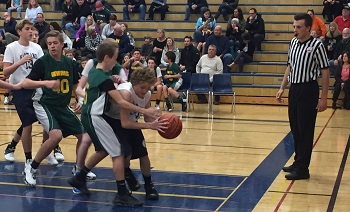
PHOTOS: (Top) Veteran official Shawn Waterman (left) stands with Grand Blanc senior Jason Caine during Caine's first game as an MHSAA referee Nov. 30. (Middle) Caine monitors the action during the junior high game in Hartland. (Photos courtesy of Steve Tannar.)
Be the Referee: Basketball Announcers
February 4, 2015
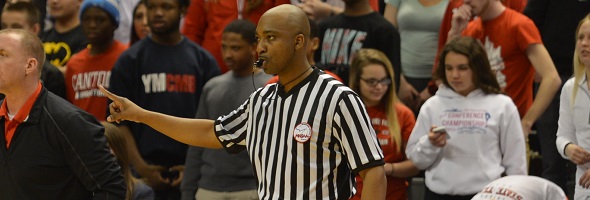
This week, MHSAA assistant director Mark Uyl explains the proper role of high school basketball public address announcers.
Be The Referee is a series of short messages designed to help educate people on the rules of different sports, to help them better understand the art of officiating, and to recruit officials.
Below is this week's segment - Basketball PA Announcers - Listen
Whenever there are rules changes in any sport, we usually think of the three groups that are most affected by those changes – obviously, the players, the coaches and the referees. This year in basketball, an additional group is receiving some attention from the rules makers, and those are the public address announcers.
At the college and pro levels, the P.A. Announcers are almost taking on a life of their own. They are seen in their communities and their towns as the home team’s biggest fan.
At the high school level, a good P.A. Announcer gives attention to both teams – the kids from both the home team and the visiting team – that do things that are noteworthy during the game. A P.A. Announcer should be there first to inform – not to entertain – and keeping sportsmanship at the forefront of every game.
Past editions
Jan. 26 - Wrestling Health Concerns - Listen
Jan. 19 - Basketball Physical Contact - Listen
Jan. 12 - Video Review Part 2 - Listen
Dec. 29 - Video Review Part 1 - Listen
Dec. 17 - Registration Part 2 - Listen
Dec. 10 - Registration Part 1 - Listen
Dec. 3 - Legacy Program - Listen
Nov. 26 - Sideline Management - Listen
Nov. 19 - 7-Person Mechanics - Listen
Nov. 12 - Blocking Below the Waist - Listen
Nov. 5 - Tournament Selection - Listen
Oct. 29 - Uncatchable Pass - Listen
Oct. 22 - Preparation for Officials - Listen
Oct. 15 - Automatic First Downs - Listen
Oct. 8 - Officials & Injuries - Listen
Oct. 1 - Overtime - Listen
Sept. 25 - Field Goals - Listen
Sept. 18 - Tackle Box - Listen
Sept. 11 - Pass Interference - Listen
Aug. 25 - Targeting - Listen