

Legacy Program Serves New Officials
By
Rob Kaminski
MHSAA benchmarks editor
October 5, 2012
Implemented 20 years ago by the MHSAA, the Legacy Student Officials Program continues to spawn enthusiastic young officials who are more likely to stay in the family beyond their formative years.
The program pairs high school juniors or seniors with mentors who are already registered MHSAA officials. The one-on-one tutelage serves to introduce, educate and encourage interested students, while upping the odds for retention. Both parties sign a Legacy Pledge form outlining the basic agreement, with one condition being that the students work only subvarsity contests with their mentor or other veteran MHSAA officials.
During the 2011-12 school year, 107 students participated as Legacy officials, bringing the total to 1,156 since 1992. It’s another example of the officiating lineage growing from within and taking care of its own. In many cases, the vets literally are family.
“After graduating high school in the spring of 2006, my father, Rick (an MHSAA registered official for more than 25 years), inspired me to register and work the football season the next fall,” said Chris “C.J.” Jackson. “The worst years of officiating for me were my first two seasons because I couldn’t stand the berating from coaches and fans. I wasn’t good, and everyone picked up on that. My Dad was the only person who kept me in the game. Six seasons later, I find myself going into my second season of college football working as a deep wing official for the Great Lakes Intercollegiate Athletics Conference (GLIAC). This achievement can only be attributed to my dad.”
Also following in Dad’s footsteps are Trevor and Austin Hartley of Lansing, as father, Eric, got them involved at an early age.
“He has helped me on the field, but more importantly off of the field to become a better official in general and a better person,” said Trevor of Eric. “He was responsible for getting me into officiating, but staying in has been a goal from the beginning.”
Trevor’s sentiment is common among the species. Once officiating gets into the bloodstream – whether from immediate family or from a mentor in the extended family – it tends to stay.
Mentors in the Legacy Program take their roles seriously, and spend countless unpaid hours helping their students develop. The finished product is all the compensation they need.
“If it weren’t for my mentor pushing me and telling me I could be a really great official, I never would have kept going this far. I continue to officiate because it is a great opportunity to give back and be a part of something I love with a passion, and that is sports,” said Detroit Martin Luther King grad Kyle Bowen, who first registered in 2008 under the guidance of Detroit’s Darryl Jones.
The basketball official has taken his skills to Grand Rapids, where he attends Grand Valley State University and continues work as an official while discovering its ancillary benefits.
“Being an official has helped me so much in a lot of different aspects in my life,” Bowen said. “I work at Grand Valley as a supervisor in the intramural program. That job entails developing and training new officials so we can produce quality officiating in our program.
 “Darryl showed me how important it is to have tough skin and how to handle adverse situations when they come up and not let them linger. He taught me that officiating is probably one of the best things you could ever do, but it’s not for everyone.”
Not for everyone, but thanks to a growing list of sports, there are more opportunities to lure potential candidates. When the Legacy Program was launched, competitive cheer and lacrosse were not yet MHSAA-sponsored sports. Cheer hit the tournament scene in 1994, while lacrosse arrived in 2005. As participation in those sports continues to increase, the pool of potential officials expands.
For recent Oakland University graduate Leah DiCristofaro, cheerleading was something she’d enjoyed since the age of 5. Her mother Renee is a veteran official for the Michigan Cheer Judges Association, where Candy Cox also serves as one of the state’s top judges.
“When Leah was a senior in high school (St. Clair Shores Lake Shore), she registered as a Legacy official,” Cox said. “She had a mentor who was with her at every competition during that year. At her first competition, she worried that she would miss something and not credit the teams properly. But, with guidance from her mentor and fellow judges those fears were short-lived.”
DiCristofaro continued to judge during college, but on a limited basis. The fact she took on any assignments at all illustrated her commitment, as she not only was putting up grades worthy of making the national honor roll, but she was a four-year starter for the Grizzlies softball team. As a catcher and designated player, DiCristofaro led the team with a .308 batting average as a sophomore, and tied for the team lead with six homers as a senior last spring.
“She accepted a limited amount of meets, but she kept officiating throughout all four years of college. Last year she filled in several times for officials who cancelled at the last minute,” Cox said.
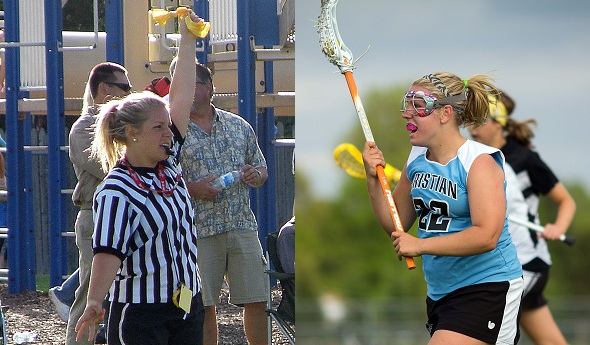
Across the state, Helen Young experienced a similar childhood centered around athletics. Her parents, Neal and Vicki, coach lacrosse for Grand Rapids Christian schools. Vicki oversees the youth program, 3rd through 12th grades, and coaches the middle school. Neal is the varsity head coach at Christian High School, where Helen excelled and earned numerous honors.
Through her experiences, she also began to help her mother coach the middle school team, and made acquaintances like Nancy Lapekas of the West Michigan Lacrosse Association. Young was hooked.
“Nancy Lapekas has been so helpful in teaching me, assigning me, and supporting me on and off the lacrosse field,” said Young, who last spring earned a $1,000 scholarship from Michigan Lacrosse. “She has kept me going. As a young ref, if she didn't have my back I don't think I would have been able to continue. I love all aspects of the sport. I play, coach, and officiate, and it is nice to see the game from all angles.”
Young is a freshman at Michigan State University, and already plans to have a busy spring, when she’ll be balancing classwork and officiating.
“The most rewarding part of being a younger official is that I get to meet and ref with wonderful role models,” she said. “Some of the greatest people are adults I get to work with on the field. The cool part about my relationship with these other refs is that they are there for me off the field as well.”
That’s the beauty of the Legacy Program. A dedicated mentor sets the wheels in motion and opens a world of possibilities to students dedicated enough to seek advancement. There are no limits to the number of contacts and support groups in the industry.
Luke Bowman is a 2008 Jackson Lumen Christi grad who still leans on mentor Chuck Walters from time to time.
“Chuck has been a huge influence in my officiating career. I am always able to give him a call to bounce rule questions off of, even after I left my hometown being 100 miles away up at Central Michigan University.”
Like all young officials, Bowman soon realized that there were more people like Walters wherever he went; an endless supply of support personnel the further one delves into this avocation.
“The Capital Area Officials Association in Lansing has helped me grow as an official by constantly challenging my skills and abilities,” Bowman said. “Each meeting begins with a closed-book rules quiz to test our knowledge. Why is it closed-book? On Friday nights we can’t bust out the rules book on the field. The tools and resources available to the members range from evaluations at games and scrimmages to working with veteran officials.”
 A couple common threads bond Legacy officials who continue to register with the MHSAA. Many are college-bound, or first officiated at the youth level.
Michael Reseigh fits the bill. While playing soccer at Rochester High School, Reseigh officiated local club games for five years. When his playing days were done he set his sights on officiating the high school level and contacted Pat Hayes of the Soccer Referees Association in the spring of 2009.
Now a senior at the University of Michigan, he has been at it ever since, with help from Hayes.
“When I went to college, my availability became limited. I was almost completely unavailable for the boys season in the fall. I was available, however, for the girls season since my semester at college finished at the end of April. I expressed my desire to Pat Hayes that I remain active in the association despite my limited availability. She has been great to me, giving me as many games as possible for the month of May when I come home,” Reseigh said.
Of course, not all in the world of fun and games is, well, fun and games. Young officials will experience all of the pitfalls that come with the uniform; tense moments, nervousness, missed calls and clashes with coaches.
They also have the additional burden of learning mechanics, contest rules and philosophies while working the lowest levels where the most chaotic action and least sympathetic coaches preside. Then, there’s the final hurdle of perception, simply brought on by their youthful appearance. It’s been said by many a veteran official that the least experienced officials have the toughest games to work.
“Some of the challenges I have had are due to my age,” Young said. “I think coaches don't take me seriously, and expect I don't know what I am talking about. If I let it bother me, then I probably wouldn't be able to ref. One time I made a call, and the coach proceeded to scream at me and yell at me and come onto the field. The behavior was even more ridiculous because it was a 5th/6th-grade game! I think that he felt like he could yell at me because I was a young ref.”
Trevor Hartley relates a similar scenario.
“I have had to deal with it since Day One,” Hartley said. “In my first-ever football game, a youth game, a coach was arguing a no-call with me and questioned if I was any older than the 5th and 6th-grade players on the field.”
The participants at that level are far from perfect. Having people understand that is one of the luxuries youth players have and officials don’t. It’sone of the great double-standards of athletics.
“A first-year official doing a 5th-grade football game is expected by coaches, players and fans to look like, act like, talk like, and officiate like a Big Ten football official,” Jackson said. “Yes, every game is important, no matter the level of play, but it is impossible to expect the greatest officials at every level of play.”
Again, this is where the Legacy Program pays dividends, as the young officials are not left on an island. There is support early and often, all the while allowing officials to grow. For those who understand their role in the game, the benefits stretch beyond the fields and gyms.
“I would tell students who are hesitant to take the step and try officiating, as there is really nothing to lose,” said Reseigh.
“I have learned how to manage any type of situation due to officiating. It has taught me respect for the game and all involved with it as well as taking responsibility for my own actions,” Jackson said.
“To younger people who want to officiate I would say, ‘Go for it,’” said Young. “It is such a great experience and it really helped me mature and be confident.”
“In the heat of the moment, you are going to have to effectively communicate with coaches and players in intense conversations,” Bowman said. “These skills will translate to the workplace as well. I directly attribute my success in the workplace to officiating.”
“The best advice I can give is, ‘Just go out there and try it,’” Bowen said. “No one will be perfect and get every call, but if you put your best effort forward then you can do great things.”
Sounds like they’ve been well trained from those before them, and are more than capable of carrying on the officiating legacy.
PHOTOS: (Top) Helen Young, a girls lacrosse official and product of the Legacy program, called youth lacrosse games while also playing on Grand Rapids Christian's varsity. (Middle) Kyle Bowen is a Legacy program and Detroit Martin Luther King grad.
NOTE: This is the second installment in the series "Making – and Answering – the Call" detailing the careers and service of MHSAA officials. Click the link below to view the first.
Hutcheson Eager to Serve Statewide
April 20, 2016
By Geoff Kimmerly
Second Half editor
On Tuesday, Dan Hutcheson was the public address announcer at a track and field meet. On Wednesday, he spent part of the morning painting a door.
As a teacher, coach, then assistant principal and athletic director, he’s performed in a wide variety of roles for Howell High School over the last two decades.
 This fall, he’ll take on another set of similar but new and wide-ranging responsibilities as an assistant director for the MHSAA.
Hutcheson, who will join the staff in August, will take over administration of wrestling, girls and boys tennis and another sport to be determined. He’ll also contribute to the Coaches Advancement Program and Athletic Directors In-Service program among other duties.
“When I look at each step I’ve taken, it’s been an opportunity to serve more people,” Hutcheson said. “As a classroom teacher and a coach, and then moving up to assistant principal where I was serving more students. And then athletic director, where I was serving more students, and now serving the entire state. It’s pretty remarkable.”
The addition of Hutcheson is one of a few changes coming to the MHSAA staff for the start of the 2016-17 school year. Longtime official Sam Davis will join part-time in September to coordinate an expansion of services and support for officials, including in the key areas of recruitment and retention, while also assisting Hutcheson with wrestling.
Andrea Osters will be promoted in August to assistant director in charge of volleyball and another sport to be determined. Osters, the current social media & brand coordinator for the MHSAA and also the lead administrator for softball the last three years, will with Hutcheson take over most of the duties of current assistant director Gina Mazzolini, who will retire at the end of July.
At Howell, Hutcheson directs 90 athletic teams for grades 7-12. His high school, with more than 2,500 students, is one of the largest in our state. He has served as athletic director for the last decade after two years as an assistant principal, and he also coached the school’s wrestling program for eight seasons while teaching applied technology at the high school and later working for the Howell Recreation Department.
A plea from a professor during his first year as a student at Ferris State University set Hutcheson’s path toward education – although along the way he’s picked up a variety of skills that have benefitted his athletic program and the surrounding sports community as well.
He went to Ferris with thoughts of becoming a graphic designer and going into advertising. But by the end of his first term, as he watched classmates stay up into the morning hours working on projects while he was getting up at 6 a.m. for wrestling practice, he figured that career might not be the best fit.
Hutcheson still remembers the day in class when that instructor remarked that there was a huge need for technical education teachers. Hutcheson, who had always wanted to coach, saw that as his eventual niche.
He graduated with a bachelor’s degree in technical education with an associate’s in graphic arts and printing technology, and later earned a master’s degree in public and educational administration at University of Michigan-Dearborn.
Hutcheson recently was named his region’s Athletic Director of the Year by the Michigan Interscholastic Athletic Administrators Association, and with Davis will bring extensive wrestling experience to the MHSAA. After competing at Howell and then Holt High School as a senior – making the MHSAA Individual Finals and finishing third at his weight as a senior in 1988 – Hutcheson was three-time NCAA Division II wrestling All-American and two-time Academic All-American while at Ferris State, and a three-time Greco-Roman Open All-American at the collegiate and post-graduate senior levels.
Hutcheson served as an assistant wrestling coach at Ferris State during the 1994-95 season and then coached the Michigan Wrestling Club from 1997-2000 guiding athletes in World Team and Olympic Trials competition. He led the Highlanders to the Division 1 Quarterfinals his first season as a high school coach, and currently serves as wrestling commissioner and overall president of the 24-school Kensington Lakes Activities Association and on MHSAA committees for wrestling and lacrosse.
He took over as athletic director at Howell from longtime administrator Doug Paige and has relied in part on work ethic learned from parents Don and Lynne Hutcheson and mentoring from college coach Dr. Jim Miller, who also is a professor of Optometry and with whom Hutcheson remains in regular contact.
Hutcheson has relished opportunities to put on big events, and one of his last as Howell athletic director will be as host of both MHSAA Boys Lacrosse Finals on June 11.
And tapping into those technical and design skills, Hutcheson also serves as webmaster and historian for the KLAA and created one of the most detailed league websites in the state.
“When we were doing (Paige’s) going-away party, I said his were big shoes to fill but my goal wasn't to fill the shoes, but to keep walking in the same direction,” Hutcheson said. “I feel the next person up will have a great foundation that’s here and will take it to the next level.
“I’m very excited about (joining the MHSAA staff). But I’ll probably take the same approach as what I did as athletic director here. Things have been done a certain way for a reason, and then we can look for ways to tweak things, fine-tune things.”
Champions who champion our games
An MHSAA Wrestling Finals individual champion for Lansing Eastern in 1969, Davis went on to wrestle briefly at Michigan State University before an eye injury ended his competitive career in that sport. However, he instead took up judo, winning state championships in 1980 and 1981 and competing at the U.S. Olympic trials. After graduating from MSU with bachelor and master’s degrees in 1974, Davis began his teaching career at Lansing Everett High School. He also coached wrestling and football and later served as an assistant principal at the school before serving as principal at Dwight Rich Middle School and then district athletic director over a 32-year career with Lansing Public Schools that concluded in 2007.
 Davis received the MHSAA’s Vern L. Norris Award in 2015 for his work in officiating, including the mentoring and educating of other officials. He has been an MHSAA registered official for 36 years, working wrestling during the entirety of his career and baseball most of the last decade. Davis has officiated in all but a few of the MHSAA’s annual Wrestling Finals since receiving his first championship-level assignment in 1983. He currently serves as a major with the Ingham County Sheriff’s Office, serving as jail administrator, and will remain employed by the county while joining the MHSAA staff.
 Osters has worked as part of the MHSAA staff since 2005 and has presented multiple times at National Federation annual meetings on her work as a nationally-recognized leader in high school sports association social media. She is a member of the Leadership Council of the NFHS Network, the national digital broadcasting initiative of the National Federation of State High School Associations, and has worked in coordination and planning of the MHSAA’s Captain’s Clinic series and other student leadership programs.
She also launched the “Officials for Kids” statewide fundraising initiative and handles all venue-specific ticketing for MHSAA statewide tournaments.
She was a high school champion as a starter on the Okemos softball team that won the MHSAA Division 1 championship in 1999 and then graduated from Michigan State in 2004 with a bachelor’s degree in communications and concentration in public relations. She served as Okemos’ freshman softball coach for four seasons, from 2002-05, and also wrote a weekly sports column for a local magazine from 2009-11. Osters is a current member of the board of directors for the Michigan Society of Association Executives and was a founding member of the MSAE’s Emerging Professionals Committee.
“Dan Hutcheson, Sam Davis and Andrea Osters are passionate advocates for the values of high school athletics,” MHSAA Executive Director John E. Jack Roberts said. “Dan is one of the most respected athletic administrators in Michigan and brings a collection of experiences and skills that will benefit all of our schools in a variety of areas. Sam has long championed officiating, and we’re excited for the possibilities his experience and abilities bring as we intensify our recruitment of new officials statewide to join the more than 10,000 who annually work our games.
“Andrea has provided the MHSAA with a variety of skills and leadership over more than a decade of service and played a prominent role in the move of the MHSAA Baseball and Softball Finals to Michigan State two years ago. We anticipate she’ll make a smooth transition in taking over new and added responsibilities.”
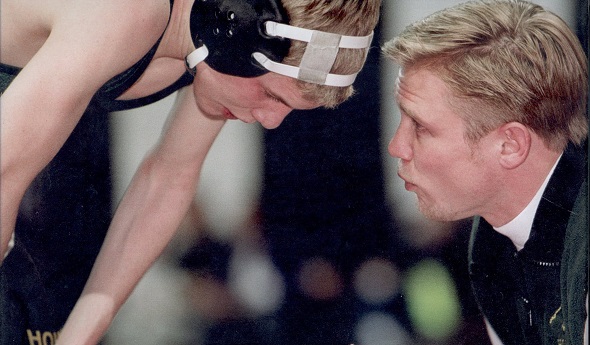
PHOTO: Howell’s Dan Hutcheson coaches one of his wrestlers during his tenure running that program from 1997-2004. (Photo courtesy of Dan Hutcheson.)