

Making the Right Calls for 50 years
May 7, 2012
By Geoff Kimmerly
Second Half editor
Lyle Berry began this track season with about 10-12 events on his officiating schedule.
But when administrators he’s known for decades called for help, that slate quickly doubled in size for this year’s MHSAA Vern L. Norris Award winner.
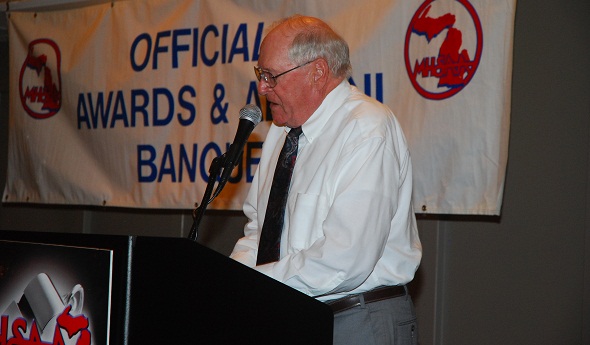
The Rockford resident has been an official for more than a half century, and was honored for his service at Saturday’s annual Officials’ Awards & Alumni Banquet at the Kellogg Center in East Lansing.
Second Half caught up with Berry a few minutes before he left for another track meet Monday. Click for our Q&A session, including conversation about what keeps him coming back every season and how he continues to mentor and recruit of new officials.
Berry has been a long-time member of both the West Michigan Officials Association and the Association of Track Officials of Michigan. He received ATOM’s Presidential Leadership Award in 2009 and its Bob Bloomer Award in 2010. Berry was the WMOA Basketball Official of the Year in 1988. Next month he'll return to the Division 3 Track and Field Finals, and later this month will officiate Division 1 and 2 Regionals.
Previous recipients of the Norris Award are:
1992 – Ted Wilson, East Detroit
1993 – Fred Briggs, Burton
1994 – Joe Brodie, Flat Rock
1995 – Jim Massar, Flint
1996 – Jim Lamoreaux, St. Ignace
1997 – Ken Myllyla, Escanaba
1998 – Blake Hagman, Kalamazoo
1999 – Richard Kalahar, Jackson
2000 – Barb Beckett, Traverse City; Karl Newingham, Bay City
2001 – Herb Lipschultz, Kalamazoo
2002 – Robert Scholie, Hancock
2003 – Ron Nagy, Hazel Park
2004 – Carl Van Heck, Grand Rapids
2005 – Bruce Moss, Alma
2006 – Jeanne Skinner, Grand Rapids
2007 – Terry Wakeley, Grayling
2008 – Will Lynch, Honor
2009 – James Danhoff, Richland
2010 – John Juday Sr., Petoskey
2011 – Robert Williams, Redford
PHOTO: Lyle Berry speaks to the audience during Saturday's Officials’ Awards & Alumni Banquet at the Kellogg Center in East Lansing.
Be the Referee: Fair or Foul Ball?
May 14, 2015
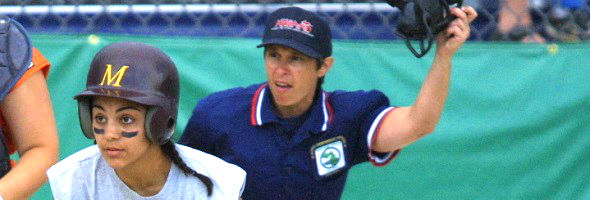
This week, MHSAA assistant director Mark Uyl explains how baselines come into play when deciding if a batted ball is fair or foul in baseball and softball.
Be The Referee is a series of short messages designed to help educate people on the rules of different sports, to help them better understand the art of officiating, and to recruit officials.
Below is this week's segment - Fair or Foul Ball? - Listen
Today’s segment is going to start with a quick “You Make The Call” question.
Baseball batter up at bat hits a line drive directly back toward the pitcher’s mound. The ball hits off the pitching rubber or the pitching plate, and rebounds directly into the first base dugout.
Fair or Foul Ball?
Baseball and Softball are unique in that these are two sports where the lines are actually considered to be in play. A ball hitting the chalk line in Baseball or Softball is a Fair Ball, to where in a basketball game, that player would be considered out of bounds.
Now back to our question – that would be considered a Foul Ball because the ball never settled or passed first base or third base in fair territory.
Past editions
May 4 - Non-Glare Helmets - Listen
April 27 - Vern L. Norris Award - Listen
March 23 - Deciding the Game - Listen
March 16 - Block/Charge Call - Listen
March 9 - Dive on the Floor - Listen
March 2 - Primary Areas - Listen
Feb. 23 - Too Much TV - Listen
Feb. 16 - Video Clip Library - Listen
Feb. 9 - Cheer Safety - Listen
Feb. 2 - Basketball PA Announcers - Listen
Jan. 26 - Wrestling Health Concerns - Listen
Jan. 19 - Basketball Physical Contact - Listen
Jan. 12 - Video Review Part 2 - Listen
Dec. 29 - Video Review Part 1 - Listen
Dec. 17 - Registration Part 2 - Listen
Dec. 10 - Registration Part 1 - Listen
Dec. 3 - Legacy Program - Listen
Nov. 26 - Sideline Management - Listen
Nov. 19 - 7-Person Mechanics - Listen
Nov. 12 - Blocking Below the Waist - Listen
Nov. 5 - Tournament Selection - Listen
Oct. 29 - Uncatchable Pass - Listen
Oct. 22 - Preparation for Officials - Listen
Oct. 15 - Automatic First Downs - Listen
Oct. 8 - Officials & Injuries - Listen
Oct. 1 - Overtime - Listen
Sept. 25 - Field Goals - Listen
Sept. 18 - Tackle Box - Listen
Sept. 11 - Pass Interference - Listen
Aug. 25 - Targeting - Listen