

Minter's Contributions Worth a Mint
April 9, 2013
By Geoff Kimmerly
Second Half editor
Tom Minter admits his wife Linda knows the spiel well. She's been hearing it spun for years.
The recently-retired MHSAA assistant director might be chatting up a recent grad at his or her high school open house, or talking with a former athlete whose playing days are done but love for a sport hasn't waned.
 “When I recruit officials, I tell them, ‘Hey, you can stay in a game you know something about. It’s good exercise. You stay with the kids, who help keep you young, and it’s one of the few hobbies that pays you,’” Minter said.
He knows all to be true after 48 years running the fields and courts of Michigan’s high schools, and more than a half-century total as a referee and umpire who worked his most recent girls soccer game just a few days ago in Ovid-Elsie.
Minter, an official for nine MHSAA Finals and longtime clinician and trainer of referees and umpires all over the state, has been selected to receive the MHSAA’s Vern L. Norris Award for 2013.
The Norris Award is presented annually to a veteran official who has been active in a local officials association, has mentored other officials, and has been involved in officials’ education. It is named for Vern L. Norris, who served as executive director of the MHSAA from 1978-86 and was well-respected by officials on the state and national levels. Minter will be honored at the Officials’ Awards & Alumni Banquet on May 4 at the Kellogg Center in East Lansing.
Minter also worked at the MHSAA’s home office from September 1995 through January 2012 and so knows or is familiar with just about every Norris winner before him – making this award extra meaningful.
While the desire to remain part of the games after his playing career ended led to Minter’s early involvement, the opportunity to pass on what he’s learned keeps him immersed in the officiating community.
“Hopefully now I’m able to pass some of this on and to encourage, provide the listening ear like people provided to me in the past,” Minter said. “It’s created in me a sense of legacy.
“To be in the company of people like Vern Norris and Dick Kalahar and all the other winners, it’s just the recognition that you’ve made a contribution. That is so satisfying.”
 Minter began his officiating career while a student at a U.S. Air Force base high school overseas. Natives of Akron, Ohio, the family followed Minter’s father – who worked for Goodyear Tires – to Scotland in 1958.
Minter played mostly baseball to that point, and didn’t know much about the pastime of his new home – soccer. But on suggestion of his physical education teacher – who also had played pro soccer – Minter took up officiating the sport to fast-forward his education in the game.
Minter refereed his first high school soccer game in 1961, and played at the high school and college levels. After also officiating for a year in Ohio, Minter began officiating in Michigan while a student at Jackson Community College. He graduated from Jackson Community College in 1966 and Michigan State University in 1971, and also served a stint with the U.S. Army.
Minter has worked games in football, boys and girls basketball, boys and girls soccer and baseball and has served as an officials assignor both at the high school and college levels; he currently is secretary for the Greater Lansing Area Soccer Officials Association. He worked five baseball MHSAA Finals, two football and one each in boys and girls soccer before joining the MHSAA staff in 1995 as the selection from nearly 200 candidates for his position.
As part of the announcement that Minter would be joining the staff as assistant to executive director John E. “Jack” Roberts, Roberts compared Minter to a versatile running back – capable of handling a variety of in-office obligations while also able to ‘bounce to the outside’ and assist with administration of sport services to member schools.
Among many contributions as an MHSAA employee, Minter was assistant director in charge of boys and girls soccer and oversaw construction of the MHSAA’s home office, which opened in December 1996. Although retired, he remains a versatile contributor providing assistance to the MHSAA in East Lansing and high school athletics on a national level.
“Tom Minter continues to help with capital improvement projects at the MHSAA office, and he continues to represent the National Federation (NFHS) Officials Association on its Sports Medicine Advisory Committee,” Roberts said. “His many contributions to high school athletics, and especially officiating, continue to be far-reaching. We are delighted to recognize Tom Minter with the Vern L. Norris Award.”
Minter came to the MHSAA after serving as Meridian Township Treasurer for 19 years and also as a volunteer fireman for that community, which includes Haslett and Okemos. Minter was an Ingham County commissioner for six years and served on Meridian Township’s planning commission and zoning board of appeals, and has been a member of the Haslett/Okemos Rotary Club for 36 years – including as its president in 1985-86.
He currently serves as chairperson of the Governor’s Council on Physical Fitness, Health and Sports, a 15-member body established in 1992 that promotes the increase of physical activity and improvement of health for Michigan residents. He was first appointed in February 2012 and serves with Kalamazoo’s Ron Winter, a friend going back to their days at MSU and a current referee in the National Football League.
Minter also continues to work as a Big Ten football replay official and observer of officials for the Great Lakes Intercollegiate Athletic Conference – for which he served as an on-field official for 25 seasons including eight as crew chief. He also worked in the Mid-American Conference and Michigan Intercollegiate Athletic Association.
All allow him to provide a wealth of knowledge to those continuing to hone the officiating craft – especially when it comes to tangible aspects like rules, mechanics and the like.
But working for the MHSAA fulltime gave Minter a unique perspective on the intangibles of officiating at the high school level – like keeping in perspective that athletes are high school students, enjoying athletics as part of the education process.
The value of providing such mentoring will be a significant part of his brief acceptance speech May 4.
“We’re all here because we worked 20, 30, 40, 45, 50 years. What are we doing to ensure our replacements?” Minter said. “That’s what we have to do, to ensure that we leave a replacement.”
High school game officials with 20, 30, 40, 45 and 50 years of service also will be honored at the Officials’ Awards & Alumni Banquet on May 4. Tickets for the banquet are available to the public and priced at $20. They will not be sold at the door. Tickets can be ordered by calling the MHSAA office at (517) 332-5046 or by sending the order form available at this link.
Previous recipients of the Norris Award
1992 – Ted Wilson, East Detroit
1993 – Fred Briggs, Burton
1994 – Joe Brodie, Flat Rock
1995 – Jim Massar, Flint
1996 – Jim Lamoreaux, St. Ignace
1997 – Ken Myllyla, Escanaba
1998 – Blake Hagman, Kalamazoo
1999 – Richard Kalahar, Jackson
2000 – Barb Beckett, Traverse City; Karl Newingham, Bay City
2001 – Herb Lipschultz, Kalamazoo
2002 – Robert Scholie, Hancock
2003 – Ron Nagy, Hazel Park
2004 – Carl Van Heck, Grand Rapids
2005 – Bruce Moss, Alma
2006 – Jeanne Skinner, Grand Rapids
2007 – Terry Wakeley, Grayling
2008 – Will Lynch, Honor
2009 – James Danhoff, Richland
2010 – John Juday Sr., Petoskey
2011 – Robert Williams, Redford
2012 – Lyle Berry, Rockford
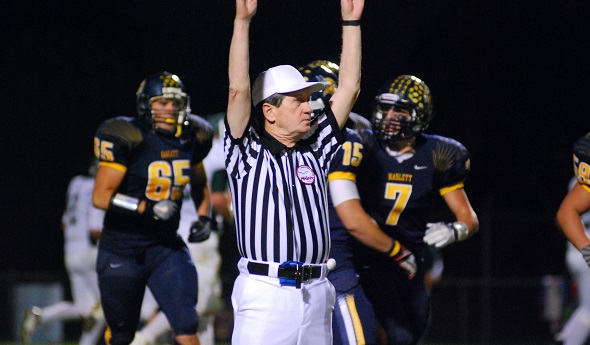
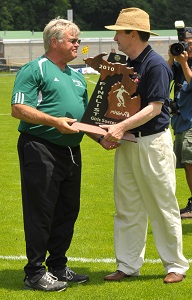
PHOTOS: (Top) Longtime official Tom Minter signals a score during a 2010 football game. (Middle) Minter awards Williamston girls soccer coach Jim Flore an MHSAA runner-up trophy in 2010.
Be the Referee: Too Much TV
February 26, 2015
This week, MHSAA assistant director Mark Uyl explains how inaccuracies in TV play-by-play can lead fans to quote rules incorrectly.
Be The Referee is a series of short messages designed to help educate people on the rules of different sports, to help them better understand the art of officiating, and to recruit officials.
Below is this week's segment - Too Much TV - Listen
The over-saturation of sporting events on television has turned too many people into thinking they know it all about coaching and especially officiating.
This only gets worse when the television commentators themselves don’t know the rules. On a recent Sunday afternoon college basketball broadcast, the team trying to bring the ball upcourt had the ball knocked out of bounds twice by the defense, and the color commentator said the offensive team was down to 6 seconds to get the ball across the center line.
The fact is, whenever the ball is knocked out under those circumstances, the 10-second count resets; and whenever there’s a mistake on television like that, you can bet someone will take that as gospel and berate an official when it happens the next time they’re at a game.
Past editions
Feb. 16 - Video Clip Library - Listen
Feb. 9 - Cheer Safety - Listen
Feb. 2 - Basketball PA Announcers - Listen
Jan. 26 - Wrestling Health Concerns - Listen
Jan. 19 - Basketball Physical Contact - Listen
Jan. 12 - Video Review Part 2 - Listen
Dec. 29 - Video Review Part 1 - Listen
Dec. 17 - Registration Part 2 - Listen
Dec. 10 - Registration Part 1 - Listen
Dec. 3 - Legacy Program - Listen
Nov. 26 - Sideline Management - Listen
Nov. 19 - 7-Person Mechanics - Listen
Nov. 12 - Blocking Below the Waist - Listen
Nov. 5 - Tournament Selection - Listen
Oct. 29 - Uncatchable Pass - Listen
Oct. 22 - Preparation for Officials - Listen
Oct. 15 - Automatic First Downs - Listen
Oct. 8 - Officials & Injuries - Listen
Oct. 1 - Overtime - Listen
Sept. 25 - Field Goals - Listen
Sept. 18 - Tackle Box - Listen
Sept. 11 - Pass Interference - Listen
Aug. 25 - Targeting - Listen