

Norris Winner Hoover Elite on All Levels
April 15, 2016
By Geoff Kimmerly
Second Half editor
Linda Hoover always had aspired to become a coach, and her class schedule at Olivet College during the late 1970s reflected that goal.
But at the suggestion of one of her advisors, Hoover added an officiating class one term. That same advisor soon needed a partner to officiate a volleyball match a few blocks down the road at Olivet High School – and Hoover found herself registering with the MHSAA the day before the first serve.
“I was scared as heck,” Hoover recalled this week. “I was going up the ladder for the varsity match, and I said, ‘It’s my first one!’ But she was kind enough … and I knew what I was doing. I was comfortable, and I truly enjoyed it.”
Nearly four decades later, Hoover has officiated eight MHSAA Volleyball Finals and seven Softball Finals – in addition to serving as an umpire at four NCAA Division I College World Series, nine Amateur Softball Association Nationals and four softball World Cups. She also has officiated at the Olympic Trials and China’s Republican National Games, and is scheduled to work the USA Junior Olympic Cup this summer in Georgia.
Admired as a pioneer in officiating, especially by women who have followed in taking up the avocation, she also continues to serve Michigan at the high school level as an umpire, clinician and mentor, and has been selected to receive the Michigan High School Athletic Association’s Vern L. Norris Award for 2016.
The Norris Award is presented annually to a veteran official who has been active in a local officials association, has mentored other officials, and has been involved in officials’ education. It is named for Vern L. Norris, who served as executive director of the MHSAA from 1978-86 and was well-respected by officials on the state and national levels.
Hoover will be honored at the Officials’ Awards & Alumni Banquet on April 30 at the Crowne Plaza Lansing West in Lansing. She is in her 36th year as an MHSAA-registered official, working softball and volleyball in addition to softball at the collegiate, national and international levels.
A teacher at Marshall from fall 1982 until her retirement at the end of the 2013-14 school year, Hoover also has served as a clinician for numerous softball and volleyball officiating clinics and as a clinician and officials evaluator during the MHSAA Softball Finals. She has contributed on various MHSAA committees and assisted at the MHSAA Volleyball Finals, and also served as a facilitator and speaker at the MHSAA’s Women in Sports Leadership Conference.
“I’ll never forget when I was still a rookie official, I’d been in it four or five years, and I was going to a high school softball game. A couple of girls were like, ‘Oh my gosh, we have a female official,’” Hoover said. “They’d never seen a female umpire.
 “I want to present a positive role model, a positive experience for those who might want to get into (officiating).
Hoover graduated from Constantine High School in 1977 and Olivet College in 1981 with a bachelor’s degree in physical education and minors in communications and psychology. She lettered in field hockey, basketball, softball and volleyball during her college athletic career, and is a sports Hall of Fame member for both her high school and college.
Hoover went on to earn her master’s degree in athletic administration and an endorsement in health education, both from Western Michigan University. At Marshall, she taught primarily freshman health education and also classes in physical education and child psychology.
She also did get that opportunity to coach, first middle school volleyball at the former Wattles Park (now Battle Creek Harper Creek), then junior varsity softball and middle school basketball at Marshall. But she found she enjoyed officiating more than coaching – and also found the avocation to be her “niche” and a place where she could make an impression on female athletes in particular.
“Linda Hoover is considered by her peers as one of the elite softball umpires in this country, and she continues to share her gifts with athletes and coaches at our level while serving as an inspiration for many aspiring officials,” MHSAA Executive Director John E. Jack Roberts said. “She has provided decades of leadership and commitment to her craft. And as during her many years of classroom teaching, Linda is a tireless, understanding and energetic instructor as she works with officials seeking to reach toward her high level of expertise.”
Hoover also has been inducted into the Michigan Amateur Softball Association Hall of Fame and has received recognition as an “Elite Umpire” by ASA/USA, and attained the gold level of the ASA Umpire Medals Program. She was awarded membership in the ASA’s National Indicator Fraternity and certification by the International Softball Federation.
About half of the games she currently officiates are at the high school level; she also continues to officiate in the Mid-American Conference and has worked in the Big Ten, Big East and Missouri Valley conferences among others as well.
Hoover also contributes to her community as a volunteer for Marshall Area Community Services – she is a past board member for the program – and volunteers as well for the Marshall Fountain Clinic.
Past recipients of the Norris Award
1992 – Ted Wilson, East Detroit
1993 – Fred Briggs, Burton
1994 – Joe Brodie, Flat Rock
1995 – Jim Massar, Flint
1996 – Jim Lamoreaux, St. Ignace
1997 – Ken Myllyla, Escanaba
1998 – Blake Hagman, Kalamazoo
1999 – Richard Kalahar, Jackson
2000 – Barb Beckett, Traverse City; Karl Newingham, Bay City
2001 – Herb Lipschultz, Kalamazoo
2002 – Robert Scholie, Hancock
2003 – Ron Nagy, Hazel Park
2004 – Carl Van Heck, Grand Rapids
2005 – Bruce Moss, Alma
2006 – Jeanne Skinner, Grand Rapids
2007 – Terry Wakeley, Grayling
2008 – Will Lynch, Honor
2009 – James Danhoff, Richland
2010 – John Juday, Sr., Petoskey
2011 – Robert Williams, Redford
2012 – Lyle Berry, Rockford
2013 – Tom Minter, Okemos
2014 – Hugh R. Jewell, West Bloomfield
2015 – Sam Davis, Lansing
High school game officials with 20, 30, 40, 45 and 50 years of service also will be honored at the Officials’ Awards & Alumni Banquet on April 30.
Six officials with 50 or more years of service will be honored, along with 34 officials with 45 years. A 40-year award will be presented to 68 officials. In addition, 108 officials with 30 years and 193 officials with 20 years of experience will be honored. With the induction of this year’s group of 409, the honor roll of officials who have aided young student-athletes grows to 10,197 since the inception of the banquet in 1980.
Tickets for the banquet are available to the public and priced at $20. They will not be sold at the door. Tickets can be ordered by calling the MHSAA office at (517) 332-5046 or by sending the order form. Click for a full list of officials who will be honored.
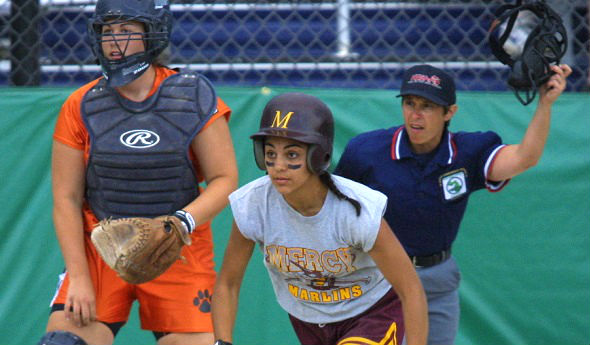
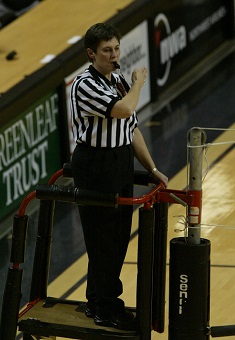
PHOTOS: (Top) Linda Hoover watches a play unfold during an MHSAA Softball Final. (Middle) Hoover works one of her eight MHSAA Volleyball Finals.
VIDEO: Linda Hoover was one of many officials who answered the question "Why Do You Officiate?" for this MHSAA series.
Be the Referee: Tackle Box
September 16, 2014
This week, MHSAA assistant director Mark Uyl discusses the differences between high school and college/NFL rules when it comes to a quarterback's movements within and outside the "tackle box."
"Be the Referee" is designed to help educate people on the rules of different sports, to help them better understand the art of officiating and to recruit officials. The segment can be heard on Mondays, Wednesdays and Fridays during the school year on The Drive With Jack Ebling on WVFN-AM, East Lansing.
Below is this week's segment - Tackle Box - Listen
Today we are going to talk about the rules that govern the quarterback, specifically when the quarterback is being rushed and is looking to throw the ball away and avoid the sack.
Under both pro and college rules, they have what’s called the tackle box. When the quarterback gets outside of the original position of the offensive tackles and throws the ball and it reaches the original line of scrimmage, there is never a foul for intentional grounding. However, under high school rules there is no such thing as a tackle box.
If the quarterback is either in pocket or scrambles outside of the pocket and now is trying to throw that ball away to avoid the sack, there always must be a receiver in the vicinity of the pass to avoid an intentional grounding foul.
Past editions
Aug. 25 - Targeting - Listen
Sept. 4 - Concussions - Listen
Sept. 11 - Pass Interference - Listen