

Northern MI Officials Honor 'Pioneer'
December 30, 2016
By Mike Spencer
Special for Second Half
TRAVERSE CITY – Barb Beckett was in a familiar spot – center circle at the Traverse City St. Francis gymnasium – for a boys varsity basketball game.
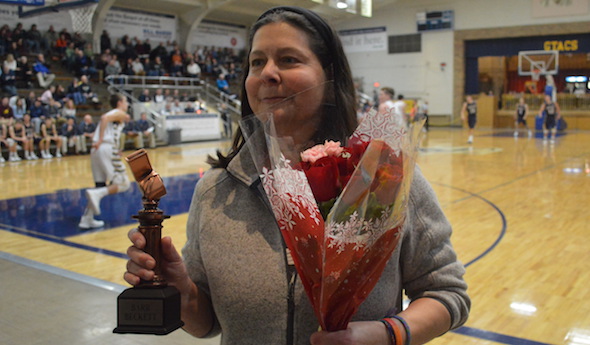
The longtime Michigan High School Athletic Association referee was not tossing up another ball to start the Dec. 17 contest with visiting Cadillac, but she was nonetheless the center of attention.
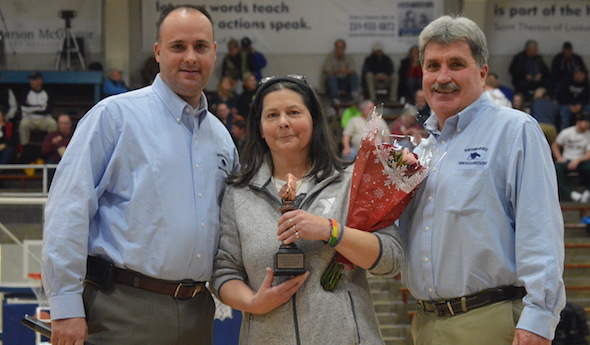
The Northern Sports Officials Association, and St. Francis athletic officials, honored Beckett for her decades of officiating service at halftime. A 34-year official and longtime president of the NSOA, she received plaudits, a trophy and a bouquet of flowers.
“To be recognized by your peers is probably the greatest thrill that one could hope for,” Beckett said. “It was a totally unexpected and humbling experience.
“I could never give back as much as the NSOA has given to me. And looking up and seeing a sea of officials and generations that I had officiated in my career was amazing.”
"Barb has been instrumental in mentoring, developing, and coaching officials to be the best they can be,” said Bill Parker, who succeeded Beckett as the association’s president earlier this year. "She has always had a great passion for high school sports and her way to stay involved has been officiating and as a leader in NSOA."
Parker said honoring Beckett was a great way to show her that the NSOA appreciated her efforts.
“When someone devotes so much time to an association, it is great to acknowledge their contributions,” Parker said.
Beckett is well known in statewide officiating circles. The first woman to officiate an MHSAA Boys Basketball Final (1995) was awarded the MHSAA’s Vern Norris Award in 2000 and Women In Sports Leadership Award in 2013.
“Barb has been a true pioneer in what she, along with the other leaders of the Northern Sports Officials Association, has been able to accomplish in areas of recruiting, training and retaining sports officials,” said MHSAA assistant director Mark Uyl, the association's director of officiating. “At her core, Barb is a people person. The relationships that she has built with fellow officials, school administrators, coaches and student-athletes have been exemplary.”
Uyl said he was not surprised to see Beckett honored by her fellow officials.
 “It’s a true testament of the kind of person Barb is,” Uyl said. “She has blazed an incredible trail as a leader in high school officiating. We need more people like Barb that are true advocates and supporters of those that are officiating games in school sports.”
Although Beckett turned in her whistle more than a decade ago, she is still involved in the NSOA as an assignor, advisor to the board and mentor.
“I knew many years ago that I was here to serve,” said Beckett, who also has been the program director for the Grand Traverse Bay YMCA. “I have been able to fulfill that life expectation of myself.”
Beckett, who officiated numerous high-level basketball and softball tournament games, said getting the association to assign games through a web-based system and getting officials better trained are two major accomplishments from her presidency.
“The assigning system has completely changed the way in which we operate and so has the training,” she said. “We emphasize the importance of educating and we wanted our officials to have the best and most comprehensive rules, mechanics and game-situation knowledge of anyone in the state.”
Beckett said she got into officiating just like a lot of others because she thought she could make a difference and do better than those that she had watched.
Beckett said working her first MHSAA Softball Final and the Class C Boys Basketball Final were among her officiating highlights.
“The boys Final was the best experience ever,” Beckett said. “I didn’t get any sleep the night before the game and I was never comfortable with all the attention of being the first female to work a boys Final.
“I saw myself as being just another official, not a female official.”
Beckett said she’s always had the “greatest partners ever,” and “they made me look way better than I actually was.” Among the greats were Joe Lemieux, Tom Post, Kenny Allen, Scott Jones, Clint Kerr and “many more, too,” she added.
As far as accolades, Beckett said she’s not a fan of self-recognition nights. But she’ll remember the cold, snowy winter night of Dec. 17, 2016.
“I like casual and homey nights like that,” she said. “My NSOA family was there with me so it was extra special.
“It’s a bond that we have as officials. We are all brothers and sisters.”
PHOTOS: (Top) Barb Beckett stands along the sidelines with her trophy and bouquet of flowers after the ceremony in her honor Dec. 17 during halftime of the Traverse City St. Francis boys basketball game against Cadillac. (Middle) Northern Sports Officials Association members, from left: president Bill Parker, assignor and mentor Barb Beckett and secretary Mark Stewart. (Photos by Mike Spencer.)
The Official View: We Are Family
By
Brent Rice
MHSAA Assistant Director
September 8, 2020
Camaraderie – and a feeling of being part of a bigger sports family – is among draws for nearly 10,000 officials who register with the MHSAA each school year.
As “The Official View” returns today for the 2020-21 school year, we feature a trio of sisters who have embraced the avocation and also announce a social media opportunity to further draw Michigan’s officiating community together as we play again for the first time in nearly half a year.

It’s Official!
Officials Awards and Alumni Banquet: Unfortunately, we weren’t able to get together this spring as a group for the annual Officials Awards and Alumni Banquet. Because of the importance of recognizing officials for their service, dedication and contributions to the MHSAA, John Johnson and Faye Verellen-Brown in our office created an excellent virtual stand-in for the traditional banquet. Check out the short video montage HERE.
For those receiving 20-, 30-, 40-, 45- and 50-year service awards, they have been received in the MHSAA office after a delay in production by our supplier due to COVID-19, and they are being sent to you via USPS.
Mark your calendars for May 8, 2021. This is the scheduled date for next year’s Officials Awards and Alumni Banquet. Plan on joining us in person to honor and recognize accomplishments by MHSAA officials across the state.
Officials Deadlines: The registration deadline for officials has been extended until Sept. 14. Consideration for further extensions will be made as necessary.
Other officials deadlines (i.e., MIGS, schedule submission, rules meetings and exams as applicable) for all fall sports remain in place for Sept. 17. The MHSAA has provided Local Approved Associations with flexibility for the 50 percent minimum-attendance requirement. Officials in those sports should submit the schedule they were assigned to start the season. While this may change as the season progresses, it will suffice for the purpose of providing the MHSAA with the assignments each official receives.
MHSAA Officials Facebook Page: To better engage and communicate with officials, the MHSAA has created a Facebook page specifically for all things officiating. Here, you’ll be able to get updates, connect with other officials and discuss rules, mechanics and plays for the high school sports you officiate. Please take some time to connect with us and others by visiting this new resource HERE.
Know Your Rules
FOOTBALL In high school football, in what ways can a team score using a kick?
Ruling: There are two categories of kicks – free kicks and scrimmage kicks. Free kicks include kickoffs (place kick or drop kick), safety kicks (place kick, drop kick or punt) and fair-catch kicks (place kick or drop kick). Of these, only fair-catch kicks can score (because the receiving team may attempt a field goal from the spot of the catch).
Scrimmage kicks include field goals (place kick or drop kick), tries (place kick or drop kick) and punts (punt). Of these, only field goals and tries can score.
NOTE: In high school an attempted field goal that does not score has the same effect as a punt.
It’s Your Call
SOCCER This newest IYC involves a trick play by the team in red. On this corner kick, players of the red team begin running out of play and around the back of the net. Then, one of those players reenters the field just as the corner kick is made, heading the ball into the net. Does the goal count? What’s the call?
The Official View: We are Family
If you were to ask any of the Bedrosian sisters a way that young women can stay physically active, learn skills that can be applied to their daily lives and make some money doing it, they undoubtedly would tell you “officiating.”
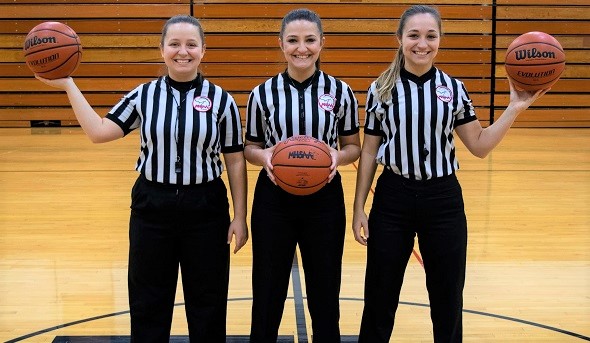
Each of the women (Sara Bauman, Leslie Bedrosian and Alex Bedrosian), who all graduated from New Lothrop, spend much of their winters on the hardcourt doing just that – officiating MHSAA basketball games. And last season, before COVID-19 caused a premature end to the basketball season, the sisters were able to work a three-person crew together for the first time.
Sara, 23, said she started officiating after meeting veteran official Mike Clark, and as a way to stay connected to the game she loved. “At that point in my life I had already coached, but I wanted something closer to what it felt like to play,” said Bauman, now a third-year law student at the MSU College of Law.
Leslie and Alex, both current college students themselves, said they each started officiating after following in their older sister footsteps and for similar reasons. Leslie said, “I love being a part of the game. In addition, refereeing has been my income while I attend college. I’m thankful for all of the friendships and connections I’ve made and the people I’ve met who are appreciative of the work that goes into officiating.”
The impact officiating has had on their lives is not lost on the sisters. Alex, 19, looks at officiating as a challenge.
“Being a female official can be tough, but I feel like it only makes me more confident and has given me a desire to show people what I am capable of doing,” says the youngest Bedrosian sister.
Similarly, 20-year-old Leslie says that officiating has “helped me become more assertive, ready to talk to people and handle difficult situations head on.”
Sara said she hopes displaying those same traits will inspire women to also take up officiating: “It is truly the best feeling to have a female player come up to you in awe because they have yet to have a female officiate (her) game.”
This trio of officiating sisters gives credit for their quick starts to the camps they attended and all of the veteran mentor officials who have helped them along the way, namely Clark and Sharon Sawyers. Bauman and the Bedrosians are committed to continued improvement, working their way up the high school ranks and maybe even working at the college level. It’s clear they enjoy everything officiating has to offer, and we expect long and successful careers from all of them.
If you have an interesting story or an official you’d like to see featured, send details and pictures to [email protected].
PHOTO: Sisters Leslie Bedrosian (left), Sara Bauman (middle) and Alex Bedrosian are MHSAA-registered basketball officials and last year worked together as a crew for the first time. (Photo by Ashley Breiler.)