


Official Feedback
June 10, 2014
We receive much unsolicited comment about the performances of officials and the conduct of spectators. Here’s some of what the MHSAA does to actively solicit input from its key constituents.
Since 1956, the MHSAA has required member schools to provide numerical ratings of officials who work their contests. Since 1998, the system has also allowed schools to cite particular areas of perceived weakness; and doing so is required whenever a school provides a rating of “5” (worst) on the 1-to-5 scale.
There are many deficiencies in a system like this, including that it sometimes means that coaches or administrators are doing the rating, and some of them have never officiated and may not know the rules and mechanics as well as the officials. The rating can also be affected by whether the school won or lost.
Nevertheless, the system has value, not as a true evaluation of an official’s performance for any particular contest, but – when the ratings of all schools are combined over a three-year average – as a number that the official can use to understand his or her abilities relative to all other officials. And it’s a number the MHSAA can use, along with recommendations of local officials associations and assigners, when considering assignments to various levels of MHSAA tournaments.
It is also noteworthy that for 25 years, the MHSAA has used a reporting form allowed in some cases and required in others, whereby officials report unusual events to the MHSAA office immediately after contests. During a typical fall season, about 300 such reports will be filed; about 250 each winter season; about 200 each spring season. Any school which receives three or more negative reports over three seasons receives a letter of concern from the MHSAA and the school’s name is published in benchmarks; and any school that receives no such reports over three seasons receives a letter of praise.
In 2008-09, the MHSAA also began a program whereby officials could rate school sportsmanship. During the winter season of 2013-14, there were approximately 4,000 reports filed, including 2,400 in basketball. The Basketball Coaches Association of Michigan honors the best 100 schools where BCAM members are coaching.
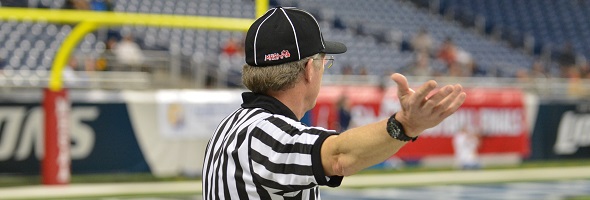
Be the Referee: Trickery & Communication
October 24, 2018
This week, MHSAA officials coordinator Sam Davis explains a key piece of communication that takes place between football referees and coaches during pregame.
Be The Referee is a series of short messages designed to help educate people on the rules of different sports, to help them better understand the art of officiating, and to recruit officials.
Below is this week's segment – Trickery & Communication - Listen
One of the long-time strategies in the game of football is deception. It has lots of other names, and most often goes these days by the name of trickery. Catching an opponent off-guard can break a game wide open. But catching the officiating crew off-guard is something you don’t want to have happen or else your big play may be blown dead inadvertently.
That’s why during the pre-game meeting the officiating crew has with each head coach, one of the questions that will be asked is – “Coach, do you have any trick plays we should be watching for?” And coaches, who are usually tight lipped about a lot of their strategies, will be very open and describe in detail anything fancy that’s in the playbook for that game.
This type of communication gets coaches and officials on the same page and ensures that when trickery comes visiting, only the opponents are surprised.
Past editions
October 18: Punts & Missed Field Goals - Listen
October 11: What Officials Don't Do - Listen
October 4: Always 1st-and-Goal - Listen
September 27: Unique Kickoff Option - Listen
September 20: Uncatchable Pass - Listen
September 13: Soccer Rules Change - Listen
September 6: You Make the Call: Face Guarding - Listen
August 30: 40-Second Play Clock - Listen
August 23: Football Rules Changes - Listen