


Official Results
August 15, 2017
We enjoy some privileges serving on the Michigan High school Athletic Association staff. However, one privilege we do not have is to ignore rules when we don’t enjoy their application.
One of the rules of Michigan school sports for very many years is that there is no protest of or appeal to the decisions of contest officials. Whether it is a traveling call in basketball, a safe/out call in baseball or softball, a five-yard illegal motion call, a 10-yard holding call, or a 15-yard unsportsmanlike conduct call in football with player or coach ejection, the call is final; and if the penalty calls for next-game disqualification, that is final too.
If after a contest, an official wishes he or she could take back a call, it’s too late. If after a contest, folks pressure an official to rescind the next-game disqualification, the outcome is unchanged: ejection from one contest for unsportsmanlike conduct requires suspension from the next day of competition.
The finality of high school officials’ calls has been challenged multiple times in courts across the country – twice in Michigan – and the nearly unanimous result nationwide has been that judges will not allow themselves to become super-referees, second guessing onsite contest officials.
On some higher levels of sports – e.g., college and professional – where there are dozens of cameras covering a handful of contests each week, league offices may review some decisions. But our level of sports lacks sophisticated cameras positioned at all angles, and it involves many hundreds of contests in several different sports every week. We have neither the time nor the technology at every venue to be involved in reviewing the calls of contest officials.
Last school year, there were nearly 1,000 player ejections and more than 200 coach ejections. School sports is not equipped to review 30 to 40 of these situations that arise each week; nor should we do so.
Officials see a play and make an instantaneous decision. Their calls are final; and living with the outcome is one of the valuable lessons we try to teach and learn in school-based sports.
A Narrower Scope to Target New Officials
October 12, 2012
By Rob Kaminski
MHSAA benchmarks editor
Several years ago, MHSAA schools received thousands of postcards imploring graduating student-athletes to “Stay in the Game” by registering as contest officials.
A miniscule portion of that quantity found its way back to 1661 Ramblewood Drive. It’s a better bet you are reading this issue of benchmarks on the rest, in the form of recycled paper.
The plan for 2012-13, then, was to move away from the mass marketing approach and narrow the scope with the help of school administrators. Each MHSAA member school athletic director was sent a memo last May, along with two registration invitations. The memo simply asked the ADs to identify two officiating candidates from the senior class and deliver the special registration form. Completed forms were returned to the MHSAA, which not only waived all sign-up fees for the student’s first year, but also set the rookies up with local associations and training opportunities.
“We took this approach as a more measured strategy knowing that officiating is not for everyone,” said MHSAA Assistant Director Mark Uyl. “Instead of marketing to everyone, we hoped that ADs would give serious time and thought in selecting two graduating seniors who seemed best equipped in terms of personality and comportment for officiating.”
 Uyl set a modest goal of attracting 50 new officials through this program, and the Association is nearly halfway there at this printing, as 22 young men and women will make their first calls during the 2012-13 season.
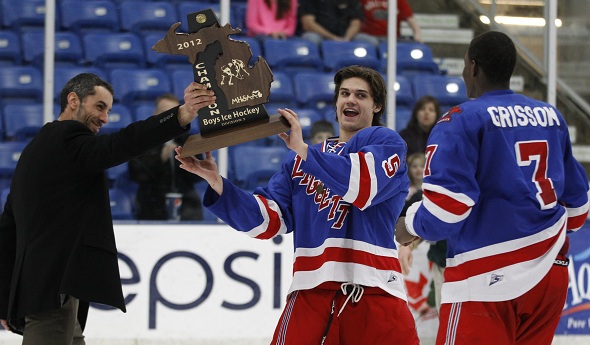
Or, at least their first calls at the high school level. One of the “rookies” is Jake Hodges, who co-captained Grosse Pointe Woods University Liggett to the 2012 MHSAA Division 3 Ice Hockey title.
“I have been a USA Hockey ref for six years, and I plan to continue in college. It is good income,” said Hodges, who also plans to work lacrosse. “I had planned to register anyway so the free registration was great. I expect to work often and continue to be a solid ref. I also played lacrosse for four years and think that will allow for a good transition.”
The process has culled candidates from Michigan’s cities, suburbs and rural areas, from below and above the Mackinac Bridge.
“I have always been interested in officiating. The biggest incentive was the free registration,” said Negaunee’s Kevin Price, who registered in baseball, softball and basketball. “I hope this year will be a learning experience as I work games with long-time officials. As a player, I got to know many officials and we have become friends. The local officials in my area have done a great job giving me advice on my upcoming ‘rookie’ season.”
Many students registered for more than one sport, with a high of seven sports for Montrel Hill of Melvindale.
Early returns give Uyl and the MHSAA reason for optimism.
“We will continue this incentive plan again next year as we try to grow the pool of new, young officials,” Uyl said.
PHOTO: Jake Hodges (center) hoists the MHSAA Division 3 championship trophy after his Grosse Pointe Woods University Liggett team claimed the title in March.
NOTE: This is the third installment in the series "Making – and Answering – the Call" detailing the careers and service of MHSAA officials. Click the links below to view the two.