


Official Results
August 15, 2017
We enjoy some privileges serving on the Michigan High school Athletic Association staff. However, one privilege we do not have is to ignore rules when we don’t enjoy their application.
One of the rules of Michigan school sports for very many years is that there is no protest of or appeal to the decisions of contest officials. Whether it is a traveling call in basketball, a safe/out call in baseball or softball, a five-yard illegal motion call, a 10-yard holding call, or a 15-yard unsportsmanlike conduct call in football with player or coach ejection, the call is final; and if the penalty calls for next-game disqualification, that is final too.
If after a contest, an official wishes he or she could take back a call, it’s too late. If after a contest, folks pressure an official to rescind the next-game disqualification, the outcome is unchanged: ejection from one contest for unsportsmanlike conduct requires suspension from the next day of competition.
The finality of high school officials’ calls has been challenged multiple times in courts across the country – twice in Michigan – and the nearly unanimous result nationwide has been that judges will not allow themselves to become super-referees, second guessing onsite contest officials.
On some higher levels of sports – e.g., college and professional – where there are dozens of cameras covering a handful of contests each week, league offices may review some decisions. But our level of sports lacks sophisticated cameras positioned at all angles, and it involves many hundreds of contests in several different sports every week. We have neither the time nor the technology at every venue to be involved in reviewing the calls of contest officials.
Last school year, there were nearly 1,000 player ejections and more than 200 coach ejections. School sports is not equipped to review 30 to 40 of these situations that arise each week; nor should we do so.
Officials see a play and make an instantaneous decision. Their calls are final; and living with the outcome is one of the valuable lessons we try to teach and learn in school-based sports.
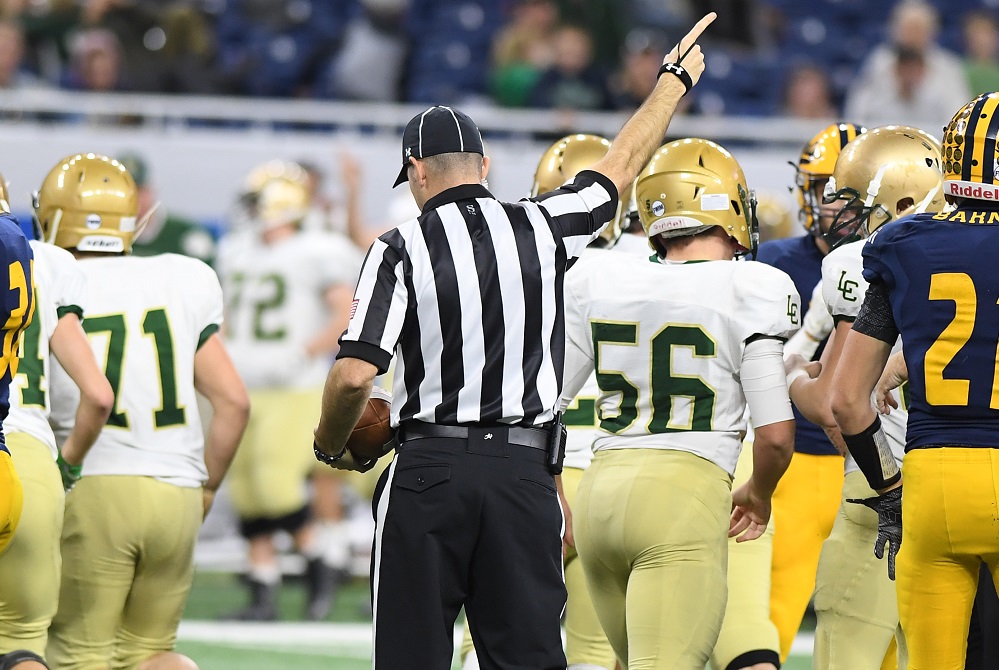
Be the Referee: Pass Interference
By
Geoff Kimmerly
MHSAA.com senior editor
September 2, 2021
This week, MHSAA officials coordinator Sam Davis explains the differences in high school pass interference rules from those at the college and pro levels.
Be The Referee is a series of short messages designed to help educate people on the rules of different sports, to help them better understand the art of officiating, and to recruit officials.
Below is this week's segment – Pass Interference – Listen
One of the big differences between high school football and the college or pro game is how pass interference is called.
In high school, there is no such thing as an “uncatchable” pass. If there is illegal contact by the defender while the ball is in the air, that’s pass interference, no matter where the pass ultimately ends up.
Also – in high school – a defender can “face guard” as long as no contact is made with the receiver. That is not pass interference, even if the defender does not look back for the ball.
Both of those interpretations differ from the college and pro game. Both (of those) levels have an uncatchable exception, and neither allows for face guarding.
Keep that in mind the next time you think you’ve spotted pass interference at the high school level.
Previous editions
Aug. 26: Protocols and Mechanics – Listen