


Official Results
August 15, 2017
We enjoy some privileges serving on the Michigan High school Athletic Association staff. However, one privilege we do not have is to ignore rules when we don’t enjoy their application.
One of the rules of Michigan school sports for very many years is that there is no protest of or appeal to the decisions of contest officials. Whether it is a traveling call in basketball, a safe/out call in baseball or softball, a five-yard illegal motion call, a 10-yard holding call, or a 15-yard unsportsmanlike conduct call in football with player or coach ejection, the call is final; and if the penalty calls for next-game disqualification, that is final too.
If after a contest, an official wishes he or she could take back a call, it’s too late. If after a contest, folks pressure an official to rescind the next-game disqualification, the outcome is unchanged: ejection from one contest for unsportsmanlike conduct requires suspension from the next day of competition.
The finality of high school officials’ calls has been challenged multiple times in courts across the country – twice in Michigan – and the nearly unanimous result nationwide has been that judges will not allow themselves to become super-referees, second guessing onsite contest officials.
On some higher levels of sports – e.g., college and professional – where there are dozens of cameras covering a handful of contests each week, league offices may review some decisions. But our level of sports lacks sophisticated cameras positioned at all angles, and it involves many hundreds of contests in several different sports every week. We have neither the time nor the technology at every venue to be involved in reviewing the calls of contest officials.
Last school year, there were nearly 1,000 player ejections and more than 200 coach ejections. School sports is not equipped to review 30 to 40 of these situations that arise each week; nor should we do so.
Officials see a play and make an instantaneous decision. Their calls are final; and living with the outcome is one of the valuable lessons we try to teach and learn in school-based sports.
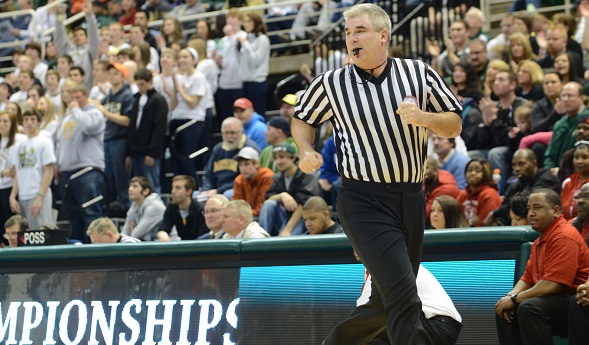
Teaching at Heart of Norris Honoree's Work
April 17, 2019
By Geoff Kimmerly
Second Half editor
David Buck’s degree in education did not lead him into a fulltime job in the classroom.
But the longtime St. Joseph baseball umpire and basketball referee has had an undeniable impact as a teacher and trainer of officials in southwest Michigan, across the state and far beyond its borders.
Buck, one of the state’s most highly-respected officials on the court and considered among the nation’s top collegiate baseball umpires, will be recognized for his vast contributions to the high school games with the MHSAA’s Vern L. Norris Award for 2019.
 The Norris Award is presented annually to a veteran official who has been active in a local officials association, has mentored other officials, and has been involved in officials’ education. It is named for Vern L. Norris, who served as executive director of the MHSAA from 1978-86 and was well-respected by officials on the state and national levels.
Buck has earned similar regard. He’s also a mentor as part of southwest Michigan’s Fruit Belt Officials Association, and considered an elite clinician who has taught the baseball umpiring trade on the national level.
“Dave Buck generously gives of his time to teach and instruct at clinics all over the country. He is an outstanding teacher who relates to all officials, from the rookies and up-and-comers to the veterans still working at improving their craft,” MHSAA Executive Director Mark Uyl said. “Dave also has brought a level of enhanced professionalism to the officiating landscape in southwestern Michigan, where he has improved the continuing education, recruitment and retention efforts and assignment process for many officials. I cannot think of a more worthy Vern Norris Award winner than Dave Buck.”
Buck will be honored at the 40th Officials’ Awards & Alumni Banquet on May 4 at the Kellogg Hotel & Conference Center in East Lansing.
He also will be recognized with his 40-year service award and remains registered with the MHSAA for basketball. He previously officiated football for 16 years, volleyball for his first seven and baseball for his first five beginning with the 1979-80 school year.
He has focused solely on basketball for the MHSAA since 2002-03 and officiated Boys Basketball Semifinals in 2012 and 2013 and the Class B Final in 2009. Additionally, he officiated 30 college basketball seasons, stepping away from that level a year ago, and has begun his 21st at the NCAA Division I baseball level, working in the Big Ten, Mid-American, Pac-12 and Big West conferences. He earned College World Series assignments in 2004 and 2007 and umpired in minor league baseball for 11 seasons, including four at the Triple-A level. Buck also is in his 15th year observing and evaluating umpires for Major League Baseball.
As noted, those experiences on the field have supplied valuable knowledge he gladly continues to pass on. After attending the prestigious Harry Wendelstedt Umpire School – he was named the “outstanding student” in 1984 – Buck also served there as an instructor for eight years. He has taught for 24 years at Doane Umpire Camps and instructed at the Division I Baseball Regional Umpire Camp.
On the high school level, he’s been a member of the Fruit Belt Officials Association for more than three decades including more than 15 years serving on its Board of Directors. He developed the FBOA’s mentoring program that pairs novice basketball officials with experienced partners for low-level games, and he also developed the FBOA website and continues to serve as its webmaster.
“We want people to succeed so much … and I still get a lot of joy out of seeing someone who discovers the world we’re in with officiating,” Buck said. “The camaraderie part of it, the feeling you get from doing the job properly, although for the most part you’re not getting pats on the back from people other than your own. It’s a unique group of people at all levels.”
Buck graduated from North Adams-Jerome High School in 1978, then earned his bachelor’s degree in education from Central Michigan University. In addition to the College World Series and nine Division I Super Regional assignments, Buck umpired two Olympic Qualifier tournaments and the Baseball World Cup in 2007.
Locally, in addition to officiating basketball, Buck has served as an assigner and evaluator for multiple southwest Michigan conferences for 15 years.
Buck most recently has been affiliated with the FBOA, Amateur Baseball Umpires’ Association, Collegiate Baseball Umpires Alliance and National Association of Sports Officials. He currently works as an electronic health records analyst at Lakeland Health in St. Joseph.
While officiating has played a significant part during the majority of Buck’s adult life, he’s equally passionate about his fundraising work to find a cure for cystic fibrosis. Buck’s oldest daughter Hannah battles the disease; he’s personally raised more than $175,000 for the Cystic Fibrosis Foundation and served as the co-chairperson of St. Joseph’s “Great Strides Walk” from 2002-16. Hannah, who was diagnosed at age 5, will graduate from University of Michigan earlier in the day May 4.
Previous recipients of the Norris Award
1992 – Ted Wilson, East Detroit
1993 – Fred Briggs, Burton
1994 – Joe Brodie, Flat Rock
1995 – Jim Massar, Flint
1996 – Jim Lamoreaux, St. Ignace
1997 – Ken Myllyla, Escanaba
1998 – Blake Hagman, Kalamazoo
1999 – Richard Kalahar, Jackson
2000 – Barb Beckett, Traverse City; Karl Newingham, Bay City
2001 – Herb Lipschultz, Kalamazoo
2002 – Robert Scholie, Hancock
2003 – Ron Nagy, Hazel Park
2004 – Carl Van Heck, Grand Rapids
2005 – Bruce Moss, Alma
2006 – Jeanne Skinner, Grand Rapids
2007 – Terry Wakeley, Grayling
2008 – Will Lynch, Honor
2009 – James Danhoff, Richland
2010 – John Juday, Sr., Petoskey
2011 – Robert Williams, Redford
2012 – Lyle Berry, Rockford
2013 – Tom Minter, Okemos
2014 – Hugh R. Jewell, West Bloomfield
2015 – Sam Davis, Lansing
2016 – Linda Hoover, Marshall
2017 – Michael Gentry, Shelby Township
2018 – Jill Baker-Cooley, Big Rapids
High school game officials with 20, 30, 40, 45 and 50 years of service also will be honored at the Officials’ Awards & Alumni Banquet on May 4.
Thirteen officials with 50 or more years of service will be honored, along with 53 officials with 45 years. A 40-year award will be presented to 66 officials. In addition, 99 officials with 30 years and 160 officials with 20 years of experience will be honored. With the induction of this year’s group of 391, the honor roll of officials who have aided young student-athletes grows to 11,397 since the inception of the banquet in 1980.
Tickets for the banquet are available to the public and priced at $20. They will not be sold at the door. Tickets can be ordered by calling the MHSAA office at (517) 332-5046 or by sending the order form available at this link. Deadline to order is April 22.
MICHIGAN HIGH SCHOOL ATHLETIC ASSOCIATION
20, 30, 40, 45 & 50-YEAR OFFICIALS
The officials on this list will receive their 20, 30, 40, 45 or 50-year service awards at the 40th annual Officials’ Awards & Alumni Banquet on May 4 at the Kellogg Hotel & Conference Center in East Lansing.
20 YEAR OFFICIALS
Ada - Dawn M. Hart
Adrian - Aaron S. Crowley
Alden - Gerald R. Grieve
Allen Park - Scott M. Antioch
Allen Park - Ronald B. Rowland
Allendale - Brent J. Clark
Allendale - Alison M. Haraburda
Ann Arbor - Kevin S. Behmer
Ann Arbor - Bradley R. Mutnick
Athelstane - Robin G. Elsner
Bad Axe - Mark J. Schultz
Battle Creek - Kim M. Leach
Battle Creek - Mark J. Nabozny
Battle Creek - Marty D. Whalen
Bay City - Rosalinn I. Hardy
Beaverton - Susan J. Walker
Belleville - John R. Cast
Berkley - Daniel J. Monaco
Berkley - Chet Ostrowski
Bronson - Al Sosinski
Brownstown Township - Mark D. Johnson
Byron Center - Alicia S. Foote
Cadillac - Roger A. Fauble
Calumet - Marc J. Norton
Canton - Luther A. Bradley
Carleton - Michael R. Norgren
Caro - Manuel J. Sapien
Carsonville - William E. Wheat
Cass City - Russell P. Biefer
Cassopolis - Jim Foster
Cassopolis - Gerald Stewart
Cheboygan - Stephen R. Warren
Clark Lake - James M. McKinley
Clarkston - Kurt N. Haines
Columbiaville - Lenny Chaltraw
Concord - Kelly Khon
Crystal - James L. Brown
Dearborn - Barry M. Morang
Detroit - Walter R. Strong Jr.
DeWitt - Scott A. Helmic
Dorr - Lynne F Hunter
East Jordan - Peter A. Elliott
Escanaba - Scott E. Kwarciany
Farmington Hills - Raymond Washington Jr.
Fenton - Juli A. Brown
Fenton - Wayne M. Mentier
Flat Rock - Nichole Mullins
Flushing - Brian R. Conover
Flushing - Matthew D. McLaughlin
Flushing - William R. White
Fort Gratiot - Steven P. Goudy
Fraser - Nicole D. Cuello La O
Fremont - Ann L. Pell
Fremont - Randall W. Pell
Fruitport - Shaun M. Danicek
Gaylord - Kent Bowen
Grand Ledge - Bruce A. Vida Jr.
Grand Rapids - Michael A. Bauer
Grand Rapids - Thomas V. Oliver
Grand Rapids - Darrian C. Thompson
Grandville - Michael S. Baio
Grandville - Robert J. Powers
Greenville - John J. Forton
Grosse Pointe Shores - Daniel F. Moffitt
Haslett - Brian M. Smith
Hillsdale - Joe P. Burkhart
Holland - Rick P. Haskins
Howard City - Alan J. Parker
Indian River - Thomas B. Stone
Ionia - Denny M. Ferguson
Ionia - Steven L. Gross
Ionia - Tim J. Swain
Ira - Harry A. Thomas Jr.
Iron River - Crystal L. Bongi
Jackson - Everton G. Davidson Sr.
Jackson - Brian A. Draper
Jackson - Tony W. Griggs
Jenison - Leisa A. Lobbezoo
Kalamazoo - Priscilla L. Bagley
Kalamazoo - Brent J. Bos
Kalamazoo - Cory M. Hinga
Kalamazoo - Susan M. Riksen
Kalamazoo - Daniel B. Stahr
Kimball - Clarence Wendell II
Lansing - Jerry L. Armstrong
Lansing - Richard C. Preston
LaPorte - Kendall L. Schaeffer
Livonia - Kire Bosnjakovski
Macomb - Dennis M. Kennedy
Marquette - Steven Paul Ritenour
Mason - Kirk R. Petee
Mason - Donald R. Sherwood
Mattawan - Anthony W. Coulter
Midland - Edward E. Saunders
Millington - Gailan R. Reinert
Monroe - Daniel W. Jukuri
Monroe - Marvin A. Krueger
Montague - Darric E. Roesler
Mt. Clemens - Jack C. Robinson
Mt. Pleasant - Todd Heller
Muskegon - James A. Allen Jr.
Muskegon - Lon C. Cross
Muskegon - Kevin D. Floyd
Muskegon - Matthew R. Koekkoek
North Branch - Jason Castle
North Branch - Lyle D. Jamison
Norvell - Trenton A. Withrow
Onsted - David C. Lauer
Petoskey - Gregory B. Brown
Pickford - Vance M. Barber
Pierson - Andrew D. Paulen
Port Austin - Michael L. Rea
Portage - Thomas L. Crook
Portage - Scott A. Muffley
Portland - Michael J. Hilley
Rochester Hills - Kevin M. May
Romulus - Victor R. Lambert
Rudyard - Sarah E. Kwiatkowski
Saginaw - Scott R. Helmka
Saginaw - Jeremy M. Mueller
Sanford - Keith Steele Stewart
Sault Ste. Marie - Todd M. Menard
Schoolcraft - Paul M. Rigby
Scottville - Nicholas T. Marshall
Shelby - Thomas E. Morningstar
South Haven - Wayne A. Wilkinson
South Lyon - Julie L. Fisette
South Lyon - Jason E. Rigley
Southfield - Kim F. Bell
Southfield - Thomas E. Marshall
Southfield - Kendall G. Sherman
Southfield - Jerome A. Shipp
Spring Lake - Marty D. Gravelyn Sr.
Spring Lake - Patrick N. Stegeman
St. Clair Shores - Michael Drake
St. Clair Shores - James E Haddad
St. Clair Shores - Randy Stuart
St. Ignace - Stacy McNamara-Perry
St. Louis - Julie G. Anderson
Sterling Heights - James P. Collier
Stevensville - Ron A. Waldvogel
Swartz Creek - Tashema M. Hayter
Sylvania - Gary F. Grycza
Taylor - Michael A. Daniel
Trenton - William T. Sanfilippo
Troy - Anthony T. Howard
Vermontville - Brian A. Hopkins
Waterford - Jeffrey P. Harnack
Weidman - John A. Cotter
West Bloomfield - Dennis J. Hannon
West Bloomfield - Michael Tarnopol
West Branch - Harold W. Wangler
West Olive - Jan Milek
West Olive - Cort E. Musolf
West Olive - Dan D. Zwick
Westland - Stephen R. Shiner
Westland - Mark J. Wludyka
Williamston - Roger F. Blasey
Wyoming - Bradley T. Brunet
Wyoming - Dennis J. Hodges
30 YEAR OFFICIALS
Allegan - Thomas D. Collins
Alpena - Terry W. King
Battle Creek - Damon J. Fox
Battle Creek - James R. Hughes
Bay City - Raul Gonzales
Bay City - Paul L. Sevilla
Bay City - Holly L. Watson
Bear Lake - Ross E. Schuch
Belleville - James M. Neal
Bloomfield Hills - Bette Norman
Brooklyn - Kevin R. Carpenter
Caledonia - Greg L. Pilbeam
Calumet - Sean D. Jacques
Carleton - Rick Grant
Carney - Paul A. Polfus
Charlotte - Ronald B. Beegle
Commerce Township - Brian R. Conley
Comstock Park - Robert L. Neier
Comstock Park - Terri L. Richards
Davison - Michael E. McKenna
Detroit - Troy Campbell
Detroit - Johnny P. Green
Detroit - John L. Walton
DeWitt - Dennis M. Beecham
Dowagiac - William J. Ward
Dundee - Robert L. Kroeger
East Leroy - Dale A. Traister
Eastpointe - David W. Vojinov
Edwardsburg - Roger A. Hostetler
Escanaba - Raymond Robitaille
Farmington Hills - Derek S. Adolf
Farmington Hills - David P. Drake
Farwell - Fred L. Witchell
Fenton - Earl L. Coad
Flint - Anthony A. Lewis
Flint - Michael L. Tipton
Flint - Gregory G. Waller
Fort Gratiot - Lowell W. Spiess
Goodrich - Kathleen S. Schollar
Grand Haven - Mark Knopf
Grand Rapids - Dawn D. Brackmann
Grand Rapids - Michael S. Dolce
Grand Rapids - James G. VanEenennaam
Grandville - Gary A. Jandernoa
Granger - Richard A. Cox
Hastings - Mark E. Martin
Holland - Duane D. Baker
Holland - Robert J. Durham
Holland - Brent T. Gawlik
Holt - David P. Gonzalez
Jenison - Jack H. Blauwkamp
Kalamazoo - Mark B. Heineman
Kalamazoo - Paul E. Kampen
Kalamazoo – R. Scott Ryder
Kalamazoo - Bradley J. Stapert
Kewadin - Jan R. Veliquette
Lacota - Ted S. Krzemen Jr.
Lansing - Robert C. Troub
Livonia - David C. Robitaille
Lowell - Randall C. Halstead
Marne - Mary J. Gavin
Marquette - Scot C. Fure
Midland - Cathy L. Bourne
Midland - Brian L. Taglauer
Monroe - Ben F. Budzios
Monroe - James O. Bunkelman
Naubinway - Elmer H. Albright
New Lothrop - Richard L. Ustishen
Norway - Donald R. Lofholm
Owosso - Randy L. Nesbit
Petoskey - Mark W. Lennemann
Plainwell - Nancy J. Snyder
Plymouth - Michael J. Craig
Rogers City - Valerie S. Peacock
Romulus - Debbie L. Dick
Royal Oak - Michael C. DeVuyst
Sandusky - Daniel W. Guibord
Sault Ste. Marie - Anthony D. Abramson
Shelby Township - Rock Dedvukaj
Shelby Township - Donald E. Schima
Southfield - Steven E. Woodfork
St. Clair Shores - Joseph S. Denomme
St. Louis - Matthew T. Chovanec
Sterling Heights - Martin A. Hacias
Sterling Heights - Brian S. Hopp
Stevensville - Charles D. Jager
Tecumseh - Lori Spotts
Thompsonville - Scott W. Lonoconus
Toledo - Thomas P. Donovan
Walker - Joseph A. Geluso
Warren - Kenneth A. Seidenwand
Waterford - Charles A. Inama
Waterford - Christopher P. Lund
Watervliet - Brian E. Hall
Wayne - Dan F. Kimberlin
West Bloomfield - Bernard Muhammad
Williamston - Norman H. Gozalka
Wyoming - Jon M. Hendrickson
Ypsilanti - Howard Portis
40 YEAR OFFICIALS
Adrian - Darwin L. Hukill
Alger - Leroy A. Oliver
Alpena - Phil C. Schultz
Bay City - Brian F. Dugan
Berrien Springs - Jamie L. Stacey
Big Rapids - Jill E. Baker-Cooley
Brighton - Thomas J. Mora
Cadillac - William T. Bartholomew
Caledonia - Conroy Zuiderveen
Cass City - Craig A. Weaver
Cheboygan - Lynwood Leightner Jr.
Concord - Charles T. Ewing
Crystal - Bruce E. Waldron Sr.
Daggett - Michael P. Lyons
Davisburg - William J. Davis
DeWitt - Perry M. Costello
Eaton Rapids - David E. Harns
Essexville - Robert J. Adamowski
Flushing - Dennis L. Harland
Franklin - Fred Tenorio
Galesburg - William W. Weese
Grand Blanc - Roy H. Linkowski
Holland - Fred C. Schmitt
Ionia - Kaye Breining
Jackson - David L. Clouse
Jackson - Chuck D. Walters
Kalamazoo - Willie B. Watson
Lake Orion - Michael J. Callahan
Lansing - Michael R. Conlin
Lansing - David D. Shipman
Lewiston - Jim Hilgendorf
Manistee - Jo L. Arnold
Marshall - Linda K. Hoover
Marysville - Thomas J. Ridas
Midland - Robert Baillie
Midland - Ken P. Beaudin
Midland - Eldon J. Dean
Midland - James A. Gillis
Monroe - Barry P. Little
Nashville - Brian D. Pufpaff
Okemos - Jay Marcotullio
Otisville - Douglas R. Fillmore
Plymouth - Henry L. George Jr.
Portage - Mike T. Hinga
Ravenna - Thomas C. Wright
Riverview - Ronald J. Barger
Rochester - Brian E. York
Rochester Hills - Fred B. Castelvetere
Saginaw - Brian D. Wakeman
Sandusky - Alan DeMott
Shelby - Edmundo Flores
South Haven - Patrick J. Conroy
Southgate - Douglas M. Pastor
St. Clair Shores - Tom P. Frattini
St. Ignace - Donald P. Gustafson
St. Joseph - David J. Buck
St. Louis - Kathleen V. Hutfilz
Toledo - Jon Everhart
Traverse City - Mark E. Stewart
Trenton - Daniel K. Whaley
Wallace - Bruce A. Pearson
Waterford - Mark W. Richer
Westland - Robert W. Allen
White Cloud - Tony A. McHattie
Whitmore Lake - David L. Wint
Wyandotte - Thomas S. Palamara
45 YEAR OFFICIALS
Ada - Bryan D. Cullens Jr.
Adrian - Judith A. Walter-Kohn
Albion - Raymond Drysdale
Alpena - David M. Kuznicki
Battle Creek - Steven K. Higgs
Birmingham - Robert S. Stark
Britton - Kenneth W. Kormos
Brooklyn - Michael Timms
Burton - Patrick M. O'Reilly
Byron Center - Andrew J. DeVries
Calumet - Bruce Coppo
Canton - Dennis J. Bostwick
Canton - Terry A. Wash
Carrollton - Ralph S. Gnotek
Chesterfield - Harold T. Younce
Davison - James L. Eastman
Dearborn Heights - Lou Giroux
East Leroy - James Alday
Fenton - Martin R. Covert
Grandville - Pat Folkertsma-Garrett
Grandville - Andrew J. Kovac
Grosse Pointe Park - Mike C. Dempsey
Holland - Bruce E. Kruithoff
Holly - Paul W. Matson
Hudsonville - Allan J. Owens
Lexington - Richard R. Hug
Livonia - Ann K. Hutchins
Macomb - Ronald L. Minoletti
Marquette - Leonard M. Angeli
Middleville - Bruce F. Bender
Milan - Brad D. Susterka
Mio - Edwin L. Cline
Monroe - Eric E. Jenkins
Mt. Pleasant - Dale P. Brecht
Mt. Pleasant - James R. MacLean II
Muskegon - Craig W. Weirich
Newaygo - Dave Baldus
Norway - Milt J. Krznarich
Petoskey - Edward L. Gunderson
Portage - Allan R. Thompson
Rives Junction - Dale A. Baum
Rochester Hills - Tom Delia Jr.
Royal Oak - Byron A. Photiades
Saginaw - Ronald L. Dressler
Saugatuck - Catherine Dritsas
South Haven - Henry L. Allen
Swartz Creek - Larry L. Schutt
Tawas City - Robert L. Ritsema
Troy - Kenyon D. Shively
Warren - Hugh R. Jewell
Waterford - Frederick A. Cohen
Wayland - Norman L. Taylor
Wyoming – H. Joseph Perrin
50 YEAR OFFICIALS
Canton - Pamela G. Yockey
Dryden - Louis W. Miramonti
Grand Rapids - Robert J. Rodenhouse
Holt - Denny Fulk
Jackson - Dennis K. Lautzenheiser
Lakeport - Donna H. Frohm
Lansing - Donald R. Murray
Lansing - Darwin S. Petersen
Negaunee - Rodney J. Guizzetti Sr.
Portage - William H. Rapley Jr.
Spring Lake - Daniel L. Bouma
Toledo - William J. Lauer
Warren - Dolores A. Marquis
PHOTO: (Top) David Buck officiates a 2013 Class C Boys Basketball Semifinal between Flint Beecher and Monroe St. Mary Catholic Central at the Breslin Center.