

The Official View: Congrats & Transitions
By
Brent Rice
MHSAA Assistant Director
December 3, 2018
By Brent Rice
MHSAA Assistant Director
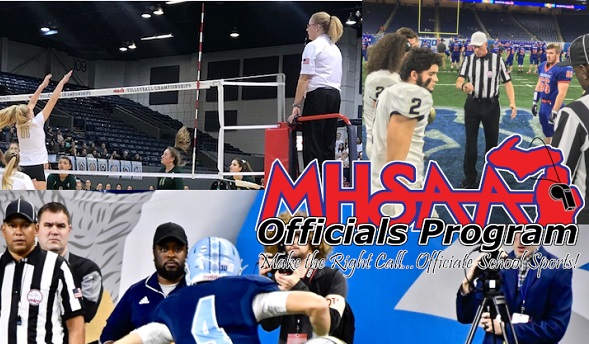
Winter is upon us at the MHSAA, and as we switch up seasons we salute the many who contributed to fall’s championship events and preview changes on the way for the MHSAA Officials Program.
It’s Official!
 Transitions: As we transition from the fall to winter sports seasons, it is fitting that we discuss some expected changes in the MHSAA Officials Program. Proposals are being developed and sent to the Representative Council to resolve a number of issues – and additional changes are expected over the coming year. The goal of these changes is to provide MHSAA member schools with the most competent and qualified officials to choose from for regular-season contests, to improve sportsmanship amongst staff, students and spectators; and to increase the compensation and benefits that come with being registered as an official with the MHSAA.
To ensure that our member schools have access to the best and brightest officials, new education and accountability standards are being put in place. Also included will be cost-effective options for training – recognizing and featuring quality camps/clinics around the state and the development of a formal mentorship program.
Improving sportsmanship continues to be a priority of the MHSAA and the Officials Program. This cannot be addressed solely by the schools and the Association. The officials are the first line of defense in ensuring good sportsmanship. We are developing a “Personal Attack” policy that will assist and support officials in the implementation of corrective decision-making when necessary. Additionally, we are developing an “Official Thanks” campaign that recognizes and shows appreciation for the officials of MHSAA contests. The Game Day Ambassador Program is another initiative designed to put a face with the names of the officials for our schools and to provide schools with resources that explain what minimal efforts can be made to improve the officials’ experience.
Finally, benefits and compensation are being reviewed, and increases are due. We are evaluating the best way to increase compensation for postseason tournaments and what other benefits of registration would provide value to MHSAA officials. If you have ideas for incentives or additions you think would be beneficial to our officials, please let me know at [email protected].
Postseason Tournament Consideration: Winter Rules Meetings and Rules Tests for tournament consideration are due by Dec. 13, 2018. Make certain to complete all of these requirements, along with the submission of your schedules, to ensure you are eligible to officiate this postseason.
‘Official View’ Submissions: Winter officials – we need more submitted photos and stories showing all sides of officiating. If you have pictures of you and your fellow officials that can offer an inside look into the officiating world, please send them to [email protected]. We need a picture (or two) and the who, what, when and where. The more interesting the photo/story, the better.
We also continue to request “Official of the Month” nominations. If you have someone you think represents the MHSAA and the Officials Program well (and is a Winter sport official), send the official’s information and a brief note letting us know why you are making the recommendation.
Thank You: Thank you to all of the officials who responded to questions regarding proposed changes in the registration benefits and format. The information was very useful for us in determining what is in the best interests of all MHSAA-registered officials in regards to security, education, training and value.
For those who didn’t receive a request for feedback, don’t worry. No decisions have been finalized, and we will be sure to keep you posted of changes moving forward.
Rule of the Week
BASKETBALL With three seconds remaining on the clock and the game tied, A1 is attempting a throw-in from B’s end line. As A1 holds the ball over the plane of the end line, B1 quickly grabs the ball from A1 and lays it into the basket as time expires.
Ruling: Two points for Team B. The basket counts, and the game is over.
It’s Your Call
WRESTLING This week’s clip shows a wrestler secure a single-leg trap. Then, as it appears he has an easy opportunity to trip the other leg for a takedown, he picks up his opponent and slams him to the mat. What’s the call?
Last IYC Ruling: The last “It’s Your Call” clip showed a backrow player in volleyball land in front of the attack line following a successful jump attack from behind the line. Because the player’s feet leapt from a position established behind the attack line, this attack is a legal back row attack. (Click to see video.)
Official View: Congratulations!
We want to take a quick moment to recognize and thank the officials assigned to our fall postseason tournament Finals. We received very good feedback about the quality and consistency of officiating during our entire postseason. Your efforts are appreciated, and we understand that without your commitment and sacrifices, we could not host such tremendous events for our member schools and student-athletes.
Here are the Finals officials assigned for each fall sport:
Cross Country: Nick Marshall, Pete Norman, Lynn Kettlehut, Myles Cleverly, Dar Devereaux, Theo Nash, Doug Kelly, Erika Rafkin, Dan Bentschneider, Eldon Dean, Jim Davoe, Ray Drysdale, Jim Cleverly, Paul Matson, Lew Clingman, Rudy Godfriodt, Kathy Hutfilz, Brian Macomber, Wayne McDonald, Kathy Schollar, Ozzie Hashley, Geri Jackson, Lou Miramonti, Bertha Smiley, Dan Johnson, Dennis Whitehead, Kim Spalsbury, Autumn Cleverly, Greg Bishop, John Goebel, Chuck Janke, Marty Lynn, Tate Tatro, Rich Vitale, Jim Loria, Michael Raffin, John Brown, Marty Crane, Becky Norman
8-Player Football: Brad Austin, Joel Barnes, Paul Binder, John Carideo, Anthony Immel, Jack Miles, Joel Mitrzyk, David Paananen, Mark Pieniozek, Joseph Strong.
11-Player Football: Trent Anderson, Kurt Ballien, Robert Barrett, Ron Blevins II, Paul Boehms, Luther Bradley, Edgard Cazal, Lakelvert Cosby, Gillie David, Christopher Dickerson, Todd Dunlap, Donta Favors, Denny Ferguson, Jeffery Flynn, Timothy Frosch, Nicholas Gayan, Darin Gilbert Sr., Todd Gooding, Allen Hebden, Kevin Hughes, Steven Johnson, Darin Kelly, Ryan Kelly, Robert King, Carl Knoop, Patrick Lane, Adam Leyton, Mario Marana, Scott Maurer, Allen Noles, Brent Novak, Justin Paluch, Dee Jay Paquette, Steve Pearce, Bradley Peet Sr., Charles Phillipson, David Radke, Daniel Renner, Lawrence Roberts, Wally Rose, Jeff Rowley, John Schweihofer, Terry Scrivener, Brian Smith, Shane Smith, Randy Straub, Kevin Sullivan, Thomas Sumner, Johnnie Tanner, Nathan Taylor, Jason Towe, Chad Vanderstelt, Eric VanHevel, Max Warriner, Gregory Waun, Thomas Wolford.
Volleyball: Augusto Dumlao, Lawrence Freeman, John Martin, Penny McDonald, Matthew Preston, Luke Reynolds, Lawrence Ross, Todd Stamm.
Boys Soccer: Bradley Barlog, Branden Bennett, Carter Brochu, Conlan Campbell, Justin Cartwright, Thomas Coatoam, James DeBrabander, Bruce Falberg, Ashley Fromson, Richard Gilbert, Andrew Hoard, Pietro Loria, Alexander Plum, Timothy Reed, Robert Scudder, Andrey Vinarov.
Girls Swimming & Diving: Susan Barthold, Dennis Betts, Steven Bredeweg, John Cast, Paul Chaffee, James Chapman, Raymond Cranston, Timothy Eastman, Brian Foust, Jerry Kelley, John Leidlein Jr., Raymond Martin, James McPartlin, Steven Smale, Brad Susterka, Maynard Timm, Michael Torrey, Larry Wegener.

Officials Registration Open
June 19, 2014
By Geoff Kimmerly
Second Half editor
The Michigan High School Athletic Association is accepting registrations by mail and online for game officials for the 2014-15 school year and hopes to continue building on a program started in 2012 and aimed at recruiting new officials from high schools’ current graduating classes.
The MHSAA again has provided each member high school with two complimentary officials registrations to be awarded to graduating seniors designated by their athletic directors as having the skills and interest in continuing their involvement in MHSAA athletics through officiating. Over the last two years, 41 graduates took advantage of this opportunity to register free of charge.
High school seniors selected do not have to pay registration fees for the next school year and receive assistance from MHSAA staff in connecting with local officials’ associations and receiving training opportunities. Graduates who registered during the first two years of the program came from the following schools: Adrian Lenawee Christian, Brimley, Calumet, Carleton Airport, Coleman, Dearborn, Detroit International Academy, Detroit Aisha Shule-W.E.B. Du Bois Prep Academy, Detroit Southwestern, Engadine, Fenton, Grand Haven, Grosse Pointe Woods University Liggett, Harrison Township L’Anse Creuse, Houghton Lake, Imlay City, Ishpeming Westwood, Jonesville, Kalamazoo Loy Norrix, Lowell, Mackinaw City, Madison Heights Lamphere, Marquette, Mayville, Michigan Center, Negaunee, New Boston Huron, New Haven Anchor Bay, Owendale-Gagetown, Owosso, Oxford, Rogers City, St. Ignace, Ubly, Waldron, Watervliet and West Branch Ogemaw Heights.
For other new and returning officials, those who register online again will receive a $5 discount off their processing fees. A $12 fee is charged for each sport in which an official wishes to register, and the online processing fee is $30. Officials submitting registration forms by mail or on a walk-up basis will incur a $35 processing fee. Officials registered in 2013-14 will be assessed a late fee of $30 for registration after July 31. The processing fee includes liability insurance coverage up to $1 million for officials while working contests involving MHSAA schools.
Online registration can be accessed by clicking “Officials” on the Home Page of the MHSAA Website. Forms also are available online that can be printed and submitted by traditional mail or hand delivery to the MHSAA Office. More information about officials registration may be obtained by contacting the MHSAA at 1661 Ramblewood Drive, East Lansing, MI, 48823, by phone at (517) 332-5046 or by e-mail at [email protected].
There is an officials' registration test for first-time officials and officials who were not registered during the past school year. The test consists of 45 questions derived from the MHSAA Officials Guidebook, which also is available on the Officials page of the MHSAA Website. Additional 50-question exams must be taken by those registering for football or basketball for the first time or those who were not registered for those sports during the previous school year. Manuals for both sports also are available on the Officials page.