

The Official View: The Crossroad We Face
By
Brent Rice
MHSAA Assistant Director
December 20, 2021
It’s time to call it what it is … a major crossroad and tipping point.
For more than a decade, the numbers of registered MHSAA officials have steadily declined from a high of about 13,000 to, today, around 7,700. While the COVID pandemic has certainly exacerbated those figures over the last two seasons, two of the top reasons officials give for leaving the avocation remains adult spectators and coach behavior.
School sports and traditional recreational programs have been supplemented, and in some cases, supplanted, by travel and club programs that, more often than not, do not share the same values and standards expected in education-based athletics. Many of these non-school programs require parents to spend exorbitant amounts in registrations fees, travel, lodging and meals with the implicit suggestion that this is the gateway to Division I college and professional sports. The result is that the criticisms hurled at the officials are more than an overzealous parent wanting a fair-called game – it is stakeholders defending their investments.
While we are often disturbed by some of the events documented during these club and travel contests, the real concern is that this permitted conduct has begun to seep into the school sports world. The result is that officials are simply walking away, leaving increasingly more games being moved or cancelled due to the lack of officials. The games that are being played are often staffed with smaller crews – perhaps two officials instead of three. Officials are in place to provide athletes with safe and fair opportunities to play sports, and shorthanded crews may reduce the ability for officials to see and call plays and fouls. These potential missed calls incite more disparaging comments from spectators, thus pushing more officials away from sports. This cycle cannot be sustainable much longer.
So, what are the solutions, and who do they come from?
The first is spectators. We refer to this as the difference between the whistle and the airhorn. When spectators just feel compelled to be vocally critical, they should make certain that their criticisms are infrequent, brief and not personal. Spectators should be the whistle and not the airhorn. Other spectators have a responsibility to set a good example and call out those who are going overboard.
School administrators also play a critical role in ensuring that officials are able to do their job in a safe and secure setting. Administrators should look for escalating situations in the stands and diffuse them before they become abusive. No one wants to remove parents and other spectators from events; but frankly, more of that needs to be done to show that inappropriate conduct and behavior will not be tolerated.
Finally, MHSAA officials need to be the first line of defense against unsportsmanlike behavior. This should be penalized when observed from coaches or players, without concern to the consequences that student or coach will later face. In short, bad behavior cannot be tolerated. Conduct found in the MHSAA Personal Attack Policy should result in an immediate ejection/disqualification, and similar conduct that occurs after the game should be handled as provided in the Post-Contest Ejection Policy. Unaddressed bad behavior by coaches and players encourages the same from spectators.
MHSAA game officials should focus their attention to the competition on the playing surface. This means that most comments from the stands should be ignored, and an official should never engage with critical spectators. This is not to say that officials must take abuse from spectators. If the language or behavior becomes a distraction to the contest, or personal and vulgar language is directed at the officials, the officials have the authority to have spectators removed from the facility (and should do so). No need for a big spectacle, ejection mechanic or yelling into the stands to engage fans. They should simply stop the contest and have the administrator on site remove the unruly spectator from the game.
There are a number of other factors contributing to the decline of officials that also need to be addressed. Low game fees, substandard locker room accommodations, unmanageable game times, and assigner and association politics all play a part. Those all pale in comparison to the main reason cited: Misbehavior by adults. MHSAA officials will inevitably continue to miss calls. That’s the nature of what they do. However, without them the games cannot be played, which means opportunities for Michigan students will also decline. We all have a responsibility to see that school sports remain closely tied to the values of educational athletics and maintain scope and perspective. We all must do better; otherwise, the crossroads of the officials shortage will only get worse.
It’s Official!
Postseason Assignments: Winter sport officials need to pay close attention to the changes for postseason consideration in effect this school year. Officials in most sports must opt into tournament consideration. This means officials this season for basketball, competitive cheer, gymnastics, ice hockey and wrestling must submit their availability on the MHSAA website – otherwise, the default is that they are unavailable. This is in addition to other postseason requirements such as completion of the rules meeting, the tournament exam and submission of the official’s regular-season schedule through the MHSAA website. These requirements are due by Dec. 15 for wrestling, Jan. 5 for basketball, Jan. 12 for competitive cheer and ice hockey, Jan. 19 for gymnastics and Jan. 26 for boys swimming & diving.
Seeking Committee Members: We are reconvening an ad hoc committee of educators/officials to assist with the development of curriculum that can be utilized by school districts for officiating classes in conjunction with the MHSAA Legacy Officials Program.
If you’re interested in serving on this committee (some in-person, but mostly virtual) and have a background as an educator, please reach out to [email protected].
Know Your Rules
BASKETBALL As Team A is preparing to make a throw-in from the end line, Team A players #15, #20 and #3 stand shoulder-to-shoulder next to each other immediately in front of the thrower. Team B player #11 requests to stand between two of the A players before the throw-in.
RULING Within three feet on the court from the throw-in, Team B players will be permitted to stand between the Team A players, if requested. If the Team A players were positioned more than three feet from the throw-in, this request would be denied.
It’s Your Call
REVIEW The play from the last It’s Your Call (found here) involved ball-handling by a back row volleyball player. Following a good dig by her teammate, the back row player appears to make contact with her left hand then right hand with her overhead pass. Since this is not the first contact on her side, the contact with the ball must be simultaneous with both hands. This is a multiple contact and a loss of point against white.
WRESTLING For the first time, the MHSAA will introduce a Girls Division into this year’s Individual Wrestling Finals. The following “It’s Your Call” takes place in a girls match but is applicable to the sport as a whole. Review the brief clip and let us know your thoughts. What’s the call?
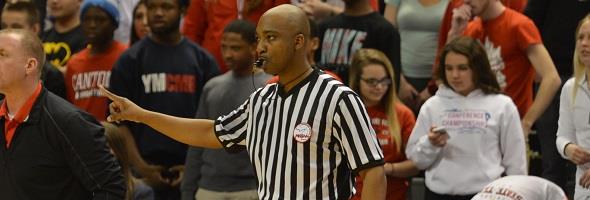
Be the Referee: Tripping in Ice Hockey
January 10, 2019
This week, MHSAA officials coordinator Sam Davis explains another of the most misunderstood rules in high school sports – this one concerning tripping in hockey.
Be The Referee is a series of short messages designed to help educate people on the rules of different sports, to help them better understand the art of officiating, and to recruit officials.
Below is this week's segment – Tripping in Hockey - Listen
Today, we’re in our series of the most misunderstood rules in high schools sports, and we’re going to talk about tripping in ice hockey.
In high school hockey, a player intentionally leaving his or her feet and knocking an opponent down is tripping – even if the puck hits the player leaving his or her feet.
This is different than the professional interpretation and frustrates amateur officials at all levels. A player can dive and legally knock the puck off the opponent’s stick, but if on the follow-through cuts down the opponent – it’s a trip. A dangerous play, pure and simple.
Past editions
January 3: Sliding in Basketball - Listen
December 27: Stalling in Wrestling - Listen
December 20: Basketball: You Make the Call - Listen
December 13: Basketball Uniform Safety - Listen
December 6: Coaching Box Expansion - Listen
November 29: Video Review, Part 2 - Listen
November 22: Video Review, Part 1 - Listen
November 15: You Make the Call - Sleeper Play - Listen
November 8: 7-Person Football Crews - Listen
November 1: Overtime Differences - Listen
October 25: Trickery & Communication - Listen
October 18: Punts & Missed Field Goals - Listen
October 11: What Officials Don't Do - Listen
October 4: Always 1st-and-Goal - Listen
September 27: Unique Kickoff Option - Listen
September 20: Uncatchable Pass - Listen
September 13: Soccer Rules Change - Listen
September 6: You Make the Call: Face Guarding - Listen
August 30: 40-Second Play Clock - Listen
August 23: Football Rules Changes - Listen