

The Official View: The Crossroad We Face
By
Brent Rice
MHSAA Assistant Director
December 20, 2021
It’s time to call it what it is … a major crossroad and tipping point.
For more than a decade, the numbers of registered MHSAA officials have steadily declined from a high of about 13,000 to, today, around 7,700. While the COVID pandemic has certainly exacerbated those figures over the last two seasons, two of the top reasons officials give for leaving the avocation remains adult spectators and coach behavior.
School sports and traditional recreational programs have been supplemented, and in some cases, supplanted, by travel and club programs that, more often than not, do not share the same values and standards expected in education-based athletics. Many of these non-school programs require parents to spend exorbitant amounts in registrations fees, travel, lodging and meals with the implicit suggestion that this is the gateway to Division I college and professional sports. The result is that the criticisms hurled at the officials are more than an overzealous parent wanting a fair-called game – it is stakeholders defending their investments.
While we are often disturbed by some of the events documented during these club and travel contests, the real concern is that this permitted conduct has begun to seep into the school sports world. The result is that officials are simply walking away, leaving increasingly more games being moved or cancelled due to the lack of officials. The games that are being played are often staffed with smaller crews – perhaps two officials instead of three. Officials are in place to provide athletes with safe and fair opportunities to play sports, and shorthanded crews may reduce the ability for officials to see and call plays and fouls. These potential missed calls incite more disparaging comments from spectators, thus pushing more officials away from sports. This cycle cannot be sustainable much longer.
So, what are the solutions, and who do they come from?
The first is spectators. We refer to this as the difference between the whistle and the airhorn. When spectators just feel compelled to be vocally critical, they should make certain that their criticisms are infrequent, brief and not personal. Spectators should be the whistle and not the airhorn. Other spectators have a responsibility to set a good example and call out those who are going overboard.
School administrators also play a critical role in ensuring that officials are able to do their job in a safe and secure setting. Administrators should look for escalating situations in the stands and diffuse them before they become abusive. No one wants to remove parents and other spectators from events; but frankly, more of that needs to be done to show that inappropriate conduct and behavior will not be tolerated.
Finally, MHSAA officials need to be the first line of defense against unsportsmanlike behavior. This should be penalized when observed from coaches or players, without concern to the consequences that student or coach will later face. In short, bad behavior cannot be tolerated. Conduct found in the MHSAA Personal Attack Policy should result in an immediate ejection/disqualification, and similar conduct that occurs after the game should be handled as provided in the Post-Contest Ejection Policy. Unaddressed bad behavior by coaches and players encourages the same from spectators.
MHSAA game officials should focus their attention to the competition on the playing surface. This means that most comments from the stands should be ignored, and an official should never engage with critical spectators. This is not to say that officials must take abuse from spectators. If the language or behavior becomes a distraction to the contest, or personal and vulgar language is directed at the officials, the officials have the authority to have spectators removed from the facility (and should do so). No need for a big spectacle, ejection mechanic or yelling into the stands to engage fans. They should simply stop the contest and have the administrator on site remove the unruly spectator from the game.
There are a number of other factors contributing to the decline of officials that also need to be addressed. Low game fees, substandard locker room accommodations, unmanageable game times, and assigner and association politics all play a part. Those all pale in comparison to the main reason cited: Misbehavior by adults. MHSAA officials will inevitably continue to miss calls. That’s the nature of what they do. However, without them the games cannot be played, which means opportunities for Michigan students will also decline. We all have a responsibility to see that school sports remain closely tied to the values of educational athletics and maintain scope and perspective. We all must do better; otherwise, the crossroads of the officials shortage will only get worse.
It’s Official!
Postseason Assignments: Winter sport officials need to pay close attention to the changes for postseason consideration in effect this school year. Officials in most sports must opt into tournament consideration. This means officials this season for basketball, competitive cheer, gymnastics, ice hockey and wrestling must submit their availability on the MHSAA website – otherwise, the default is that they are unavailable. This is in addition to other postseason requirements such as completion of the rules meeting, the tournament exam and submission of the official’s regular-season schedule through the MHSAA website. These requirements are due by Dec. 15 for wrestling, Jan. 5 for basketball, Jan. 12 for competitive cheer and ice hockey, Jan. 19 for gymnastics and Jan. 26 for boys swimming & diving.
Seeking Committee Members: We are reconvening an ad hoc committee of educators/officials to assist with the development of curriculum that can be utilized by school districts for officiating classes in conjunction with the MHSAA Legacy Officials Program.
If you’re interested in serving on this committee (some in-person, but mostly virtual) and have a background as an educator, please reach out to [email protected].
Know Your Rules
BASKETBALL As Team A is preparing to make a throw-in from the end line, Team A players #15, #20 and #3 stand shoulder-to-shoulder next to each other immediately in front of the thrower. Team B player #11 requests to stand between two of the A players before the throw-in.
RULING Within three feet on the court from the throw-in, Team B players will be permitted to stand between the Team A players, if requested. If the Team A players were positioned more than three feet from the throw-in, this request would be denied.
It’s Your Call
REVIEW The play from the last It’s Your Call (found here) involved ball-handling by a back row volleyball player. Following a good dig by her teammate, the back row player appears to make contact with her left hand then right hand with her overhead pass. Since this is not the first contact on her side, the contact with the ball must be simultaneous with both hands. This is a multiple contact and a loss of point against white.
WRESTLING For the first time, the MHSAA will introduce a Girls Division into this year’s Individual Wrestling Finals. The following “It’s Your Call” takes place in a girls match but is applicable to the sport as a whole. Review the brief clip and let us know your thoughts. What’s the call?
Trail-Blazing Beckett Leads On
By
Geoff Kimmerly
MHSAA.com senior editor
February 27, 2013
Barbara Beckett had an idea this was going to be big.
But until she arrived in East Lansing for the 1995 MHSAA Boys Basketball Finals, she had no idea how major a deal her next assignment would be.
 Beckett had made the trip from Traverse City for Boys Finals weekend before, and officiated Semifinals two of the three previous seasons. But until that Saturday’s Class C Final between Ishpeming and Lakeview, no woman had ever officiated an MHSAA boys basketball championship game.
“I was pretty fearless. I was really, really driven to succeed,” Beckett said. “I was just so happy I got to be that person. It could’ve been a couple of other people. We had other women who were tremendous officials. I was very fortunate.”
Many who have worked with Beckett over the last three decades would claim the same. A 30-year MHSAA registered official, and the Grand Traverse Bay YMCA program director for the last 28, Beckett has left a long-lasting imprint on athletics not just in the northern Lower Peninsula, but statewide. She will be presented with the 26th MHSAA Women in Sports Leadership Award during halftime of the Girls Basketball Class A Final on March 16 at Michigan State University’s Breslin Center.
“Barbara Beckett is a demonstrated leader, evidenced by her previously being awarded the Norris Award for her efforts in recruiting and training officials,” said John E. “Jack” Roberts, executive director of the MHSAA. “In that regard, she’s a trailblazer for women in the officiating family, and her influence continues to be felt. We’re pleased to honor her with the Women In Sports Leadership Award.”
Each year, the Representative Council considers the achievements of women coaches, officials and athletic administrators affiliated with the MHSAA who show exemplary leadership capabilities and positive contributions to athletics.
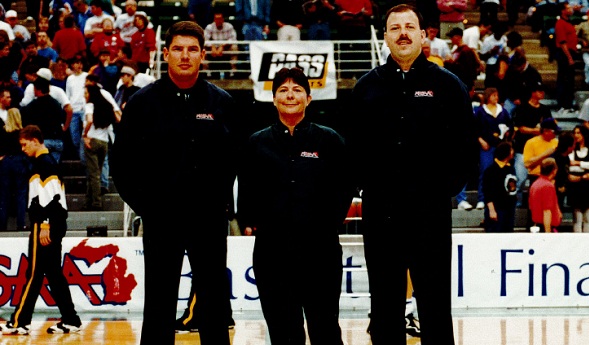
Beckett worked with Donald Gustafson and Todd Geerlings on the crew that called the 1995 Class C Boys Basketball Final. But that wasn't her first experience reffing the guys.
On top of officiating games at lower levels of the MHSAA tournaments, she also had begun reffing rec league games at the Y during the early 1980s. That might’ve come as a shock to some of those players – but she must’ve won them over, as now she helps build programs for their children and grandchildren.
During her nearly three decades at the Y, she’s developed women’s, men’s and co-ed softball leagues that have grown to include more than 1,500 players and a men’s recreational basketball league with more than 250 participants. Under her guidance, the YMCA’s Pop Warner football league has grown to become one of the largest in the Midwest with 2,500 players.
She also achieved another MHSAA first in 2000 when she became the first female selected for the Vern L. Norris Award for her work as an official.
“My purpose always has been to be an advocate for the officials and game participants,” Beckett said. “I try to be an active advocate all the time. And working for the Y too, we’re all about participation. My time 24 hours a day is actively advocating for game participants and officials.”
Beckett is a 1971 graduate of Mount Pleasant High School and a 1973 graduate of Northwestern Michigan College. She briefly left Traverse City after college before returning a few years later, and became involved with the thriving and close-knit recreational scene in her new hometown. She soon began working part-time at the YMCA, in charge of organizing its basketball program.
Her credo as program director is similar to that of the MHSAA – she creates programs for people who want to participate, and she works to give them the best possible experience in part by making sure the programs are managed by qualified officials.
But she’s also made it a priority to mentor and provide a positive influence to women and men both who are following in her paths.
“At times, it can be very intimidating to be one of the few women in our field. Barb has such an amazing relationship with those she works with and for. To tell you the truth, I can’t say if I know of anyone more well-liked and respected who does so many things,” said Heather Simpson, who coaches volleyball at Traverse City St. Francis, girls basketball at Traverse City Central and works for Beckett at the YMCA.
“I can’t imagine where I would be had I not been able to work and learn from someone like Barb Beckett. I work with young athletes currently, and I want for them to see that women can be a success in whatever they choose. We talk about choices in life. … I try each day to choose to do something positive. That’s what I learned from Barb. Women can make an impact. Women can make a difference. Barb has made such an impact in our area in the world of athletics. She has opened so many doors for so many women.”
Beckett also has worked three MHSAA Girls Basketball Finals and three Softball Finals, twice serving at the latter as umpire in chief, and was an alternate for a number of other championship games. She has officiated several Boys and Girls Basketball Semifinals and Softball Quarterfinals during her career, and continues to serve as president of both the Grand Traverse Area Umpires Association and the Northern Sports Officials Association. She also serves as an assigner of girls and boys basketball and softball officials in the Traverse City area, and was named to the Basketball Coaches Association of Michigan Hall of Honor in 2006.
Beckett also has served as commissioner of District 19 of the Michigan Amateur Softball Association since 1992, and has been instrumental in hosting four women’s, two men’s and one co-ed state final. She’s officiated both women and men’s MASA state finals and received that body’s Award of Excellence in 1996.
“Barb Beckett believes in how athletics and extracurricular activities can impact our kids and communities in such a positive way. So often when I am frustrated with how things are going and how everyone points fingers, she simply says to me, ‘Heather, be part of the solution, not part of the problem,’” Simpson said. “She reminds me that I can make a difference, just as she has with so many. We are in a society where it’s all about travel teams and what the scoreboard says; Barb is still old school and cares about the product she puts out there and the relationships that are formed from her work at the YMCA and in athletics. People like Barb, who care so much for those around her, get lost in the shuffle.
"Administrators call her, officials call her, coaches call her and parents call her for advice and simply just to talk. For me, she has done so many things to help me grow as a person, as a coach and a leader in our community. It's an honor to work for and with Barb Beckett. I truly think that each and every one of us could benefit from sitting in her office and just listening to her."
Past Women In Sports Leadership Award recipients:
1990 – Carol Seavoy, L’Anse
1991 – Diane Laffey, Harper Woods
1992 – Patricia Ashby, Scotts
1993 – Jo Lake, Grosse Pointe
1994 – Brenda Gatlin, Detroit
1995 – Jane Bennett, Ann Arbor
1996 – Cheryl Amos-Helmicki, Huntington Woods
1997 – Delores L. Elswick, Detroit
1998 – Karen S. Leinaar, Delton
1999 – Kathy McGee, Flint
2000 – Pat Richardson, Grass Lake
2001 – Suzanne Martin, East Lansing
2002 – Susan Barthold, Kentwood
2003 – Nancy Clark, Flint
2004 – Kathy Vruggink Westdorp, Grand Rapids
2005 – Barbara Redding, Capac
2006 – Melanie Miller, Lansing
2007 – Jan Sander, Warren Woods
2008 – Jane Bos, Grand Rapids
2009 – Gail Ganakas, Flint; Deb VanKuiken, Holly
2010 – Gina Mazzolini, Lansing
2011 – Ellen Pugh, West Branch; Patti Tibaldi, Traverse City
2012 – Janet Gillette, Comstock Park
PHOTO: Barbara Beckett stands between Todd Geerlings (left) and Donald Gustafson moments before becoming the first woman to officiate an MHSAA Boys Basketball Final in 1995.