

The Official View: The Crossroad We Face
By
Brent Rice
MHSAA Assistant Director
December 20, 2021
It’s time to call it what it is … a major crossroad and tipping point.
For more than a decade, the numbers of registered MHSAA officials have steadily declined from a high of about 13,000 to, today, around 7,700. While the COVID pandemic has certainly exacerbated those figures over the last two seasons, two of the top reasons officials give for leaving the avocation remains adult spectators and coach behavior.
School sports and traditional recreational programs have been supplemented, and in some cases, supplanted, by travel and club programs that, more often than not, do not share the same values and standards expected in education-based athletics. Many of these non-school programs require parents to spend exorbitant amounts in registrations fees, travel, lodging and meals with the implicit suggestion that this is the gateway to Division I college and professional sports. The result is that the criticisms hurled at the officials are more than an overzealous parent wanting a fair-called game – it is stakeholders defending their investments.
While we are often disturbed by some of the events documented during these club and travel contests, the real concern is that this permitted conduct has begun to seep into the school sports world. The result is that officials are simply walking away, leaving increasingly more games being moved or cancelled due to the lack of officials. The games that are being played are often staffed with smaller crews – perhaps two officials instead of three. Officials are in place to provide athletes with safe and fair opportunities to play sports, and shorthanded crews may reduce the ability for officials to see and call plays and fouls. These potential missed calls incite more disparaging comments from spectators, thus pushing more officials away from sports. This cycle cannot be sustainable much longer.
So, what are the solutions, and who do they come from?
The first is spectators. We refer to this as the difference between the whistle and the airhorn. When spectators just feel compelled to be vocally critical, they should make certain that their criticisms are infrequent, brief and not personal. Spectators should be the whistle and not the airhorn. Other spectators have a responsibility to set a good example and call out those who are going overboard.
School administrators also play a critical role in ensuring that officials are able to do their job in a safe and secure setting. Administrators should look for escalating situations in the stands and diffuse them before they become abusive. No one wants to remove parents and other spectators from events; but frankly, more of that needs to be done to show that inappropriate conduct and behavior will not be tolerated.
Finally, MHSAA officials need to be the first line of defense against unsportsmanlike behavior. This should be penalized when observed from coaches or players, without concern to the consequences that student or coach will later face. In short, bad behavior cannot be tolerated. Conduct found in the MHSAA Personal Attack Policy should result in an immediate ejection/disqualification, and similar conduct that occurs after the game should be handled as provided in the Post-Contest Ejection Policy. Unaddressed bad behavior by coaches and players encourages the same from spectators.
MHSAA game officials should focus their attention to the competition on the playing surface. This means that most comments from the stands should be ignored, and an official should never engage with critical spectators. This is not to say that officials must take abuse from spectators. If the language or behavior becomes a distraction to the contest, or personal and vulgar language is directed at the officials, the officials have the authority to have spectators removed from the facility (and should do so). No need for a big spectacle, ejection mechanic or yelling into the stands to engage fans. They should simply stop the contest and have the administrator on site remove the unruly spectator from the game.
There are a number of other factors contributing to the decline of officials that also need to be addressed. Low game fees, substandard locker room accommodations, unmanageable game times, and assigner and association politics all play a part. Those all pale in comparison to the main reason cited: Misbehavior by adults. MHSAA officials will inevitably continue to miss calls. That’s the nature of what they do. However, without them the games cannot be played, which means opportunities for Michigan students will also decline. We all have a responsibility to see that school sports remain closely tied to the values of educational athletics and maintain scope and perspective. We all must do better; otherwise, the crossroads of the officials shortage will only get worse.
It’s Official!
Postseason Assignments: Winter sport officials need to pay close attention to the changes for postseason consideration in effect this school year. Officials in most sports must opt into tournament consideration. This means officials this season for basketball, competitive cheer, gymnastics, ice hockey and wrestling must submit their availability on the MHSAA website – otherwise, the default is that they are unavailable. This is in addition to other postseason requirements such as completion of the rules meeting, the tournament exam and submission of the official’s regular-season schedule through the MHSAA website. These requirements are due by Dec. 15 for wrestling, Jan. 5 for basketball, Jan. 12 for competitive cheer and ice hockey, Jan. 19 for gymnastics and Jan. 26 for boys swimming & diving.
Seeking Committee Members: We are reconvening an ad hoc committee of educators/officials to assist with the development of curriculum that can be utilized by school districts for officiating classes in conjunction with the MHSAA Legacy Officials Program.
If you’re interested in serving on this committee (some in-person, but mostly virtual) and have a background as an educator, please reach out to [email protected].
Know Your Rules
BASKETBALL As Team A is preparing to make a throw-in from the end line, Team A players #15, #20 and #3 stand shoulder-to-shoulder next to each other immediately in front of the thrower. Team B player #11 requests to stand between two of the A players before the throw-in.
RULING Within three feet on the court from the throw-in, Team B players will be permitted to stand between the Team A players, if requested. If the Team A players were positioned more than three feet from the throw-in, this request would be denied.
It’s Your Call
REVIEW The play from the last It’s Your Call (found here) involved ball-handling by a back row volleyball player. Following a good dig by her teammate, the back row player appears to make contact with her left hand then right hand with her overhead pass. Since this is not the first contact on her side, the contact with the ball must be simultaneous with both hands. This is a multiple contact and a loss of point against white.
WRESTLING For the first time, the MHSAA will introduce a Girls Division into this year’s Individual Wrestling Finals. The following “It’s Your Call” takes place in a girls match but is applicable to the sport as a whole. Review the brief clip and let us know your thoughts. What’s the call?
Launching Pad and Destination
November 30, 2012
By Rob Kaminski
MHSAA benchmarks editor
Lamont Simpson’s “home” is a place he visits twice a week during his peak season, when NCAA Division I officiating duties have him navigating the Midwest like a person in a race for frequent flyer miles.
His travels pale in comparison to Stacey Thomas, who has lived in Latvia, Turkey and Sweden thanks to the game of basketball.
Then there’s Jim Garofalo, who authored his own cheat sheets to assist with the eight different rules books which intertwined during a period of time in his hockey officiating career, which included a trip to the Olympic Games.
So, naturally, there’s Simpson officiating an MHSAA Pre-District Football Playoff game in Detroit last fall, taking a postgame earful from a father who believed his son was the subject of a cheap shot during the game.
There’s Thomas, blowing a whistle with teenagers at the Healthy Kids Club in Detroit this summer
There’s Garofalo, ditching seven of the rules books over the last few years, and using only one now: the high school rules book.
It’s true that Simpson is at the pinnacle of his career, working Big Ten, Mid-American Conference and Horizon League men’s basketball, in addition to the WNBA in the summer, where he recently worked his eighth straight WNBA Finals.
And, yes, Thomas has her sights set on the NCAA Division I level and beyond, as her officiating career is still in its infancy.
Sure, Garofalo has achieved much on the ice both as an amateur and professional referee.
But, like so many in the officiating family, they deeply appreciate their roots and the people who helped them along the way. It’s a people business, first and foremost.
This week, continuing its "Making – and Answering – the Call" series, Second Half introduces Simpson, an officiating veteran of more than three decades. Profiles of Thomas and Garofalo will follow later this month.
It's about patience and honesty
The late June heat at the Kensington Valley Golf Course doesn’t seem to bother Lamont Simpson. The secret to his cool aura lies in his hand, a golf ball which he has identified as “Ref” in permanent marker.
Simpson is indeed a ref – permanently – thanks to a suggestion from Robert Menafee during the late 1970s, and the 1977 Detroit Redford grad has been most comfortable in the heat of competition’s spotlight ever since.
“I was at a football game at Henry Ford a year or two after high school, and Mr. Menafee, my former coach, saw me and asked what I was doing,” Simpson recalled. “He said I should try officiating. That’s the first I’d ever thought about it.”
It would be the impetus to a craft that has consumed nearly 30 years of Simpson’s life, as he now jets around the country as a top-flight NCAA Men’s Basketball official, and one of the senior officials in the WNBA, where he recently called his eighth consecutive Finals.
For all of his accomplishments, Simpson can still recall with great detail various moments that led to his current standing; mental snapshots which help to explain why he still registers as an MHSAA football official each year, and why he gives so freely of himself to anyone interested in getting a start in officiating.
“I still remember my first game, thinking, ‘I can’t believe I’m doing this,’” Simpson recalled. “In my second year I did a PSL (Detroit Public School League) playoff game, and to this day, walking into that gym is still one of my most gratifying times. There were about two or three thousand people in the stands, and I remember the butterflies.”
Fast forward to the Pontiac Silverdome in November 1992. In the waning seconds of the MHSAA Class A Football Final, a pigskin floats in the air doing its best butterfly imitation. Following a double-reverse pass, the tipped ball is finally corralled by Muskegon Reeths-Puffer’s Stacey Starr at the 10-yard line and carried into the end zone to give his school a 21-18 win over Walled Lake Western in one of the most frenzied finishes in MHSAA Finals history.
Simpson had a good view of the moment.
“I was the back judge, working my first MHSAA Final. My first thought is to get in position and then, ‘Oh man, the ball is tipped,’” Simpson replays in his mind. “You’re part of a game-ending situation and you don’t want to screw it up. You almost become a fan in a game like that—a moment like that—but you’ve got your job to do. Afterward, when it was all over, I just remember thinking, ‘What a football game I got to be a part of.’”
 Simpson would also get a shot as a Football Final referee in 2003, and worked the 1995 Boys Basketball Final which featured Flint Northern’s team led by future MSU Spartans Mateen Cleaves and Antonio Smith. But, Simpson remembers that game for a different reason.
“It was the last time that the Final was worked with a two-person crew.” Simpson said. “I remember the great athletes in the game, and being part of history as the last two-man crew in the Finals is something to be proud of.”
Simpson is quick to point out, however, that simply having what it takes to officiate an athletic event at any level is something of which to be most proud. While it’s natural for new officials to covet championship assignments and careers beyond the high school level, Simpson stresses patience, hard work, and – in many cases – honesty with one’s own performance as the most valuable traits an official can possess.
“I work and speak at a lot of camps, and I stress that people need to work at the craft – mechanics, rules, physical appearance – and above all have patience.” Simpson said. “The thing I see in younger officials now that is so different than when I was coming in, is they don’t have the patience; they don’t want to pay their dues.”
Sometimes, even the greatest amount of patience, perseverance and hard work isn’t enough. And, that’s where honesty in self-evaluation comes in. Yes, there are egos in officiating. To some extent, it’s a prerequisite. However, humility can also lead to finding a niche in the game.
Simpson himself is an example.
“My goal was to work in the NBA, but after seven years in the CBA, I realized that it probably wasn’t going to happen,” he said. “But, you know, there was still a lot of good basketball out there to work. When I left the CBA, I did so on my own terms, and went to work on my college career. So, sometimes you weigh your options and focus on the next goal.
“The point is, work at being the best at whatever level you work. I’ve seen guys spend a lot of money at the same camps year after year, and never get that college assignment,” Simpson said. “Maybe it’s time for them to focus on a different level.”
In that respect, the very thing that drives officials and gets them in the game in the first place can by the very thing that drives them out. Passion and drive, the need to reach the next level, can keep people focused in their chosen quest; the frustration of not advancing can also lead to their exit.
True, Simpson is one of 32 officials in the WNBA, and just worked his eighth WNBA Final. He has a full NCAA Division I men’s basketball schedule. But, the father of three grown children and grandfather of five cannot express enough the fringe benefits that officiating brings at any level.
“You become a better people person through officiating. Your communication skills are sharper,” he says. “Not only what to say and when to say it, but you learn to listen. You have to be a listener in this business, and that’s a great skill to have in life.”
It also provides the opportunity to be a teacher and recruiter. It’s one of the reasons he’s closing in on nearly three decades as an MHSAA registered official. What better way to pass the knowledge forward?
“No matter where you end up, always remember where you started, and keep your friends,” Simpson said. “I return every call, every text. I still talk to the same guys I grew up with. From an officiating standpoint if we could all just bring along one person at a time, think of the effect that would have.”
Simpson does more than his share, from speaking at camps and clinics – all voluntarily, mind you – to the behind the scenes recruitment, such as the time he surrendered all of his baseball umpiring equipment to a friend under the condition that person register with the MHSAA and begin working games.
He thinks back to the suggestion from Coach Menafee frequently. “Oh, all the time,” Simpson said. “I think of the places I’ve been, the things I’ve seen, the people I’ve met and the person I’ve become. This is what being an official does.”
There’s a scenario that Simpson replays time and again when he talks of officiating, and it doesn’t pertain to his collegiate or professional experience. In fact, it’s not even about basketball.
“It’s Friday night, and you’re working the big rivalry game between two communities. You get on the field, the bleachers are packed, the bands are playing, and you’re right in the mix,” Simpson says with reverence. “That’s it right there. It doesn’t get much better than that. That’s it.”
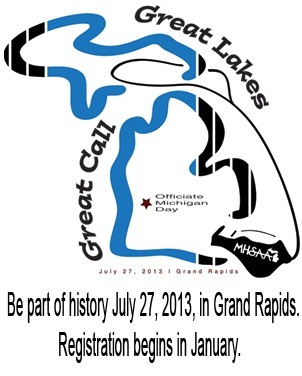
PHOTO: Lamont Simpson officiates WNBA games during the summers, including this contest involving the Atlanta Dream and player Erika de Souza (14).
NOTE: This is the fifth installment in the series "Making – and Answering – the Call" detailing the careers and service of MHSAA officials. Click the links below to view the others.