

The Official View: The Next Generation
By
Brent Rice
MHSAA Assistant Director
October 27, 2020
By Brent Rice
MHSAA Assistant Director
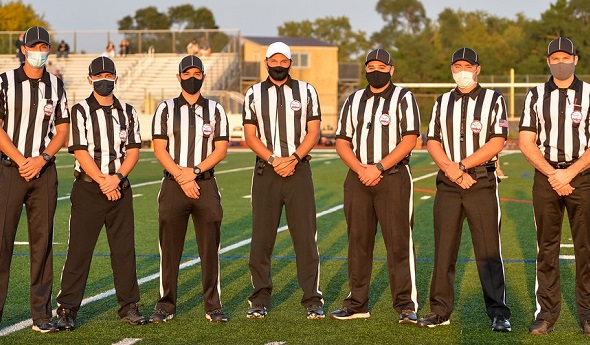
At a time when we continually hear about the aging population of our veteran officials, it is refreshing to have an entire varsity crew made up of officials under 30.
 The MHSAA continues to push to recruit the next generation of officials. Current officials can do their part by signing up someone new each year … and of any age.
We kick of our October installment of “The Official View” with this photo of one of those up-and-coming crews.
Pictured above (left to right) are Nick Wallace, Joey Lapinski, Dan Dobrosielski, Nick Meyer, Zach Ferguson, Austin White and Kevin Klein.
It’s Official!
Postseason assignments: Officials in cross country, football, soccer, swim and volleyball are being notified of their postseason assignments. Especially during a year when it has been difficult to find officials to conduct our sports safely and fairly, we appreciate all of those who have been able to put on the uniforms for both the regular and postseason. For those who were not able to officiate this year, we understand; and we look forward to having you back as soon as we can get back to normal.
Meetings & exams: Rules meetings for winter sports have been released, and tournament exams will soon follow. Please make sure to mark Dec. 10 on your calendar as the date when winter postseason eligibility requirements are due for officials.
Guidelines: Officials for all sports can keep up-to-date on facial covering requirements by CLICKING HERE, and stay current on policies for your specific sport by going to the sport-specific officials page of the MHSAA website.
Know Your Rules
SWIMMING For an event requiring a forward start, a swimmer requests permission to start in the water.
Ruling: This is permissible. In order to remain legal though, the swimmer must enter the pool feet first.
It’s Your Call
Last month’s IYC involved a trick play with Team A players leaving the playing field. First this is a no goal, and each of the players that left without the permission of the official should receive a yellow card. However, since the cards occurred during a stoppage of play, and before the kick was made, Team A retains the corner kick when play resumes.
VOLLEYBALL The newest “It’s Your Call” comes from the volleyball court. Team A’s kill attempt is blocked back to its side of the net. As the ball is about to hit the floor, A13 lunges her leg out and kicks the ball in the air. Then, the libero instinctively kicks her leg out, doing the same. Finally, A3 makes a diving dig back to the other side of the net. The ball lands in, near Team B’s end line. What’s the call?
The Official View: What’s in a Uniform
Officials in most sports are identified by the style of their shirts. Soccer referees are well-known for wearing shirts in a variety of bright, stunning colors. For many years, baseball umpires were so closely identified with the color of their uniform tops, they were (and often still are) contemptibly referred to as “Blue.”
But perhaps there is no more iconic uniform shirt than the black and white stripes worn by officials in a number of sports over the last century. In fact, this easily recognizable pattern associated with referees has its origins in Michigan high school sports.
That’s right, the first reported occurrence of any official wearing stripes goes back to the 1921 Michigan high school basketball finals. That referee was Lloyd Olds, and he was a multi-sport official out of Ypsilanti. The idea came to him following an unfortunate incident in a college football game when the Arizona quarterback mistook Olds as a teammate and threw him the football. You see, the Arizona team wore white uniforms, and were very similar looking to Olds’ own officials uniform – consisting of black slacks and a white dress shirt with bow tie. It became apparent to him that officials should wear a uniform that distinguished them from the teams.
When Olds returned home, he sat down with friend and sporting goods store owner, Greg Moe, to design the first black-and-white striped uniform. He decided to pull the uniform shirt out of the closet for the final game of the high school basketball postseason, and soon began wearing it when he worked both basketball and football.
This new outfit quickly caught on at both the high school and college levels, and it wasn’t long before this became the norm around the world and across all levels. While officials’ uniforms regularly change these days, some form of stripes will likely be around forever – and it all started with a Michigan high school official.
If you have an interesting story or an official you’d like to see promoted, send details and pictures to [email protected].

Supporting Sports Officials
February 20, 2015