

The Official View: Night with the Crew
By
Brent Rice
MHSAA Assistant Director
October 1, 2018
By Brent Rice
MHSAA Assistant Director
In this week’s edition we discuss the power of our words and delivering them proactively, examine a football rule regarding rushing the punter and take a look at an “It’s Your Call” at the volleyball net.
It’s Official!
The Words We Use: Officials face criticisms regularly for their rule enforcement, judgment decisions and even positioning. As we know, these criticisms will be tossed about whether you get plays and rulings correct or not, so there is very little we can control in this area. One area we can control the criticisms we receive is the way we speak to others.
I’ve heard people say, “I’ll give them respect when they earn it.” If that’s your line of thinking, maybe you should consider giving respect simply because it’s the right thing to do. The way you communicate as an official to coaches, players and administrators reflects on you professionally, and often is a determining factor on how these parties view you in carrying out the rest of your responsibilities. If they think you’re a bad person, they often don’t give you the benefit of the doubt in close-call situations.
There are a number of books written on the art of diffusing situations through the words you use. One that immediately comes to mind is “Verbal Judo” by George Thompson. It is rather succinct and definitely worth the read. It provides much more detail on the philosophy of word usage, but let me provide you with a couple of seemingly innocuous phrases that can draw the ire of a coach and should be avoided:
“Well, that’s the rule” – Rules citation is very important when providing explanations, but simply stating that the rule says so sounds flippant and is looked at as a cop-out. Instead, start with “By rule,” then use rulebook terminology to describe the situation and ruling.
“Calm down” – While this is much better than the cringe worthy “Shut up” or “Hush” we hear being used from time to time, it still can provoke a primal urge to respond and can actually have the opposite effect of what is intended. Instead, try getting the results you desire by having them talk it through. Try statements like “All right, I’m listening to you,” or “Okay, explain to me what you’re asking.” And when using a phrase like “calm down,” trying adding an “if” statement along with it. For instance, “I’ll explain to you what I have if you calm down.”
Rule of the Week
FOOTBALL Team R loads up the box with rushers to put pressure on K’s punt deep in its own zone. As K1 punts, R1, coming from the center of the line, just gets fingers on the ball and partially blocks it. R2, from the edge, then firmly contacts the kicker’s plant leg and sends him to the ground.
Ruling: This is not a foul (in itself). The rulebook does not provide that only the player who touches the kick is excused from contacting the kicker. This exception to the rule refers only to when “the defense touches the kick.” (9-4-5-b) Of course, this does not give carte blanche to defensive players to go out of their way to unnecessarily rough the kicker just because the ball is touched.
It’s Your Call
VOLLEYBALL The clip from this week picks up after an extended volley. As Team S plays the ball over the net for its third hit, a front row member of Team R makes a play on the ball. The questions is, are the two contacts by the front row R player legal? Why or why not?
Last Week’s IYC Ruling: The basic spot on the play is the end of the run. Using the all-but-one principle, this foul would be penalized from the spot of the foul (A’s 35). If the defense accepts the penalty, it would be A’s ball, 3rd-and-27 on A’s 20. If the defense declines, it would be 4th-and-8 on A’s 39. This is definitely an instance that you want to run the options by B’s coach before enforcing the penalty. (Click to see the video from last week.)
Official View
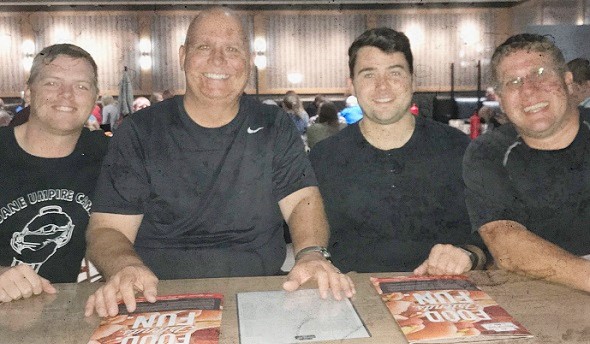
After a long, hard-fought Friday night contest between Rockford and Greenville, crew members (left to right) Dale Feutz, Brian Donovan, Sam Boland, and Luke Griemsman stop in at a local Rockford eatery to discuss the night’s game over a meal.
Be the Referee: Sideline Management
December 5, 2014
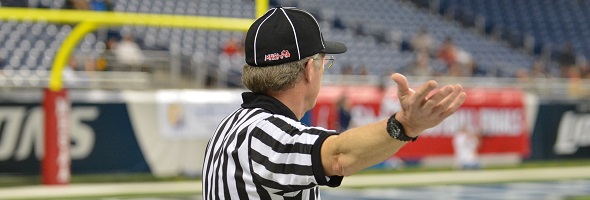
This week, MHSAA assistant director Mark Uyl dicusses how the sideline rule helps to keep the adults working in football, including coaches and officials, safe during football games.
"Be the Referee" is designed to help educate people on the rules of different sports, to help them better understand the art of officiating and to recruit officials. The segment can be heard on Mondays, Wednesdays and Fridays during the school year on The Drive With Jack Ebling on WVFN-AM, East Lansing.
Below is this week's segment - Sideline Management - Listen
The hottest topic right now in the sport of football deals with safety. We have talked a great deal over the fall about some new rules that have improved player safety. Today we’re going to focus on the adults - specifically coaches and officials that work at the sideline area just in front of the team box.
The rules require that from the time just before the snap until the end of the play, all coaches and team personnel must be completely out of the 6-foot safety zone located in front of the team box at each sideline. This then gives the official plenty of room to work unimpeded in either direction.
Now as soon as the play ends, coaches can move into this area to instruct their players or send in the next play and then move back prior to the next snap.
Past editions
Nov. 19 - 7-Person Mechanics - Listen
Nov. 12 - Blocking Below the Waist - Listen
Nov. 5 - Tournament Selection - Listen
Oct. 29 - Uncatchable Pass - Listen
Oct. 22 - Preparation for Officials - Listen
Oct. 15 - Automatic First Downs - Listen
Oct. 8 - Officials & Injuries - Listen
Oct. 1 - Overtime - Listen
Sept. 25 - Field Goals - Listen
Sept. 18 - Tackle Box - Listen
Sept. 11 - Pass Interference - Listen
Aug. 25 - Targeting - Listen