

The Official View: Official Thanks
By
Brent Rice
MHSAA Assistant Director
September 13, 2021
A return to the start of another school year means a return to school sports contests – and what separates those contests from simply being kids playing a pick-up game is the attendance of assigned officials.
The steady declining trend of MHSAA registered officials was accelerated last year in the complicated world of facemasks, testing and late cancellations, when the MHSAA lost nearly 15 percent from its previous year’s ranks. Now that we have returned to some (relative) normalcy, it’s more important than ever to recognize those officials who allowed athletes to play a season last year and to welcome back those who had to take the season off.
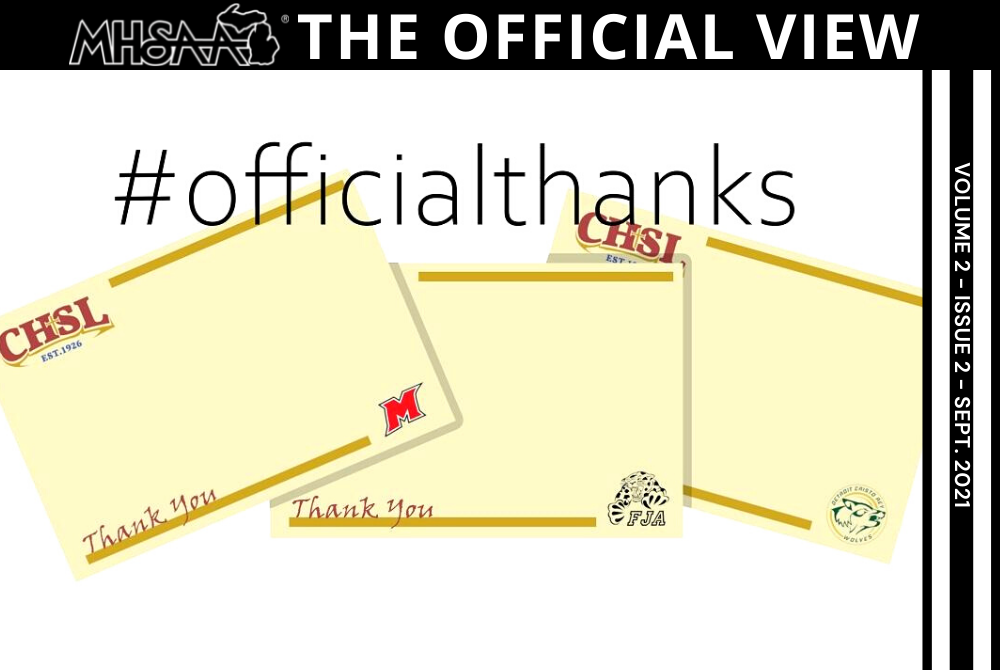
A new program being instituted in Detroit’s Catholic High School League does just that. This year, CHSL schools will be presenting officials throughout the season with “thank you” cards to express their gratitude for the dedication and hard work these individuals provide to ensure students have an opportunity to compete.
These gestures of appreciation serve to retain officials by recognizing how important they are to the game, and to recruit new officials by showing that officiating is an honorable avocation that allows them to serve the community and stay in athletics.
The MHSAA will be rolling out a new Game Day Ambassadors Program in Spring 2022 which will include similar ideas for increasing the morale of officials and developing long-lasting, cooperative relationships between schools and officials. Some of the ways outlined include:
► “Thank an Official” events where the team and spectators recognize the officials in their community.
► Adding alternative “compensation” to officials by occasionally providing promotional items, small gift certificates from local businesses and eateries, and snacks and refreshments in the locker room.
► Presenting mid-game sportsmanship PSAs.
► Regularly reviewing officials game fees to ensure that officials are being fairly paid for their work.
The most surefire way to recruit and retain officials is to treat them with respect. The No. 1 reason given for individuals leaving officiating is negative behavior and treatment by adult spectators and coaches. These folks that give up their time to officiate school contests do so by scheduling around their day jobs, family commitments and other personal responsibilities. They are required to make real-time, split-second decisions in a world filled with zoomed in and slow-motion video, social media and camera phones at every turn, but without the luxury of replay review. And in the end, they aren’t paid nearly the amount as their college and professional counterparts.
Maintaining reasonable perspective and expectations is a core value in educational athletics … and it should be with the officials as well.
Thank you, MHSAA officials, for your commitment to school sports, and thank you to the Catholic League and others willing to acknowledge the same.
It’s Official!
Postseason Assignments: A number of changes have been instituted for postseason consideration over the past few years. Notably this year, officials in most sports must opt into tournament consideration. This means officials this season for football, soccer and volleyball must submit their availability in the MHSAA website – otherwise the default is that they are unavailable. This is in addition to other postseason requirements such as completion of the rules meeting, the tournament exam and submission of the official’s regular-season schedule through the MHSAA website. These requirements are due by Sept. 15 for soccer and volleyball, Sept. 22 for football and Oct. 6 for girls swimming & diving.
Officials Review Committee: The Officials Review Committee is scheduled to convene the first week of October to discuss issues and make proposals. Agenda items this year include volleyball and swim uniforms, video review, officials fees, sport committees including officials, registration fee deadlines and the basketball District officials assignment process. An update on these subjects will be provided in next month’s Official View.
Know Your Rules
VOLLEYBALL Team A’s server steps on the end line before contacting the ball in her serve. As she makes contact with the ball, CB (center back) and RB (right back) on Team R are overlapping.
Ruling: When the server illegally contacts the ball while in contact with the floor on the end line, the ball remains dead. Even though Team R is out of position on the play, the ball never became live, and so the foot fault is enforced and it is a loss of rally/point against Team A.
It’s Your Call
FOOTBALL This month’s It’s Your Call comes on a play from the gridiron. As Team A’s lead blocker comes around the end, Team B’s No. 17 moves up to take him on at the A 32-yard line. The ballcarrier is sprung for another eight or nine yards before being tackled. What’s the call?
Be the Referee: Sideline Management
December 5, 2014
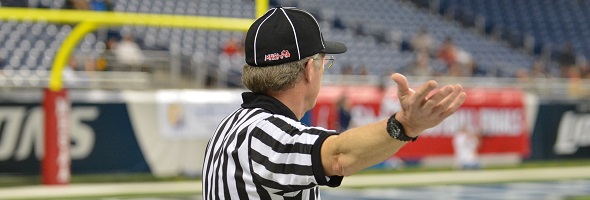
This week, MHSAA assistant director Mark Uyl dicusses how the sideline rule helps to keep the adults working in football, including coaches and officials, safe during football games.
"Be the Referee" is designed to help educate people on the rules of different sports, to help them better understand the art of officiating and to recruit officials. The segment can be heard on Mondays, Wednesdays and Fridays during the school year on The Drive With Jack Ebling on WVFN-AM, East Lansing.
Below is this week's segment - Sideline Management - Listen
The hottest topic right now in the sport of football deals with safety. We have talked a great deal over the fall about some new rules that have improved player safety. Today we’re going to focus on the adults - specifically coaches and officials that work at the sideline area just in front of the team box.
The rules require that from the time just before the snap until the end of the play, all coaches and team personnel must be completely out of the 6-foot safety zone located in front of the team box at each sideline. This then gives the official plenty of room to work unimpeded in either direction.
Now as soon as the play ends, coaches can move into this area to instruct their players or send in the next play and then move back prior to the next snap.
Past editions
Nov. 19 - 7-Person Mechanics - Listen
Nov. 12 - Blocking Below the Waist - Listen
Nov. 5 - Tournament Selection - Listen
Oct. 29 - Uncatchable Pass - Listen
Oct. 22 - Preparation for Officials - Listen
Oct. 15 - Automatic First Downs - Listen
Oct. 8 - Officials & Injuries - Listen
Oct. 1 - Overtime - Listen
Sept. 25 - Field Goals - Listen
Sept. 18 - Tackle Box - Listen
Sept. 11 - Pass Interference - Listen
Aug. 25 - Targeting - Listen