


'Officiate Michigan Day’ to Draw 1,100
July 23, 2013
More than 1,100 Michigan High School Athletic Association officials are scheduled to attend “Officiate Michigan Day” on Saturday, July 27, at the DeVos Place Convention Center in Grand Rapids, where they will receive training from 40 of the best in the officiating field.
Officials representing the amateur, collegiate and professional ranks will speak and provide training during four instructional workshops throughout the day plus additional sessions mid-day and at the end of the afternoon. “Officiate Michigan Day” is the kickoff event to the National Association of Sports Officials’ (NASO) annual Sports Officiating Summit, which will follow July 28-30 in Grand Rapids.
MHSAA Executive Director John E. “Jack” Roberts and Barry Mano, founder and president of NASO, will give the opening address. Four-time Super Bowl official Jerry Markbreit will speak to close the event. Four instructional sessions will focus on sport-specific training in officiating the following: baseball, basketball, competitive cheer, football, gymnastics, lacrosse, ice hockey, soccer, softball, track & field, volleyball and wrestling.
 “We’re expecting this to be one of the largest gatherings of sports officials ever held in the United States,” said MHSAA assistant director Mark Uyl, who oversees the association’s officials program. “It will be a historic day of learning and training for our officials.”
Among scheduled clinicians are current National Basketball Association officials Joe Crawford and Bill Kennedy, NCAA National Coordinator of Volleyball Officials Joan Powell, National Hockey League Senior Vice President and Director of Officiating Terry Gregson and official Dan O’Halloran, and National Football League officials Perry Paganelli, Carl Paganelli, Jr., and Dino Paganelli. All three Paganellis have officiated Super Bowls, and O’Halloran is coming off working his fourth straight Stanley Cup Final. Crawford and Kennedy both officiated during the recent NBA Finals, and Powell also served as team leader of the U.S. women’s national volleyball team that won the silver medal at the 2008 Olympics.
“Officiate Michigan Day” is open to all officials, including those not registered with the MHSAA, and cost to attend is $35. It is recommended officials sign up online by 5 p.m. Thursday, July 25. Click to register for the conference or see the schedule and list of presenters and clinicians.
The MHSAA is a private, not-for-profit corporation of voluntary membership by more than 1,500 public and private senior high schools and junior high/middle schools which exists to develop common rules for athletic eligibility and competition. No government funds or tax dollars support the MHSAA, which was the first such association nationally to not accept membership dues or tournament entry fees from schools. Member schools which enforce these rules are permitted to participate in MHSAA tournaments, which attract approximately 1.6 million spectators each year.
Be the Referee: Hockey Equipment
January 24, 2019
This week, MHSAA assistant director Brent Rice discusses the need to monitor the proper wearing of the ice hockey neck guard.
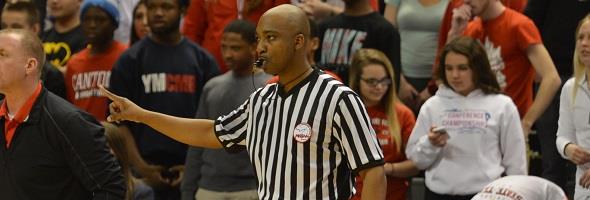
Be The Referee is a series of short messages designed to help educate people on the rules of different sports, to help them better understand the art of officiating, and to recruit officials.
Below is this week's segment – Required Hockey Equipment - Listen
A number of sports require certain equipment be worn, and be worn unaltered. In ice hockey, one such piece of equipment is the neck guard.
This is something not very well understood. And it’s not just that some players try to either not wear the neck guard or alter it – resulting in a team warning if caught – but that upwards of half of the neck guards on the ice on any given night of high school play are actually altered. Common alterations are putting tape around the guards, removing padding and wearing the donut style way below the collar bone.
Coaches, officials, players, parents and administrators have to treat this risk management issue more seriously than they are now to make the game as safe as it can possibly be.
Past editions
January 17: You Make the Call: 10-Second Clock - Listen
January 10: Tripping in Hockey - Listen
January 3: Sliding in Basketball - Listen
December 27: Stalling in Wrestling - Listen
December 20: Basketball: You Make the Call - Listen
December 13: Basketball Uniform Safety - Listen
December 6: Coaching Box Expansion - Listen
November 29: Video Review, Part 2 - Listen
November 22: Video Review, Part 1 - Listen
November 15: You Make the Call - Sleeper Play - Listen
November 8: 7-Person Football Crews - Listen
November 1: Overtime Differences - Listen
October 25: Trickery & Communication - Listen
October 18: Punts & Missed Field Goals - Listen
October 11: What Officials Don't Do - Listen
October 4: Always 1st-and-Goal - Listen
September 27: Unique Kickoff Option - Listen
September 20: Uncatchable Pass - Listen
September 13: Soccer Rules Change - Listen
September 6: You Make the Call: Face Guarding - Listen
August 30: 40-Second Play Clock - Listen
August 23: Football Rules Changes - Listen