


'Officiate Michigan Day’ to Draw 1,100
July 23, 2013
More than 1,100 Michigan High School Athletic Association officials are scheduled to attend “Officiate Michigan Day” on Saturday, July 27, at the DeVos Place Convention Center in Grand Rapids, where they will receive training from 40 of the best in the officiating field.
Officials representing the amateur, collegiate and professional ranks will speak and provide training during four instructional workshops throughout the day plus additional sessions mid-day and at the end of the afternoon. “Officiate Michigan Day” is the kickoff event to the National Association of Sports Officials’ (NASO) annual Sports Officiating Summit, which will follow July 28-30 in Grand Rapids.
MHSAA Executive Director John E. “Jack” Roberts and Barry Mano, founder and president of NASO, will give the opening address. Four-time Super Bowl official Jerry Markbreit will speak to close the event. Four instructional sessions will focus on sport-specific training in officiating the following: baseball, basketball, competitive cheer, football, gymnastics, lacrosse, ice hockey, soccer, softball, track & field, volleyball and wrestling.
 “We’re expecting this to be one of the largest gatherings of sports officials ever held in the United States,” said MHSAA assistant director Mark Uyl, who oversees the association’s officials program. “It will be a historic day of learning and training for our officials.”
Among scheduled clinicians are current National Basketball Association officials Joe Crawford and Bill Kennedy, NCAA National Coordinator of Volleyball Officials Joan Powell, National Hockey League Senior Vice President and Director of Officiating Terry Gregson and official Dan O’Halloran, and National Football League officials Perry Paganelli, Carl Paganelli, Jr., and Dino Paganelli. All three Paganellis have officiated Super Bowls, and O’Halloran is coming off working his fourth straight Stanley Cup Final. Crawford and Kennedy both officiated during the recent NBA Finals, and Powell also served as team leader of the U.S. women’s national volleyball team that won the silver medal at the 2008 Olympics.
“Officiate Michigan Day” is open to all officials, including those not registered with the MHSAA, and cost to attend is $35. It is recommended officials sign up online by 5 p.m. Thursday, July 25. Click to register for the conference or see the schedule and list of presenters and clinicians.
The MHSAA is a private, not-for-profit corporation of voluntary membership by more than 1,500 public and private senior high schools and junior high/middle schools which exists to develop common rules for athletic eligibility and competition. No government funds or tax dollars support the MHSAA, which was the first such association nationally to not accept membership dues or tournament entry fees from schools. Member schools which enforce these rules are permitted to participate in MHSAA tournaments, which attract approximately 1.6 million spectators each year.
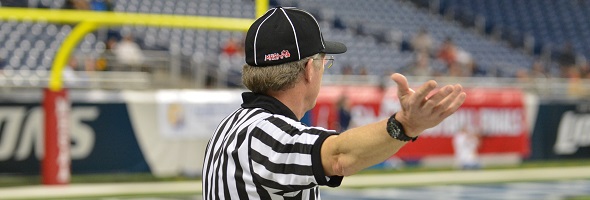
Be the Referee: Always Stay Registered
September 14, 2017
This week, MHSAA assistant director Mark Uyl relays a quick story of how a retired NFL official stepped in to give a pair of junior varsity teams a chance to play another game this season.
Be The Referee is a series of short messages designed to help educate people on the rules of different sports, to help them better understand the art of officiating, and to recruit officials.
Below is this week's segment – Always Stay Registered - Listen
As Thursday night of Labor Day weekend arrived, with a full slate of football games having long been scheduled, a late junior varsity game was added at the last minute.
The problem was that most officiating crews had already been assigned to other games months in advance.
That’s when one of Michigan’s most decorated officials, retired NFL and three-time Super Bowl official Dean Look, stepped up to help out. Dean, along with four other area officials, put together a crew for that night, so these two junior varsity teams could play.
Many officials from our state who have moved up the ladder to the college and professional ranks have kept their MHSAA registration current to help out on nights like this at the last minute.
Past editions
September 7: Other Football Rules Changes - Listen
August 31: Pop-Up Onside Kicks - Listen
August 24: Blindside Blocks - Listen