

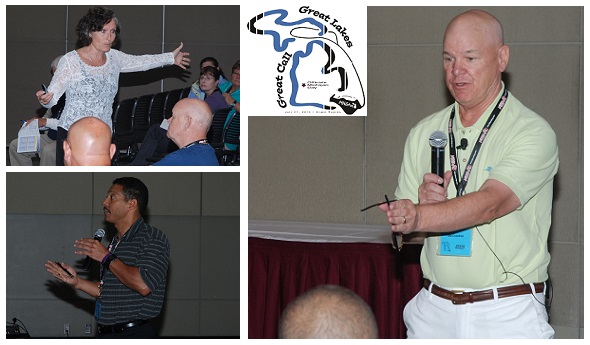
'Officiate Michigan Day' Welcomes 1,200
By
Geoff Kimmerly
MHSAA.com senior editor
July 27, 2013
GRAND RAPIDS – April Martin aspires to move up the college basketball officiating ladder. Receiving an NCAA Tournament assignment someday is a dream.
So she spent the first half of Saturday's "Officiate Michigan Day" at DeVos Place in Grand Rapids receiving tips and learning what it takes to get to the top from two of the most respected referees in her field -- NBA Finals veterans Joe Crawford and Bill Kennedy.
Crawford and Kennedy were two of more than 40 officials representing the professional, college and high school levels who passed on their expertise to Martin and a total of 1,248 officials who attended Saturday's event, believed to be one of the largest gatherings of sports officials in U.S. history.
Officiate Michigan Day was a cooperative effort by the National Association of Sports Officials and Michigan High School Athletic Association in advance of the NASO annual summit, which kicks off Sunday in Grand Rapids.
"It's just a great day to be a Michigan official," said Martin, a 1997 Detroit Renaissance grad who currently officiates at the high school, junior college, NAIA and NCAA Division III levels. "Seeing your family, which is referees, … it was great seeing everyone here just knowing that everyone is trying to get something out of this day."
Officials from all corners of both peninsulas received the opportunity to learn and interact on a variety of topics and with a variety of officials regarded at the top of their respective fields in Michigan and in some cases nationally.
Sport-specific sessions provided training for officials working in baseball, basketball, competitive cheer, football, gymnastics, lacrosse, ice hockey, soccer, softball, track & field, volleyball and wrestling. Joining Crawford and Kennedy among the best-known instructors and speakers were NCAA National Coordinator of Volleyball Officials Joan Powell, National Hockey League Senior Vice President and Director of Officiating Terry Gregson and official Dan O’Halloran, and National Football League officials Perry Paganelli, Carl Paganelli, Jr., and Dino Paganelli.
 All three Paganellis have officiated Super Bowls, and O’Halloran is coming off working his fourth straight Stanley Cup Final. Crawford and Kennedy both officiated during the recent NBA Finals, and Powell also served as team leader of the U.S. women’s national volleyball team that won the silver medal at the 2008 Olympics.MHSAA Executive Director John E. “Jack” Roberts and Barry Mano, founder and president of NASO, gave the opening address to a packed DeVos Center ballroom. Four-time Super Bowl official Jerry Markbreit addressed the entire group to close the afternoon.
"I hope you appreciate what you got here today," said Bill Topp, a presenter Saturday and vice president of publishing and management services for NASO and Referee magazine. "It's not just about the volume of people. It's the types of people you have here and the interaction that's going on and the fact that you've got sports talking to each other where they normally don't talk."
Martin learned but also taught. She sat on the "Officiating 101" panel that discussed issues for new officials, one of 13 lunchtime workshops on topics ranging from life in the NBA to female officials recruitment to outside views on high school officiating.
Marquette's Mark Petrie was one of a small group of officials who made the trip from the Upper Peninsula, and he spent his lunch hour listening to a round table discussion on "Making Good Associations Great." An MHSAA official since 1993, he's the trainer for volleyball for the Upper Peninsula Officials Association.
"It's an opportunity to get together with fellow officials, but more importantly an opportunity to learn and grow as an official," Petrie said. "The day any of us thinks we know everything is the day we should retire."
Commonality was a theme throughout the inaugural Michigan day, with presenters sharing mechanics and strategies that apply at every level of athletics. Equally emphasized was the responsibility of officials to take what they learned back to their local colleagues while working to recruit new officials to the ranks.
"This is pretty unique in that we have this many officials, both men and women, coming together in one place. We have a common theme to improve officiating and to make it consistent at the high school level," said DeWitt's Mike Brya, a high school official since 1995.
"I want to first off be a better official, but also to help our association. To help our officials, help our younger officials, and try to give back as much as I can.
NASO reported on its website that only Georgia's officiating day in 2011, with 1,600 participants, has outdrawn Michigan for a similar event.
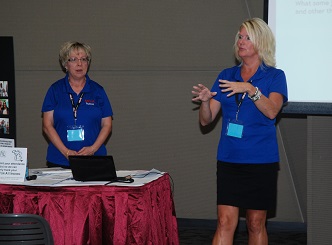
PHOTOS: (Top) Clockwise from top left, Joan Powell, Joe Crawford and Bill Kennedy were among speakers at Saturday’s “Officiate Michigan Day.” (Middle) Cheer officials Candy Cox (left) and Stacy Smith present during a breakout session. Click to see more photos from Saturday's event.
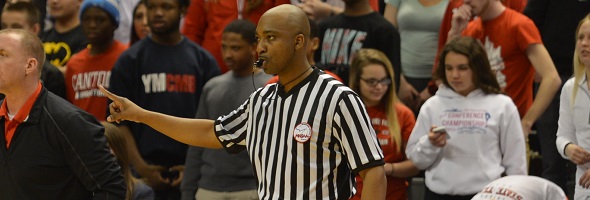
Be the Referee: Basketball Announcers
February 4, 2015
This week, MHSAA assistant director Mark Uyl explains the proper role of high school basketball public address announcers.
Be The Referee is a series of short messages designed to help educate people on the rules of different sports, to help them better understand the art of officiating, and to recruit officials.
Below is this week's segment - Basketball PA Announcers - Listen
Whenever there are rules changes in any sport, we usually think of the three groups that are most affected by those changes – obviously, the players, the coaches and the referees. This year in basketball, an additional group is receiving some attention from the rules makers, and those are the public address announcers.
At the college and pro levels, the P.A. Announcers are almost taking on a life of their own. They are seen in their communities and their towns as the home team’s biggest fan.
At the high school level, a good P.A. Announcer gives attention to both teams – the kids from both the home team and the visiting team – that do things that are noteworthy during the game. A P.A. Announcer should be there first to inform – not to entertain – and keeping sportsmanship at the forefront of every game.
Past editions
Jan. 26 - Wrestling Health Concerns - Listen
Jan. 19 - Basketball Physical Contact - Listen
Jan. 12 - Video Review Part 2 - Listen
Dec. 29 - Video Review Part 1 - Listen
Dec. 17 - Registration Part 2 - Listen
Dec. 10 - Registration Part 1 - Listen
Dec. 3 - Legacy Program - Listen
Nov. 26 - Sideline Management - Listen
Nov. 19 - 7-Person Mechanics - Listen
Nov. 12 - Blocking Below the Waist - Listen
Nov. 5 - Tournament Selection - Listen
Oct. 29 - Uncatchable Pass - Listen
Oct. 22 - Preparation for Officials - Listen
Oct. 15 - Automatic First Downs - Listen
Oct. 8 - Officials & Injuries - Listen
Oct. 1 - Overtime - Listen
Sept. 25 - Field Goals - Listen
Sept. 18 - Tackle Box - Listen
Sept. 11 - Pass Interference - Listen
Aug. 25 - Targeting - Listen