

Payne Game Recalls Official's Legacy
September 9, 2014
By Geoff Kimmerly
Second Half editor
At 4:30 p.m. before the first game of this high school football season, a small group of mid-Michigan officials met at Lansing’s Mount Hope Cemetery.
As has become their tradition, they paid respects to a friend gone too soon, told a few stories, then worked the game in his honor before winding down by rehashing more of the same memories of Tony Payne they recall at the start of each fall.
Payne, a Lansing Harry Hill High School and Ferris State University graduate, served as an MHSAA official for 23 years and also worked in the Big Ten, Mid-American Conference and NFL Europe before dying on April 21, 2006. He was only 44 years old, passing after a lengthy illness.
Each fall since, a group of officials mostly from the Lansing area but representing Jackson and Muskegon as well have gathered to work a “Tony Payne Game,” mostly to honor their friend but also to raise money in his name for a scholarship that could be awarded for the first time next year.
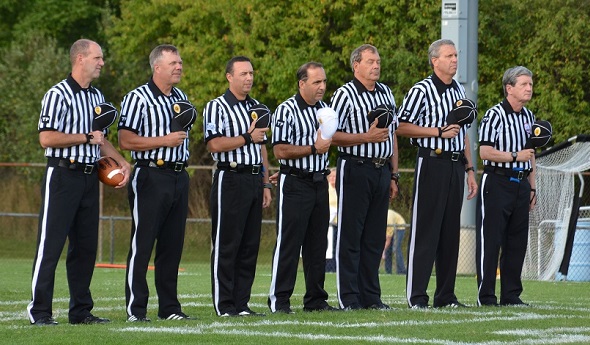
This year’s Payne Game was opening night, Aug. 28, at Haslett as the Vikings took on Walled Lake Central.
“Tony was a mentor to everybody; he pretty much epitomized what we try to do around here,” said Jeff Spedoske, president of the Capital Area Officials Association and one of many who learned under Payne’s tutelage. “When you accomplish something in officiating, get the privilege to be at that level, you try to turn around and help as many behind you as you can. That was him to a T.
“I can’t believe we’ve done it seven years. Every time I see that date that Tony passed, it doesn’t seem really that long ago.”
Joining Spedoske on the crew for this year’s Payne Game were Rob Stanaway, Bruce Keeling, Mark Coscarella, Craig Weirich, Mike Maisner and Tom Minter. That’s generally the group, along with Mike Conlin, who did not work this year’s game but was in attendance. All worked with Payne at some point during their careers, be it at high school games or as a member of his college crews.
 Together, they represent a combined 270 years of MHSAA officiating experience, although for a few the Payne Game is the only high school event they work each year. Conlin, Keeling and Maisner in particular remain active officials in the Big Ten, and the other five all have vast experience at higher levels.
But as Spedoske noted, so did Payne – and how he used that knowledge is part of what the crew annually celebrates.
Payne remained an MHSAA registered official through 2004-05, most years for football, basketball and baseball and also once for softball. He officiated six MHSAA Semifinals in either football, girls or boys basketball, and championship games in 1992, 1996, 2000 and 2001.
Conlin recalled a week when he and Payne worked a junior varsity football game at Leslie on a Thursday with two rookies – taking the opportunity to pass on their skills and experience in front of mostly players’ families.
Two days later, Payne officiated a Big Ten game in front of tens of thousands, not counting those catching the game on TV and the radio waves.
Stanaway’s first girls varsity basketball game was with Payne, a last-minute opportunity for the then-newer official. During the ride to the game, Payne quizzed Stanaway on rules, plays and handling people, then continued that support during the game and provided the “most honest and constructive feedback I have ever received” when the game was done, Stanaway said.
Within a couple of days, Stanaway was contacted by his assigner, who had changed all of his sub-varsity games for the rest of the year to varsity games – per Payne’s recommendation.
“Tony had gone out of his way to help me by contacting the person in charge and recommending me for ‘bigger’ games,” Stanaway said. “I thanked Tony over and over, and he only responded by saying that someday I would have the opportunity to help someone else, and when I did, I had better help them along.
“Tony's words are a driving force in my desire to be a part of the Capital Area Officials Association, added Stanaway, who serves as the CAOA co-director of basketball operations. “Tony has been a role model for me in teaching other officials about our avocation and supporting their officiating dreams. As I've watched new officials grow, improve, and achieve their dreams of working their first varsity game, their first tournament assignment, their first State Final or even advance to collegiate opportunities, I thank Tony for showing me not only how to help them, but why to help them.”
Conlin serves as assigner in the Capital Area Activities Conference and sets the game for the crew to work each year in addition to also working it most seasons. He and Payne went back to 1989, and Conlin hasn’t worked high school games regularly since moving to the Division I college level in 2000 – aside from the last few Tony Payne Games.
 The CAOA gives a lifetime achievement award each year in honor of Payne, the association’s first treasurer.
“We work hard to keep Tony’s name out front,” Conlin said, “to make sure people don’t forget where he came from.”
While the crew always donates its fees from working the Payne Game to the scholarship fund, the biggest annual boost comes from the Art Don Tony Memorial golf outing at Arbor Hills in Jackson. Proceeds from the annual event will fund scholarships in three officials’ names: Payne’s for a student attending Lansing Community College, late Grand Rapids official Don Edwards’ for a scholarship at Grand Rapids Community College, and late Jackson official Art Willard’s for a scholarship to Jackson Community College. All three died during a two-year stretch.
The CAOA, with an initial donation from Alro Steel founder Al Glick and later contributions from the West Michigan and Jackson associations and crews Payne knew from college levels, has raised $75,000 – enough to make those three $1,000 scholarships endowed – and make it possible those scholarships could be given for the first time next year.
Comparatively, the money raised by the crew working the Tony Payne Game is only a small percentage. But the game is as much for that group of officials to work together in remembering Payne and then meeting together after at whoever’s house is closest to unwind and remember some more.
“It’s easily the most important game on my schedule in the fall, for me personally, and it’s fun to be able to work with those guys once a year,” Spedoske said.
“After the game we end up at somebody’s house, and that’s kinda what it’s all about. We end up telling a lot of the same stories over and over. It’s about remembering Tony and the times we had on the field and off the field with him, and keeping his memory alive.”
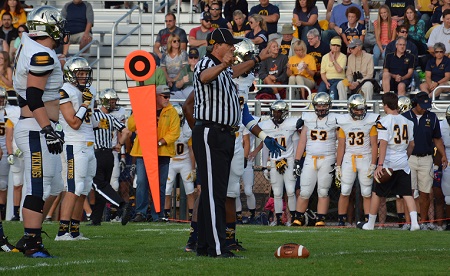
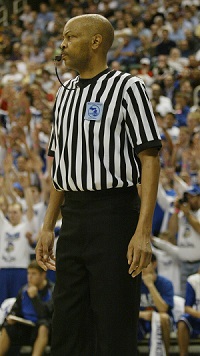
PHOTOS: (Top) The crew for this season’s Tony Payne Game at Haslett lines up for the National Anthem, in order from left: Rob Stanaway, Bruce Keeling, Jeff Spedoske, Mark Coscarella, Craig Weirich, Mike Maisner and Tom Minter. (Middle) Craig Weirich signals between plays. (Below) Tony Payne officiates a basketball during his career that stretched more than two decades.
Norris Honoree Adding to 60-Year Legacy
By
Geoff Kimmerly
MHSAA.com senior editor
May 13, 2020
One of many who recommended Saginaw's Hugh Matson for this year's Vern L. Norris Award called him "an interscholastic icon" and what "high school athletics should be all about."
Already recognized prestigiously for his leadership as a coach and administrator, Matson made lasting impacts on Michigan high school sports serving those duties over a career stretching four decades.
And more than 20 years after retiring from that work, Matson’s contributions to school sports continue in another key role. He has been selected as this year’s honoree for the MHSAA's Norris Award as he celebrates his 50th school year as an MHSAA-registered contest official.
The Norris Award is presented annually to a veteran official who has been active in a local officials association, has mentored other officials, and has been involved in officials’ education. It is named for Vern L. Norris, who served as executive director of the MHSAA from 1978-86 and was well-respected by officials on the state and national levels.
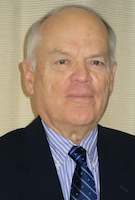 Matson is the second honoree in MHSAA history to receive both the Norris and Charles E. Forsythe Award, the latter presented to Matson in 2015 for his overall contributions to interscholastic athletics. Matson joined Kalamazoo’s Blake Hagman, who received the Norris Award in 1998 and the Forsythe Award in 2000.
Matson was to be honored with his Norris Award this month at the MHSAA’s 41st Officials’ Awards & Alumni Banquet. However, the banquet was canceled due to safety concerns because of COVID-19, and he instead will be invited to accept his award formally at the 2021 banquet.
Matson first registered with the MHSAA to officiate track & field and cross country during the 1970-71 school year and has officiated combined more than 800 meets in those sports – including more than 20 Regionals and nearly 20 MHSAA Finals. He also has officiated cross country and track & field at the Division I, II and III and NAIA collegiate levels.
His career in education began when Matson took his first teaching job in 1957, at Mattawan. He then moved to Saginaw Township Community Schools, teaching and coaching at Saginaw MacArthur High School from 1962-71 and then Saginaw Eisenhower from 1971-88. Matson served as head varsity football and track & field coach at Mattawan and as head track & field coach at both MacArthur and Eisenhower, in addition to serving as an assistant football coach at both schools. He became the first and only athletic director in Eisenhower’s history – holding that position from the school’s first day during the 1970-71 school year until the end of the 1987-88 school year, when he became co-athletic director of the new Saginaw Heritage High School, which was created from a merger of MacArthur and Eisenhower. Matson served as the sole full-time athletic director of Heritage for 1996-97 before retiring.
“When I started, I knew wanted to be a coach; I didn’t know for sure if I wanted to be a teacher. But I found out teaching and coaching are really the same thing, and I enjoyed the teaching as much as the coaching. Then I found out that officiating is much the same,” Matson said. “I enjoy the kids. One of the things that warms my heart is when a kid will come up and say, ‘Thanks for officiating.’ Officiating is all just part of working with kids as I did as a coach and as I did as a teacher.”
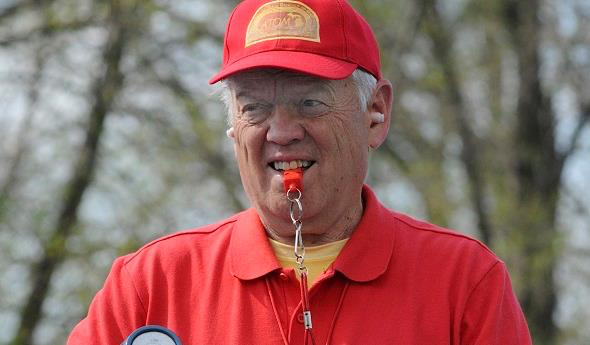
Matson has been a member of the Association of Track Officials of Michigan (ATOM) since 1993 and received its 2009-10 Art Jevert/Bruce Jacobs Distinguished Service Award. He also received the Chuck Wheeker Volunteer of the Year Award from Saginaw Valley State University track & field in 2012 and the USA Track & Field (USATF) National Officials Committee Outstanding Service Award in 2014. He received designation as a Certified Master-level starter by USATF in 2000.
He has served as a volunteer track starter for SVSU and as a volunteer official for middle and high school meets as part of the Michigan Indoor Track Series, both since 1997.
While an athletic director, Matson was a member of the Michigan Interscholastic Athletic Administrators Association (MIAAA) from 1970-97 and served as its president during the 1989-90 school year. He was a member of the National Interscholastic Athletic Administrators Association (NIAAA) from 1980-97 and served as a representative and speaker for the MIAAA at regional conferences in Iowa and Wisconsin and to the NIAAA Leadership Forum in 1987. Matson was named to the Saginaw County Sports Hall of Fame in 2014.
“The same attributes that made Hugh Matson a beloved teacher, coach and athletic director have made him beloved to the officiating community as well,” MHSAA Executive Director Mark Uyl said. “His selflessness and dedication continues to shine through in his mentorship of officials, as well as athletes and coaches, and his guidance and insights continue to benefit the track & field and cross country communities statewide.”
Coincidentally, Matson had crossed paths with both men whose awards he has received before beginning his career in education. Matson was a sophomore on the 1951 Newaygo boys basketball team that reached the Class D Semifinals and was greeted in East Lansing by Forsythe. And as a senior at Western Michigan University, Matson received advising from Norris, who was working in the placement office at the time. Matson then did his student teaching at Godwin Heights, Norris' alma mater.
Matson graduated from Newaygo in 1953, having earned 13 varsity letters over four sports – football, basketball, baseball and track. He received his bachelor’s degree in physical education with minors in English and history in 1957 from WMU.
He taught English and history at Mattawan, and then English and physical education during his three tenures as part of Saginaw Township Community Schools. Matson remains an active member of First Congregational Church in Saginaw, having served as an usher for more than 50 years, as a board member and as part of a breakfast club serving local homeless.
He's been married to his wife Jackie for 59 years, and together they have two daughters.
Previous recipients of the Norris Award
1992 – Ted Wilson, East Detroit
1993 – Fred Briggs, Burton
1994 – Joe Brodie, Flat Rock
1995 – Jim Massar, Flint
1996 – Jim Lamoreaux, St. Ignace
1997 – Ken Myllyla, Escanaba
1998 – Blake Hagman, Kalamazoo
1999 – Richard Kalahar, Jackson
2000 – Barb Beckett, Traverse City; Karl Newingham, Bay City
2001 – Herb Lipschultz, Kalamazoo
2002 – Robert Scholie, Hancock
2003 – Ron Nagy, Hazel Park
2004 – Carl Van Heck, Grand Rapids
2005 – Bruce Moss, Alma
2006 – Jeanne Skinner, Grand Rapids
2007 – Terry Wakeley, Grayling
2008 – Will Lynch, Honor
2009 – James Danhoff, Richland
2010 – John Juday Sr., Petoskey
2011 – Robert Williams, Redford
2012 – Lyle Berry, Rockford
2013 – Tom Minter, Okemos
2014 – Hugh R. Jewell, West Bloomfield
2015 – Sam Davis, Lansing
2016 – Linda Hoover, Marshall
2017 – Michael Gentry, Shelby Township
2018 – Jill Baker-Cooley, Big Rapids
2019 – David Buck, St. Joseph
High school game officials with 20, 30, 40, 45 and 50 years of service also are being honored with service awards. Twenty-three officials with 50 years of service are being honored, along with 55 officials with 45 years. A 40-year award is being presented to 55 officials. In addition, 108 officials with 30 years and 181 officials with 20 years of experience are being honored.
MICHIGAN HIGH SCHOOL ATHLETIC ASSOCIATION
20, 30, 40, 45 & 50-YEAR OFFICIALS
The officials on this list are receiving their 20, 30, 40, 45 or 50-year service awards.
20-YEAR OFFICIALS
Ada - Michael D. Packard
Adrian - Keith J. Zubke
Allen Park - Julie A. Goodwin
Alpena - Ian K. Lundquist
Ann Arbor - Nancy E. Brucken
Auburn Hills - Frank Benion Jr.
Bath - Ruth J. Miehlke
Battle Creek - Jack McCulley
Battle Creek - Michael W. Smith
Battle Creek - Levi R. Watkins
Bay City - Jason R. Andrzejewski
Bay City - James J. Fitrakis
Bay City - Thomas L. Oleniacz
Bellevue - Stanley L. Guzy
Benton Harbor - Denny L. Edwards
Benzonia - James R. Sheets
Bessemer - Tony Gheller
Bessemer - Mark L. Movrich
Beulah - Jeffrey T. Bretzke
Beulah - Dennis J. Keeney
Birmingham - Patricia M. Hayes
Bloomfield Hills - Eric T. Seifert
Brighton - Jennifer J. Brown
Brighton - Jeffrey J. Houtteman
Cadillac - Kyle J. Hondorp
Caledonia - Timothy J. Restau
Canton - Makia D. Alexander
Canton - Gregory S. Santilli
Canton - Kevin W. Winningham
Cedarville - Charles G. Paquin Jr.
Charlotte - Eric C. Frohriep
Clinton Township - William R. Blickensdorf
Clio - Tim C. Ashbury
Clio - Gene VanAlst
Coleman - Jerry R. Evans
Commerce Township - Ronald J. Eberline
Crystal Falls - Jason W. Price
Daggett - Richard J. Dietz
Davisburg - Paul E. Knudson
Davison - Thomas M. Dowdall
Dearborn - Dave Deckert
Dearborn Heights - Gerald P. Boudreaux
Dearborn Heights - Bennie C. Roach
Detroit - Aaron F. McDaniel
Detroit - W. James Pierce
Dorr - James R. Graham
Dowagiac - Ronald A. Gunn
Eau Claire - Lance E. Green
Elsie - Nathan R. Taylor
Farmington - Timothy A. Fino
Farmington Hills - Katherine E. Williams
Fenton - Eric R. Golota
Fenton - Thomas C. Ureche Jr.
Flat Rock - Douglas R. Hill
Flint - Gregory T. Folsom
Flint - Arden P. Irwin
Flint - Floyd B. Williams
Flushing - Caron M. Sullivan
Fort Gratiot - Todd A. Kackman
Fowlerville - Robert G. Myers
Fremont - Paulette J. Moon
Gladwin - Art J. Adamec Jr.
Gowen - Patrick M. Cain
Grand Blanc - Jared R. Hoffmeyer
Grand Blanc - Scott C. Smith
Grand Haven - Daniel R. Holt
Grand Ledge - Marvin E. Hardy Jr.
Grand Rapids - Greg T. Adams
Grand Rapids - Burton J. Cook
Grand Rapids - Thomas C. Emery
Grand Rapids - James H. Fellinger
Grand Rapids - Bruce L. Hull
Grand Rapids - Richard G. Koperski
Grand Rapids - Scott A. Maternowski
Grand Rapids - Kelly A. Richardson
Grosse Pointe - Allan Diver
Hamilton - Douglas W. Braschler
Hanover - Donald M. Bergstrom
Harrison Township - David B. Jones
Haslett - David R. Miller
Holland - Brian E. Burtch
Holland - Walter C. Lamb
Hudsonville - Mike S. Bartosiewicz
Huntington Woods - Gary R. Schack
Iron Mountain - Ryan C. Gordon
Irons - Thomas R. Batista
Ironwood - Judy Cisewski
Ironwood - Ted E. Sim
Ishpeming - Adam J. Bergman
Jackson - Pete J. Ambs
Jackson - Eric L. Baldwin
Jackson - Larry E. Owens Jr.
Jenison - Mark E. Heagle
Kalamazoo - Karen L. Asch
Kalamazoo - John M. McBride
Kalamazoo - Larry A. Morrell
Laingsburg - David M. Barnhill
Lake Odessa - Phillip J. Whitcomb
Lansing - Elliotte Love
Lansing - Daniel W. Mausolf
Lansing - Calvin G. Sanders
Livonia - Michael C. Cushman
Livonia - Michael J. Smith
Livonia – Bill Williams
Ludington - James T. Nordlund
Luther - Robert L. Rose
Macomb - Daniel P. Westfall
Manistique - Mark A. Giannunzio
Manistique - Barbara A. Landis
Maple City - Lawrence R. Olsen
Marshall - Toby L. Crull
Mason - Philip S. Nardone
Mendon - Kenneth R. Blough
Mendon - Shawn D. Griffith
Michigan Center - George A. Wyers
Midland - Jill A. Bertuleit
Midland - Carl H. Smith
Monroe - Ronald P. Coury
Monroe - Paul N. Howey
Monroe - Tracy L. Yeary
Moran - Mitchell J. Perry
Muskegon - Bob Covert
Muskegon - Thomas J. Nichols Jr.
Negaunee - Michael F. Leanes
Negaunee - Jeffrey A. Marshall
New Baltimore - David A. Koch Sr.
North Muskegon - Gene A. Hyrns
Norton Shores - Kirk C. Antekeier
Okemos - Robert Ianni
Olivet - Dana S. Higgins
Owosso - Mike W. Valasek
Parma - Douglas D. Higelmire
Petoskey - Joseph R. Malec
Plymouth - Kara M. Burns
Plymouth - Jay D. Buelow
Pontiac - Troy F. Craft
Port Huron - Mitchell J. Nichols
Portage - Dustin J. Ruthven Sr.
Prescott - Gary A. Ragels
Riverview - Joseph S. Murnane
Rochester - Gary M. Cook
Rochester Hills - Peter D. Oudsema
Roseville - Wayne Cupp
Royal Oak - Michael F. Henahan Jr
Saginaw - Michael J. Fick
Saginaw - Charles F. Lydy
Saginaw - Clarence A. Thompson
Saline - Gary S. Quantock
Shepherd - Michelle E. Turpin
Sheridan - Randy A. Freed
Southfield - Quincey J. Price
St. Ignace - Doug J. Ingalls
St. Joseph - John K. Carr
Stanton - Thomas M. Wall
Stanwood - Doug VanSyckle
Sterling Heights - Ronald M. Camilletti
Sterling Heights - Jon Caran
Sterling Heights - Gratian P. Moldovan
Sterling Heights - Dean Ristovski
Sterling Heights - Tyrone Smith
Stevensville - Brandon D. Stacey
Sturgis - Kenneth A. Schau
Sylvania - Bruce E. Ralston
Taylor - Mark X. Rigotti
Tecumseh - Sarah S. Eubanks
Three Rivers - Tom L. Muckel
Traverse City - Bruce E. Falberg
Traverse City - Scott C. Jones
Traverse City - Kenneth J. Knudsen
Tustin - Jerry A. Nelson
Vicksburg - Neil E. Kreamalmeyer
Warren - Darrell Brown
Warren - Chad C. Davinich
Warren - Milissa A. Schell
Warren - Mark W. Sullwold
Williamsburg - Mark D. Stormzand
Wyandotte - Scott F. Neifert
Wyoming - Roger L. Bouma
Wyoming - Frits J. Hoekstra
Ypsilanti - Thomas D. Biggs
Ypsilanti - Richard J. Mull
30-YEAR OFFICIALS
Allen Park - Lisa S. Lee
Alma - Pamela J. Hanson-Bender
Alpena - Joseph M. Garant
Ann Arbor - Larry T. Kenyon
Bay City - Kevin J. Sinicki
Blissfield - Ronald A. Gentz
Brooklyn - Charles A. Janke
Brownstown Township - Joseph C. Barzo
Brownstown Township - Jim M. Joseph
Buchanan - Francis M. Brown
Byron - David A. Czerniakowski
Cadillac - Douglas E. McGiness
Cadillac - Kevin L. Taylor
Caledonia - David C. Dzierzyc
Carson City - Ted A. Kelly
Carson City - Arthur G. Kurtze III
Chesterfield - Douglas P. Stark
Clark Lake - John J. Jimenez
Clinton Township - Clifford S. Bliss
Coldwater - Brien S. Kelly
Coldwater - William M. Peiffer
Columbiaville - Donald W. Gordon
Dearborn Heights - David P. Mann
Delton - Katherine R. Dolfman
Detroit - Darren F. Ford
East Lansing - Douglas D. Ripley
Farmington Hills - Jack G. Light
Farwell - Patrick H. Uhrig
Fenton - Dan A. Reason
Flushing - Neil T. McCarthy
Fraser - Thomas A. Suminski
Freeland - Dennis J. Argyle
Gladstone - Jeffrey D. Diebolt
Grand Blanc - James M. Brigance
Grand Blanc - Michael E. Fair
Grand Blanc - David J. Griffel
Grand Rapids - Don L. Buchholz
Grand Rapids - Daryl S. Henderson
Grand Rapids - James F. Jakubowski
Grand Rapids - Scott W. Markham
Grayling - David K. Latusek
Hamilton - John A. Wood
Hart - Victor N. Salazar
Haslett - Lisa M. Bain
Highland Park - Melvin D. George
Holland - Christine E. Durham
Holland - Kevin E. VanderHulst
Iron Mountain - George D. Pond
Ithaca - Bradley D. Peet Sr.
Jackson - Shawn C. Spitler
Jenison - Steven C. Warber
Kalamazoo - Richard A. Hurdelbrink
Kalamazoo - Steven J. Nuyen
Kentwood - Christopher T. Maday
Kingsford - Mark E. Shanks
Laingsburg - Thomas A. Rourke
Lansing - Justin E. Terry
Lansing - Amy L. Willing
Leonard - Thomas F. Kmita
Lincoln - Brad D. Cole
Macomb - Thomas M. Heabeart
Macomb - Kyle J. Plutschuck
Marquette - Bruce A. Tiseo
Marysville - W. Randy Jacobs
Mesick - Paul W. Osborne
Midland - Oliver G. Myers
Monroe - David H. Gelwicks
Monroe - John C. Hilken
Mt. Morris - Robert F. Sunday
Muskegon - Theo R. Burrel
Muskegon - Timothy A. Cook
New Boston - Wayne C. Hamilton
Newport - Glen A. Scafidi
North Muskegon - Daniel L. Millhisler
Northville - Robert P. Juhasz
Olivet - Lonnie L. Spencer
Onsted - William M. Bayko
Onsted - Robert Wright
Ortonville - Franklin E. Olson
Owosso - Gary W. Barta
Port Sanilac - Dan Dean
Ray - Danny P. Kuskowski
Riverview - Benjamin Madero
Romulus - A. Terry Brinston
Royal Oak - Ronald G. Buchanan
Saginaw - Daniel L. Houston Sr.
Saginaw - Robert C. Kubczak
Saline - Kirk D. Spangler
Scottville - Stacey R. Swiatlowski
Shelby Township - Lawrence Gerbe
Shelby Township - Jeffrey P. Sandora
Sidney - James R. White
South Bend - David P. Sexton
Southfield - Anthony W. Johnson
St. Clair Shores - John W. Hartley Jr.
St. Joseph - Patrick J. Clark
Stalwart - Barbra A. Storey
Sumner - Jeff D. Rowley
Three Rivers - Bruce E. Mastny
Traverse City - James P. Barbera
Traverse City - Peter J. Garthe
Vassar - Matthew J. Cox
Vassar - Mark A. Schoenow
Washington Township - Peter J. Friedrich
Westland - Richard W. Kus
Westland - Thomas E. Mallon
Wixom - Lawrence W. Grant
Wyandotte - David A. Maloney
40-YEAR OFFICIALS
Bad Axe - Paul A. Binder
Berkley - Sheila M. Homic
Blissfield - Christopher L. Bates
Brimley - Jerald P. Cook
Calumet - Daniel W. Junttila
Champion - Gary P. O'Brien
Clarksville - Jim D. Johnson
Dearborn Heights - Kevin P. Kabacinski
Decatur - Patrick L. Boitnott
Delta - William H. Wiseman
Detroit - James E. Briggs
Dundee - Karl J. Schmidt
Farmington Hills - Mark J. Kronk
Ferndale - Bradford D. Skauge
Flint - James V. Newell
Fremont - James M. Goorhouse
Fruitport - George L. Frederick
Gaylord - Paul B. Holmes
Grand Blanc - Douglas W. Tipton
Grand Haven - Richard W. Lott
Grosse Pointe Woods - Robert E. Zaranek
Harbor Beach - Steven M. Linn
Hillsdale - Bruce Caswell
Hudson - Fred C. Bowers
Hudson - Patrick W. Wollet
Hudsonville - Bob C. Wojcik
Iron Mountain - John R. Pucci
Kalamazoo - James L. Ketelaar
Lansing - Sam L. Davis
Lansing - Eric D. Wills
Lansing - Donald J. Yuvan
Ludington - David L. Wright
Madison Heights - Marie S. Bessler
Madison Heights - Richard Hillman
Manistee - David A. Nemecek
Marshall - David N. Benham
Marysville - Joel P. Venia
Mattawan - David W. Breithaupt
Muskegon - Charles M. VanDongen
Niles - Michael J. Nate
Okemos - John H. Garrison
Onsted - Kathi Frank
Pinckney - David D. Sontag
Redford - Gregory J. Smetek
Richland - Thomas D. Cox
Rockford - Timothy G. Erickson
Saginaw - Roberta A. Beyerlein
Scottville - Rodney D. Marshall
Temperance - Randall A. Sehl
Trenton - Frederick L. Bruley
Vicksburg - Timothy A. Baker
Waterford - Douglas E. Zimmerman
West Bloomfield - Benjamin R. Armstrong
Westland - Donna J. Strang
Zeeland - Marvin F. Hinga
45-YEAR OFFICIALS
Ann Arbor - Jack L. Coffey
Battle Creek - Kendall A. Lewis
Bay City - Thomas F. Cole
Berrien Springs - Timothy A. Krieger
Boyne City - Kirk D. Kujawski
Brighton - Bill T. Rubin
Brownstown Township - Joseph A. McCormick
Caledonia - Edward T. Hedgecock
Caledonia - Tom A. Hoffman
Canton - John A. Davidson
Caseville - Barry L. Zinger
Clark Lake - Robert L. McComb Jr.
Clarkston - Eugene R. English Jr.
Clarksville - David A. Mersman
Clawson - Betty A. Wroubel
Detroit - Lawrence D. Freeman
Detroit - Billy L. Waters
Dowagiac - William L. Brooks
Flushing - Edwin H. McKimmy
Grand Rapids - Robert G. Galvin
Grand Rapids - Dirk E. Pegman
Grand Rapids - Jeanne L. Skinner
Grayling - Thomas A. Kemp
Grosse Ile - James R. Knopp
Haslett - David E. Gillison
Hemlock - Rudy Godefroidt
Howell - L. Lee Piepho
Howell - Dennis M. Troshak
Ironwood - James K. Krznarich
Jackson - Michael C. French
Kent City - Robert J. Sarachman
Kentwood - Betty J. Near
Lansing - Ken J. Sudall
Manistee - Michael J. Gielczyk
Manton - Burton Harrison
Marysville - Mark A. Brochu
Mason - Victor T. Cena
Michigan Center - Charles D. Sprang
Muskegon - James A. Goorman
Negaunee - Steven R. Ayotte
Ontonagon - Eugene Fiszer
Pittsford - Chuck Pelham
Rogers City - Gerald Purgiel
Royal Oak - Carol A. Sheldon
Smiths Creek - Jud D. Kastner
Southfield - Thomas R. Sullivan Jr.
St. Clair Shores - Thomas L. Driscoll
St. Clair Shores - Fusako Hines
Taylor - Terry H. Styer
Tekonsha - Daniel A. Washburn
Trenton - Robert Bolak
Trenton - Evelyn Langlands
Vicksburg - Richard L. Simon
Whitmore Lake - Charles E. Lindsay
Wyandotte - Michael R. McMahon
50-YEAR OFFICIALS
Byron Center - Joe A. Zomerlei
Cheboygan - William B. Watkins
Clio - Anthony J. Leonardo
Custer - Edward C. Miller
Essexville - Donald A. Rose Sr.
Hudson - Michael A. McCullough
Ishpeming - David J. St. Onge
Kingsford - Joseph R. Reddinger
Lowell - Curtis J. Cummings
Monroe - Albert M. Fernandez
Muskegon - Larry T. Vaandering
New Baltimore - James C. Cleverley
Okemos - Tom Woiwode
Onsted - John M. Springer
Redford - Robert J. Williams
Royal Oak - Paul M. Engelberts
Saginaw - Hugh R. Matson
Sanford - Charles P. Russian
Shelby Township - Frank A. Talerico
Vassar - H. Dan Johnson
Walker - Dennis J. Rothenthaler
Waterford - Burton Hurshe
Wyoming - Daniel J. Schultz