


Supporting Sports Officials
February 20, 2015
There recently has been some criticism that the MHSAA hasn’t “had the backs” of sports officials regarding a proposal for a new state law.
To make a difference of opinion about legislative strategy the litmus test of MHSAA support for officials is misguided at best and manipulative at worst.
Moreover, from the standpoint of coaches and spectators, the MHSAA is much too ready to support officials, even when officials misapply a game rule or misjudge a contest situation. That we always back officials, even when they are wrong, is a criticism that resonates with the public far more than the recent, rare criticism that we don’t have officials’ backs on a piece of legislation that we believe lacks merit.
Despite the hype and hope, there are two things the proposed legislation will not do:
First, additional legal sanctions will not dissuade someone who has momentarily lost his or her mind to pause and think, “Oh yeah, If I slug this person, there’s an extra penalty.” There is no evidence that such legislation works as a deterrent to emotional outbursts.
Second, putting such legislation on the books will not improve sportsmanship on the front lines. Such laws are empty words; improving sportsmanship is year-round, grassroots work of real substance.
Because our energies are invested in the ongoing work of improving sportsmanship in interscholastic athletics’ special niche in the world of sports, the MHSAA has been known nationwide for several decades as a high school association with great passion for good sportsmanship and innovative programs to improve sportsmanship.
This week alone we have thousands of students and others voluntarily watching videos promoting school spirit and good sportsmanship as the fourth annual “Battle of the Fans” concludes. This program, born in Michigan, is now spreading to our counterpart organizations across the U.S.
This week, and almost every week, we have staff traveling “anytime, anywhere” to deliver face-to-face education to groups of high school coaches who, more than anyone else, influence the behaviors of both players and spectators.
Through the years, we have promoted sportsmanship with audio and video and print promotions. We’ve conducted statewide, league and local sportsmanship summits as well as team captain and student leadership workshops. We have rewarded good sportsmanship, and penalized bad.
The MHSAA’s Constitution requires every member school to adopt a code of good sportsmanship for its athletes, coaches and spectators, an educational program to promote good sportsmanship, and a system of progressive discipline for failure to behave according to the code of good sportsmanship. A condition of MHSAA membership is to demonstrate that those requirements are being met.
Time and money spent on real solutions, not symbolism, is the MHSAA’s approach to creating and maintaining a higher level of sportsmanship. And it’s the best way for the MHSAA to demonstrate its ongoing support for contest officials.
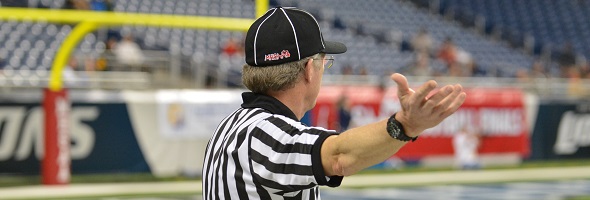
Be the Referee: Kick Returns
October 1, 2015
This week, MHSAA assistant director Mark Uyl explains the difference in high school kick return rules from those in the college and professional games.
Be The Referee is a series of short messages designed to help educate people on the rules of different sports, to help them better understand the art of officiating, and to recruit officials.
Below is this week's segment - Kick Returns - Listen
One of the biggest differences in high school football rules and those in college and pro deal with kick returns. In the high school game, once a kick (a punt or kickoff) breaks the plane of the goal line, the ball is dead and a touchback is awarded.
The key is the position of the ball … if it breaks the plane of the goal line, it is a touchback. It does not matter where the feet of the returner are located. That is why the longest kick return possible under high school rules is 99 yards.