

West Michigan Mourns Longtime Mentor
By
Geoff Kimmerly
MHSAA.com senior editor
June 25, 2019
As quickly as June has come to an end, summer soon will give way to another highly-anticipated football season in the Grand Rapids area – but also one that undoubtedly will feel like someone is missing for the many officials who learned from Carl Paganelli.
The longtime high school, college and professional official died May 21 at age 82 after fighting cancer, and was laid to rest May 29 in Wyoming, near Grand Rapids, where he lived most of his life.
Paganelli’s most high-profile on-field work likely came during his time in the former USFL, World Football League and Arena Football League. More of his 58 years in the game came as supervisor of officials in the Mid-American Conference, Arena League and during the initial campaign of the XFL. His three sons Carl Jr., Perry and Dino all have gone on to officiate in NFL Super Bowls.
Those impressive notes were mentioned most when Carl Sr. died. But his influence on the high school game was similarly substantial and should continue through those he mentored during nearly 60 years as part of the West Michigan Officials Association – which referred to him as “one of the founding fathers of officiating in West Michigan” in announcing his passing.
Paganelli was an MHSAA registered official for 36 football seasons through fall 1998, and also for 24 basketball seasons through winter 1987-88. Also during the 1990s, Caledonia native Mark Uyl began a multi-sport officiating career that would carry him in part to two baseball College World Series. He got to know Paganelli well through wearing the stripes and while also serving as athletic director at his alma mater and then Middleville Thornapple Kellogg on the way to becoming an MHSAA assistant and now executive director.
“Carl was one of the greatest officiating mentors that there’s ever been, and what made Carl most unique in that area was the fact he would go out and watch a junior high game Thursday in Grand Rapids, see a new official, and give that official the same time and care and detail that he would when he was supervisor of officials for the MAC or evaluating NFL officials,” Uyl said.
“To him, an official was an official. He was there, and he wanted to help you get better.”
As noted in his obituary, Paganelli was considered the “godfather of Grand Rapids area officials” and has been credited by numerous NFL officials for his guidance over the years. He was inducted into the Arena Football Hall of Fame and also into the Grand Rapids Sports Hall of Fame twice – solo in 2008 and with his three sons as the “Paganelli Team” in 2018.
Carl Sr. with his sons was among presenters when more than 1,200 officials from across the state poured into Grand Rapids during July 2013 for the first Officiate Michigan Day. His local footprint also includes a substantial presence at Grand Rapids Community College, where the foyer of the Gerald R. Ford Fieldhouse is named after the family and a scholarship in their name is presented annually to a student-athlete. Paganelli Sr. had attended Grand Rapids Junior College in 1954 and 1955. He also served in the U.S. Navy during the Korean War, and later sat on the Wyoming City Council.
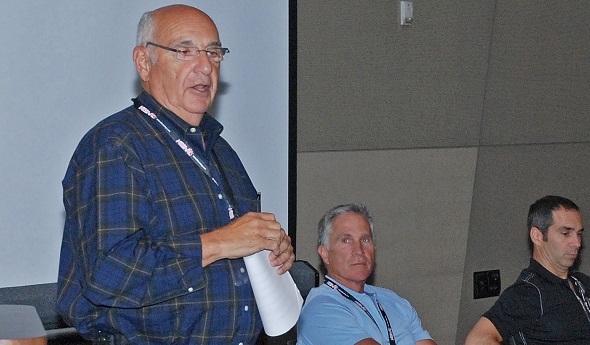
PHOTO: Carl Paganelli speaks to an audience during Officiate Michigan Day in 2013 as part of a roundtable with his three sons.
Be the Referee: Baseball Pace of Play
May 19, 2015
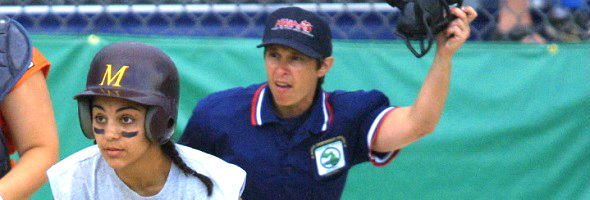
This week, MHSAA assistant director Mark Uyl discusses some of the strategies in use at the pro and high school levels to keep baseball's pace of play at an appropriate speed.
Be The Referee is a series of short messages designed to help educate people on the rules of different sports, to help them better understand the art of officiating, and to recruit officials.
Below is this week's segment - Baseball Pace of Play - Listen
If you’ve been listening to the sports media lately, one of hot topics in professional baseball is the length of games and pace of play. Major League Baseball is trying some things this year in terms of a clock that’s on the outfield wall in-between innings to try and hurry up or speed up that dead time between half innings.
In high school rules, pace of play continues to be an area of focus as well. When a pitcher who has thrown the previous inning comes out for the next inning, they are limited to five warm-up pitches, and those must be completed in under 60 seconds.
Umpires are also encouraging kids to hustle on and off the field, to try and keep high school baseball a fast-paced, exciting game for everyone.
Past editions
May 11 - Fair or Foul Ball? - Listen
May 4 - Non-Glare Helmets - Listen
April 27 - Vern L. Norris Award - Listen
March 23 - Deciding the Game - Listen
March 16 - Block/Charge Call - Listen
March 9 - Dive on the Floor - Listen
March 2 - Primary Areas - Listen
Feb. 23 - Too Much TV - Listen
Feb. 16 - Video Clip Library - Listen
Feb. 9 - Cheer Safety - Listen
Feb. 2 - Basketball PA Announcers - Listen
Jan. 26 - Wrestling Health Concerns - Listen
Jan. 19 - Basketball Physical Contact - Listen
Jan. 12 - Video Review Part 2 - Listen
Dec. 29 - Video Review Part 1 - Listen
Dec. 17 - Registration Part 2 - Listen
Dec. 10 - Registration Part 1 - Listen
Dec. 3 - Legacy Program - Listen
Nov. 26 - Sideline Management - Listen
Nov. 19 - 7-Person Mechanics - Listen
Nov. 12 - Blocking Below the Waist - Listen
Nov. 5 - Tournament Selection - Listen
Oct. 29 - Uncatchable Pass - Listen
Oct. 22 - Preparation for Officials - Listen
Oct. 15 - Automatic First Downs - Listen
Oct. 8 - Officials & Injuries - Listen
Oct. 1 - Overtime - Listen
Sept. 25 - Field Goals - Listen
Sept. 18 - Tackle Box - Listen
Sept. 11 - Pass Interference - Listen
Aug. 25 - Targeting - Listen