


“Who Needs This?”
May 24, 2013
One of the best barometers we have for informing us of the health of Michigan’s economy is to examine the number of registrations to be an MHSAA official. When the economy is poor, registrations trend upward; when the economy is improving, registrations decline.
Well, business must be booming in Michigan! Since the 2007-08 school year we’ve fallen almost 2,000 registrations.
Some of this decline can be explained away by the fact that registrations spiked upward when we allowed some free registrations in volleyball and basketball following the 2007 court-ordered changes in the girls volleyball and basketball seasons. But most of the recent decline – certainly the 1,000 decline of the past two years – is unrelated to discontinuing those promotional efforts; and it’s unrelated to a very reluctant resurgence in Michigan’s economy.
What is at work here now are two newer forces that frustrate efforts to maintain a pool of officials that is adequate to handle all the contests of a broad and deep interscholastic athletic program, and to handle those contests well:
- The first is the rise of social media and “instant criticism.” Spectators not only can critique calls before the official gets home from the game, those spectators can do so during the game. Their biased comments – and photos – can go worldwide before the official has left the venue! Really, who needs this? There have got to be less stressful hobbies.
- The second factor is the increased dependence on assigners. As local school athletic directors’ jobs became larger and more complicated, and as they were often given less time to do those jobs, more have had to turn to local assigners who will hire contest officials for groups of schools in one or more sports. As assigners built their little kingdoms, new officials have found it harder to break in and obtain a rewarding number of assignments. Many officials who have found themselves out of sorts with a local assigner have said, “Really, who needs this?” They find more fulfilling ways to spend their time.
The fact is that school-based sports – educational athletics – needs officials. We need them.
We need more officials and we especially need more young officials. Officials are vital members of the team that is necessary to provide a school-based sports program that actually does what it says it does – and that is to teach life lessons, including fair play and sportsmanship.
The Official View: Winter Wonderland
By
Brent Rice
MHSAA Assistant Director
November 12, 2018
By Brent Rice
MHSAA Assistant Director
In this week’s “Official View” we explain the important of insurance and offer a brief primer on how the MHSAA helps officials stay covered.
 We also work through some rule scenarios in football, volleyball and swimming and take a look at a few of the wintery scenes braved not only by teams on the field and fans in the stands but officials in stripes as well.
It’s Official!
Most officials will go their entire lives without needing to utilize insurance coverage for something that occurred while officiating. In the often rough-and-tough world of school sports, though, the need for officials to protect themselves on and off the field has never been greater. While officiating is not considered a dangerous avocation, officials should prepare themselves for those one-in-a-million situations.
There are a variety of coverage options out there for officials, ranging from medical and loss of income coverage due to injuries sustained while officiating to liability coverage and legal fees. Officials, individually and through their associations, can purchase increased coverages that suit their needs.
The MHSAA continues to look out for the best interests of our registered officials in this area and in other ways. When officials annually register with the MHSAA, they are included in both a comprehensive liability plan and catastrophic medical coverage for incidents that occur during MHSAA contests. Major injuries due to officiating are rare, but it is nice to have the security that you’re covered in the event of some tragic event. Though the few lawsuits that officials are a party to are often summarily dismissed, the MHSAA’s liability coverage kicks in at dollar one, including any legal fees or attorney retainers.
We will be seeking your feedback in how we can best serve these interests as they pertain to increased insurance coverage, training and development and providing additional useful resources. We thank you for your input and continued commitment and dedication to the MHSAA and the Officials Program.
Rule of the Week
FOOTBALL It’s 4th-and-8 on Team K’s 35-yard line. R1 signals for a fair catch at Team R’s 40-yard line. R1 muffs the punt, and the ball is picked up by K5 at Team R’s 35. With no one else around, K5 runs into his end zone for an apparent touchdown.
Ruling: The ball is dead at the moment the muffed kick is possessed by Team K. The ball cannot be advanced. It will be 1st-and-10 for Team K on R’s 35.
It’s Your Call
VOLLEYBALL This week’s clip shows a back row player for Team S making a back row attack and then landing on the attack line. What’s the call?
Last Week’s IYC Ruling: Last week’s video shows a swimmer drifting into the lane divider before ultimately finishing first in the meet. This incidental contact with the lane divider is legal since she did not grab ahold or otherwise use the divider to pull herself through the water. (Click to see last week's video.)
Official View: Reffing in a Winter Wonderland
The first day of winter is scheduled for Dec. 21, but you wouldn’t know that by the weather from this past weekend’s football games.
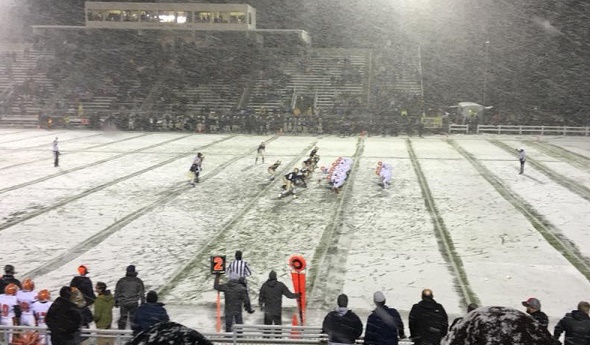
 Snow covered most of the state Friday and Saturday, even causing some teams to play in a couple of inches of the falling white stuff. Just like our teams, the officials braved the cold and flurries to ensure another great week of MHSAA football.
The top photo shows Thirlby Field during the Division 6 Regional Final between Traverse City St. Francis and Kingley.
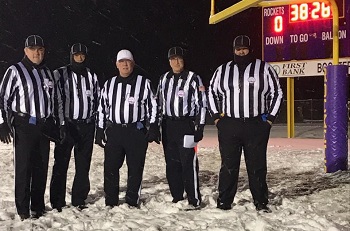
The photo above and to the right is from the 8-Player Semifinal between host Rapid River and Cedarville. The crew, from left: Joel Mitrzyk, Mark Pieniozek, Jan Viliquette, Paul Binder and David Paananen.