


Why They Don’t Officiate Anymore
December 16, 2016
Several years ago, the Michigan High School Athletic Association produced a series of radio and television spots in which MHSAA registered officials explain why they officiate. For the third time in the past 12 years (2004, 2012, 2016), the MHSAA conducted an extensive survey of former MHSAA officials to identify the reasons individuals have left the avocation of high school officiating.
From the 1,065 responses to the 2016 survey, it is demonstrated that career and job changes continue to be the top reason why individuals leave officiating. This has been the No. 1 reason in all three surveys.
Local association politics was again the No. 2 reason, which was the same second place reason in 2012. However, in the 2004 survey results, local association politics was sixth. This illuminates the reality that over the past 12 years there has been a significant shift from local schools hiring officials to using assigners in many, if not all, sports. The concerns are not so much with the association itself (training, recruiting, retaining) but with the assigning dynamic within the association or local area. Many recent MHSAA policy changes and most MHSAA in-service training have focused directly on assigners, and this survey confirms that this must continue and expand.
The next three most common reasons for leaving MHSAA officiating continue to be lack of sportsmanship by coaches, lack of sportsmanship by spectators, and low game compensation. The sportsmanship concerns from these adults must be continually addressed by all MHSAA constituent groups to improve the working conditions for officials.
The MHSAA increased tournament officiating fees at the start of the 2016-17 school year, and many local leagues and conferences have done the same. The reality is that many leagues and conferences are still playing “catch up” from the long fee freezes in the late 2000s and early 2010s when Michigan schools were in historically bad financial shape.
A significant reason to leave officiating seen in all three surveys is the official’s family situation. Many have indicated they left officiating due to time away from their spouse or children, or because of travel time or a family move. These reasons have been in the top 10 in all three surveys, and could have ranked higher had these individual questions been combined into one single category.
One troubling trend from the 2016 survey is that lack of sportsmanship by players was inside the top 10 (No. 7) for the first time since 2004. In 2012, this issue with students was No. 11. This may show that players are much more apt to argue, criticize or demonstratively disagree with calls than years ago.
(This posting was prepared with the assistance of MHSAA Assistant Director Mark Uyl.)
The Official View: All in This Together
By
Brent Rice
MHSAA Assistant Director
November 5, 2018
By Brent Rice
MHSAA Assistant Director
“The Official View” has received significant positive feedback, from both officials and non-officials – and we thank you for your interest in learning more about this essential avocation.
 This week, we discuss a promising effort to recruit Legacy officials and another “get-to-know-you” opportunity at MHSAA Sportsmanship Summits, plus dive into rules scenarios in volleyball and swimming.
It’s Official!
MHSAA officials will be presenting over the coming weeks at the annual Sportsmanship Summits held around the state. Renewed focus will be concentrated on the effect that poor sportsmanship has on the challenge of recruiting and retaining officials. Discussions will be led by noted officials in those areas to allow students to discuss the concerns and solutions to these issues.
Improving sportsmanship is a priority of the MHSAA Officials Program, and officials should be looking for new initiatives to support this goal. They include new policies on protecting officials, providing schools with framework to institute a Game Day Ambassadors Program, “Official Thanks” nights and several others.
Some efforts already have proven successful. “The Official View” continues to serve its purpose in humanizing the folks that officiate MHSAA contests. On that note, keep sending those photos and stories to [email protected] for features in The Official View. Ideally, submissions will be for in-season sports and include photo(s). Don’t forget to add the who, what, where, and when.
Rule of the Week
VOLLEYBALL As A1 tosses the ball in the air to serve, she realizes she is the improper server and catches the ball in attempt to force a re-serve. The proper server (A2) then immediately takes her place and makes a legal serve, scoring a point. A2’s toss for her second serve is bad and she catches the ball.
Ruling: This is an illegal serve and loss of rally/point. The re-serve privilege was used up by A1 since this was during A2’s term of service.
It’s Your Call
SWIMMING In the clip, the swimmer in Lane 5 begins to stray in her backstroke and ends up incidentally contacting the lane divider. She ultimately continues and wins the race. What’s the call?
Last Week’s IYC Ruling: In the clip, as the attacker and the keeper approach the ball, the attacker strikes the keeper’s ear. Since this is outside of the penalty area, a direct free kick would be awarded and the attacker would be assessed a yellow card. (Click to see last week's video.)
Official View: We’re All in This Together
The MHSAA Legacy Program has produced some terrific officials since its inception in 1992, many of whom are still officials today. We feel that recruiting eager and qualified officials is a collective partnership between the MHSAA, schools and officials associations around the state.
 For our part, the MHSAA offers a reduced registration fee for enrolled-student officials to get them started into officiating. We suggest that the schools and associations further alleviate these new officials from their startup costs by taking on this reduced fee. Schools benefit because they can then utilize these officials’ services at middle school and junior high school contests, and associations benefit because they are able to add a new official to their rosters for years to come.
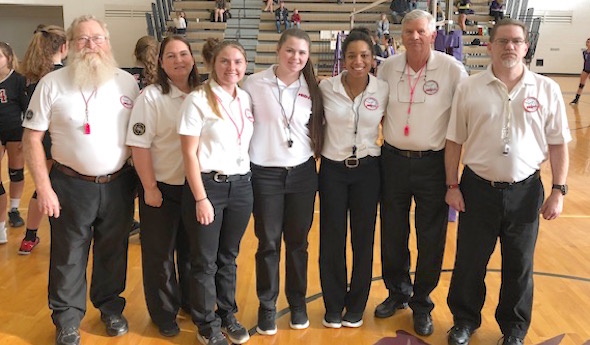
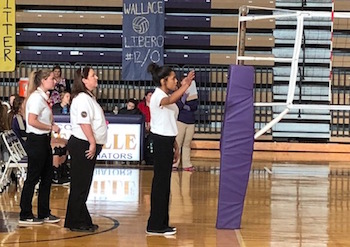
Fowlerville has taking the lead in this area by recently hosting a Legacy clinic where veteran officials were paired with newly registered (paid for by Fowlerville Schools) Legacy officials and assigned to a volleyball match with local middle school Red Cedar League teams. This event allowed experienced mentor officials to provide on-the-spot constructive feedback in live game scenarios.
Other schools are following suit by hosting clinics and other events to draw new officials into the fold, including adding curriculum in officiating to next year’s course load. Schools interested in adding officiating to their curriculum can contact Brent Rice of the MHSAA for a curriculum outline and guides to make it a success.
PHOTOS: (Top) Fowlerville Legacy officials and mentors work a recent middle school volleyball match; left to right: John Garrison, Kelli Hart, Lindsey Darby, Jackie Jarvis, Dalaija Franklin, Rodney Horton and Tyler Hover. (Middle) Hart (mentor) instructs Franklin, far right, while Darby shadows. (Photos courtesy of the Fowlerville athletic department.)