

Paying Tribute with Diamond Donation
May 14, 2014
By Geoff Kimmerly
Second Half editor
Rochester Adams and Bloomfield Hills Cranbrook-Kingswood baseball players and coaches both had loved ones on their minds when they took the field at Comerica Park earlier this month.
And they paid tribute to those loved ones over their hearts and across the backs of their jerseys.
 Together, the teams raised more than $3,500 for the Coaches vs. Cancer research initiative.
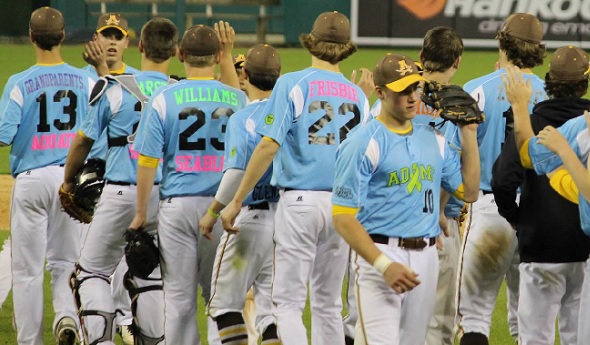
Instead of its usual brown and yellow, Adams wore jerseys of light blue with a green ribbon as the middle “A” in its name across the front in honor of those suffering with lymphoma, including 2011 graduate and former standout Matt Williams.
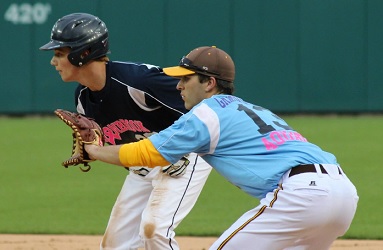 Cranbrook-Kingswood wore dark blue jerseys with a pink ribbon as the “A” in Cranbrook and with lime green writing on the back as the Cranes remembered longtime coach Jack Sanders, who died in 2012 after also battling lymphoma.
Sanders’ was among names adorning the backs of jerseys, along with other cancer victims the players and coaches knew.
Adams won the May 1 game, 18-3. Click to read more from the Oakland Press’ Keith Dunlap, who leading up to the game detailed both Williams’ fight and Sanders’ longtime contributions.
Net finder
Lake Fenton’s Jordan Newman will finish her high school soccer career later this spring as the top goal-scorer in MHSAA girls soccer history.
The Blue Devils’ senior forward broke the career record on April 28, scoring her 169th goal against Perry to pass the mark set by Newaygo’s Jaleen Dingledine from 2004-07. Newman also is a four-year varsity player.
Click to read more on her record run from the Flint Journal's Eric Woodyard.
5 K, 1 IP
The MHSAA doesn't keep a record for most strikeouts in an inning. But if it did, there’s a great chance Brighton’s Garrett Russell would top the list.
Against Ann Arbor Pioneer on April 5, Russell struck out five batters in an inning.
Yes, five.
Here’s how:
Russell struck out the first two batters of the inning swinging, leaving one out to get. He then struck out that third batter as well, but that batter reached first base because the third strike turned into a wild pitch.
The fourth batter of the inning was the only one to not strike out – he walked, putting runners on first and second base with two outs. Those runners advanced to second and third base, respectively, on a wild pitch thrown to the fifth batter of the inning.
That fifth batter then struck out swinging (which made it four strikeouts in the inning), but that third strike turned into a passed ball – and that batter ended up on first base, loading them for the sixth hitter of the inning.
But Russell found enough for one more K, striking out that sixth hitter swinging on a 2-2 pitch.
His line for the inning: 0 hits, 0 runs, 1 bases on balls, 5 strikeouts.
Brighton went on to sweep the doubleheader 12-4 and 11-1.
Family ties
Basketball clearly runs in a pair of families who have come through Corunna High School.
This winter, brothers M.J. and Mikhail Myles both scored their 1,000th career points – M.J., a senior, on Jan. 3 and Mikhail, a junior, in the team’s District Semifinal on March 5.
On Feb. 18, senior Payton Birchmeier became the fifth player in girls program history to score her 1,000th point – despite scoring only four points as a freshman before suffering a season-ending knee injury in her first high school game. She became the first Corunna girl to score 1,000 since her sister Megan finished accomplishing the feat in 2010.
Payton Birchmeier went on to play her final three seasons also on varsity, and M.J. Myles also was a four-year varsity player. Mykhail Myles has played three on varsity with next season still to play. The Myles' stepsister Klarissa Bell this winter finished an outstanding career at Michigan State University and won the Miss Basketball Award as a senior at East Lansing High School in 2010, and stepbrother Devlin Bell also was a Trojans standout.
PHOTOS: (Top) Rochester Adams players congratulate each other during their May 1 game at Comerica Park. (Middle) The Adams' first baseman and a Cranbrook-Kingswood base runner await the next pitch. (Photos courtesy of Rochester Adams baseball.)
Michigan's Ranking for High School Sports Participation Continues to Outpace Population
By
Geoff Kimmerly
MHSAA.com senior editor
September 4, 2026
Michigan enjoyed the sixth-highest boys participation in high school sports nationally in 2025-26, moving up one spot in that ranking, and maintained its girls and overall rankings of eighth as well – continuing to outpace where it ranks nationally for population of school-aged children according to U.S. Census Bureau estimates.
Michigan’s overall participation ranking was based on a total of 295,634 participants, data collected as part of the annual national participation study conducted by the National Federation of State High School Associations (NFHS) – of which the Michigan High School Athletic Association is a member. That total number of participants counts students once for each sport played, meaning students who are multiple-sport athletes are counted more than once.
A total of 171,573 boys participants moved Michigan up to sixth nationally on that list, after ranking seventh the past two school years and ninth in 2022-23. The girls total of 124,061 participants ranked eighth for the third-straight school year after Michigan was listed ninth for girls participation also in 2022-23.
Meanwhile, Michigan continued to rank 10th for both high school-aged boys and girls populations – and all high school-aged children combined – according to U.S. Census Bureau estimates.
Three sports for which the MHSAA sponsors postseason tournaments moved up on their respective national lists. Michigan counted the fifth-most boys basketball players, the state’s highest ranking in that sport since 2012-13 and two spots ahead of 2024-25. Girls competitive cheer also moved up two spots to ninth nationally, and boys wrestling moved up one spot on its list to seventh.
Participation in several more MHSAA sports continued to outpace the state’s ranking for high school-aged population.
For girls, bowling (third), tennis (third), golf (fourth), cross country (sixth), track & field (sixth), volleyball (sixth), basketball (seventh), softball (eighth), swimming & diving (eighth), and soccer (ninth) joined cheer in ranking higher than their population listing of 10th nationally. Among boys sports, bowling (second), ice hockey (fourth), golf (fifth), track & field (fifth), tennis (sixth), football (all contact formats combined – sixth), cross country (seventh), swimming & diving (eighth), baseball (ninth) and lacrosse (ninth) joined basketball and wrestling in exceeding the boys ranking of 10th for population. Boys soccer participation placed 10th on its national list.
Only 12 states sponsor alpine skiing, but Michigan again ranked third on both the girls and boys lists for that sport.
Nationally, participation in high school sports increased for the fifth consecutive year and set another record, with the total of 8,415,684 participants an increase of 1.8 percent from 2024-25. The total included 4,761,095 boys and 3,654,589 girls – both record highs as well – according to figures obtained from the 51 NFHS member state associations, which include Washington, D.C.
Eleven-player football remained the most popular boys (and overall) sport, totaling 1,043,716 athletes. Next on the boys list were outdoor track & field, basketball, soccer, baseball, wrestling, cross country, golf, tennis, and swimming & diving, respectively, repeating the same top 10 as in 2024-25.
For girls, the top nine sports remained the same from the previous year – outdoor track & field, volleyball and soccer, in that order, followed by basketball, softball, competitive spirit, tennis, cross country and swimming & diving, respectively. Flag football moved ahead of lacrosse into the 10th spot this past school year.
Texas (911,405) and California (859,022) remained atop the list for overall state participation. Ohio (347,994) ranked third, followed by Illinois (326,756), Pennsylvania (315,647), New York (312,563), Florida (311,233), Michigan (295,634), New Jersey (273,711) and Minnesota (241,536).
The NFHS participation survey was started in 1971 and compiled in its current form through the 2018-19 school year, resuming annually with the 2021-22 survey.
The NFHS, based in Indianapolis, is the national leadership organization for high school sports and performing arts activities. Since 1920, the NFHS has led the development of education-based interscholastic sports and performing arts activities that help students succeed in their lives. The NFHS writes playing rules for 18 sports for boys and girls at the high school level. Through its 50 member state associations and Washington, D.C., the NFHS reaches more than 19,800 high schools and 12 million participants in high school activity programs, including more than 8.4 million in high school sports.
The MHSAA is a private, not-for-profit corporation of voluntary membership by more than 1,500 public and private senior high schools and junior high/middle schools which exists to develop common rules for athletic eligibility and competition. No government funds or tax dollars support the MHSAA, which was the first such association nationally to not accept membership dues or tournament entry fees from schools. Member schools which enforce these rules are permitted to participate in MHSAA tournaments, which attract more than 1.4 million spectators each year.