

Powerful Voice for High School Sports
December 19, 2014
By Geoff Kimmerly
Second Half editor
Paul Carey was home from the U.S. Army only a few months and just shy of 25 years old when Beal City embarked on its first trip deep into the MHSAA boys basketball tournament.
On the call for local radio station WCEN from gyms at Saginaw Arthur Hill and Lansing Sexton, Carey served as the voice of the previously “laughable” Aggies as they reached the Class D Semifinals before falling just six points short of playing for the title.
“All of Beal City emptied out. They’d never had anything before,” Carey recalled during his annual Thanksgiving weekend visit to the MHSAA Football Finals at Ford Field. “When I got home, within the next two weeks I got a letter from every citizen of Beal City thanking me for broadcasting their games. That’s the kind of appreciation that meant so much.”
During 42 years on the airwaves, Carey was best known as a voice of the Detroit Tigers bounding out of transistor radios all over Michigan, thanks to WJR’s powerful signal.
But for the state’s high school sports community, his legacy is similarly memorable as the voice of the longtime football and basketball scoreboard show and a voter for various all-state teams and wire polls over the decades.
Now 86 and retired since 1991, Carey remains a regular during the first day of the Football Finals, taking in games he broadcast for the MHSAA during the late 1970s and that continue to hold his eye as they have for more than a half-century.
“It was a passion of mine. High school sports always has been,” Carey said. “I think because my dad was a high school coach, and teacher initially, and my brother was a high school coach and teacher, I just grew up in families that appreciated coaching and athletics. I was not a great athlete, but it kept my hand in following sports that way.”
Now, the scores
Carey partnered with Ernie Harwell for Tigers radio broadcasts from 1973-91, including during the march to the 1984 World Series championship. He was named Michigan Sportscaster of the Year six times and to the Michigan Sports Hall of Fame in 1992.
But Carey’s early career included sitting on top of a car, plugged into a phone pole, for a Sacred Heart football game at old Fancher Field just a few blocks from his family’s Mount Pleasant home. Among many more accolades are a Distinguished Service Award from the Michigan High School Coaches Association and a place in the Basketball Coaches Association of Michigan Hall of Fame.
In fact, the start of his weekly announcing of statewide football and basketball scores preceded his baseball career by 16 years and ended two months after he announced his final professional out.
The Michigan High School Scoreboard show was a staple of WJR’s late Friday nights from 1957-91. Carey would read every score he could collect from a variety of sources, often organized by league and with state rankings and context mixed in.
His idea came from something similar read by Len Colby for Kalamazoo’s WKZO. Carey’s brother Terry was coaching at Niles during the second half of the 1950s, and he and other coaches would get together to listen to the Friday night scores from the southwestern part of the state.
Carey, who left WKNX in Saginaw for WJR in 1956, explained to then-sports director Bob Reynolds that the station’s strong signal could provide for a truly statewide scoreboard experience.
Carey then connected with Edgar Hayes of the former Detroit Times, who gave the OK for Carey to call the paper on Friday nights to get scores from the Detroit metro area. For the rest, Carey relied on wire services – there were three at the time – who relied on newspapers from all over Michigan to call in scores over the course of an evening.
Before every Friday during high school football season – and later Tuesdays and Fridays during boys basketball season – Carey typed up lists of games based on schedules in the newspaper, with spaces to add scores. More than a few times, Carey raced down a back ramp at Tiger Stadium after a Friday night game, back to the WJR studio, with 15 minutes to prep for the show’s 11:30 p.m. start.
“If the Flint Journal, the Grand Rapids Press, the Traverse City paper didn’t call in scores to the AP, then I was out of luck too. And that happened all the time,” Carey said. “I would call back occasionally, say, ‘Did you get anything more?’ It was a rat race.”
The show originally was set for 10 minutes and then extended to 15. American Airlines sponsored a record show that followed, and Carey’s scoreboard show had a sponsor only once in 35 years. Finishing up on time was expected, even with more than 200 scores to read.
But Carey said he always went 20 minutes, sometimes 25.
“Because I wasn’t done. I just kept right on going,” Carey said. “Jay Roberts did the all-night show most of the time, and he was patient with me. He didn’t say too much on the air about ‘that guy ahead of me took all of my time.’”
Carey continued the “rat race” until his final scoreboard show, Dec. 20, 1991. He retired from WJR at the end of that calendar year. And it's important to note: Carey was never paid a dime extra for doing the program. .
“I think Paul is really just a sports fan, and that came across to the listener on his broadcasts,” MHSAA historian Ron Pesch said. “Paul would gather as much as possible off the wire. He'd interject if scores were missing from sections of the state. Press polls from the Free Press, News, AP and UPI were big, so he could point out close calls and upsets.
“He provided immediacy, or the closest thing to it in the days before cable TV and the Internet, and because of his scoreboard show, you could get the results before the morning paper. For listeners, he brought life to something as simple as game scores.”
First team all the way
Carey, who resides in Rochester, also served as the engineer on Tigers broadcasts for 16 years, through 1990. He broadcast Pistons games on the radio for six seasons and did the first broadcast of a Central Michigan University football game, in 1949.
Harry Atkins, covering Detroit’s teams while with The Associated Press for 29 years including the last 21 as its sports editor for Detroit, took note of his colleague's hard work – and especially that Carey was one of few broadcasters who was a journalist in addition to a voice.
That made Carey's other major role in high school sports a natural fit.
Atkins split The Associated Press all-state selection panels for football and basketball into 11 regions, and Carey represented the Detroit area for a number of years. He also was a longtime voter in those sports' weekly polls.
“Paul is just that kind of guy. He thought it was important and he made time in his busy schedule to do it,” Atkins said “And it had an impact on the other 10 voters on the All-State panels, too.
“Some of them were from small out-state newspapers or radio or TV stations. Yet every one of them knew who Paul Carey was. And when he spoke, of course, with what often is called "The Voice of God," those voters paid attention.”
And he still does, as well.
At the end of each fall, Carey still puts together a compilation of the three high school all-state football teams – Associated Press, Detroit Free Press and Detroit News – and files them with years of research and results.
“It’s important to me. Nobody sees it but me, but I get a certain kick,” Carey said. “Once in a while I’ll see a kid playing at Central, Western or (Michigan) State or Michigan, and they’ll say he came from Clawson. I’ll go into my all-state collections, say that would’ve been 2009 he played, and I find a name.”
In addition to the Football Finals on WJR, Carey was part of the Baseball Finals broadcasts into the early 1990s, continuing to contribute even after his retirement from his fulltime gig.
He spent high school games over the years sitting next to legends like the Free Press’ Hal Schram and remembers when current Free Press longtime scribe Mick McCabe was just a rookie. One of Carey's final broadcasts was a 1992 Baseball Final with his nephew Mike Carey, who continues to broadcast MHSAA championship games to this day.
“I am eternally grateful to Paul Carey. His contribution to high school sports in Michigan has been great and significant,” Atkins said.
“We are lucky to have him.”
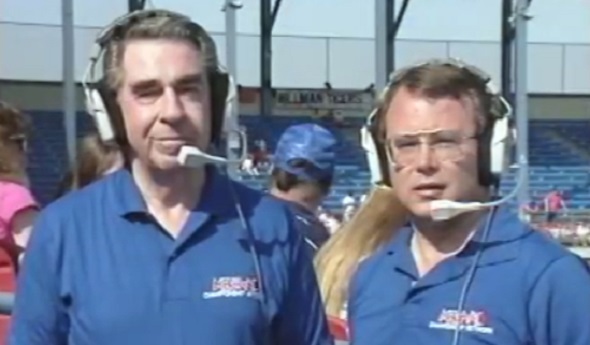
PHOTO: Paul Carey (left) and nephew Mike Carey broadcast the MHSAA 1992 Class D Baseball Final between Hillman and Athens for PASS.
Preview: Reigning Champs Could Set Pace, but Contenders Ready to Climb
By
Geoff Kimmerly
MHSAA.com senior editor
June 2, 2026
There are three strong repeat championship candidates teeing off at this weekend’s Lower Peninsula Boys Golf Finals.
But there are several more hopefuls hoping to enjoy that ultimate accomplishment for the first time, or first time in a while.
Bloomfield Hills Brother Rice in Division 1 and Auburn Hills Oakland Christian in Division 4 are both top-ranked teams seeking their first team titles in more than a decade. Grand Rapids Catholic Central, Essexville Garber, Charlevoix and Muskegon Western Michigan Christian are teams ranked among the top three in their divisions seeking a first Finals win. There will be four new individual medalists as well, as all four of last season’s were seniors.
Play begins both Friday and Saturday at 10 a.m. See below for more on a number of teams and individuals who could be in contention, and check out the Boys Golf page for full lineups and more.
Division 1 at Ferris State’s Katke Golf Course
Top-ranked: 1. Bloomfield Hills Brother Rice, 2. Detroit Catholic Central, 3. Hartland.
Bloomfield Hills Brother Rice: The Warriors are seeking their first Finals championship since 2012, and after finishing sixth a year ago with just one senior in the lineup. Five of those golfers are back (including two who played a round apiece at the 2025 Final) and three placed among the top 11 individuals as Brother Rice won its Regional at Milford’s Mystic Creek in a tie-breaker over DCC. Sophomore William Smidt was the Regional medalist, senior Rocco Iabobelli tied for fourth and senior Joseph Karoutsos tied for 11th.
Detroit Catholic Central: The Shamrocks are seeking a third-straight Division 1 title and fourth over the last five seasons. Although they finished second with that tie-breaker at the Regional, senior David Krusinski tied for fourth, senior Jack Whitmore and junior Kyle Chong tied for seventh and senior Collin Davis tied for 11th. Krusinski, Whitmore and Davis were part of last season’s lineup, Whitmore finishing second in the individual standings and missing out on first by just a stroke. Krusinski and Whitmore were part of the 2024 championship lineup as well.
Hartland: The Eagles are seeking their first championship since winning Class A in 1997, and making their first appearance at the Finals since 2021. Hartland advanced this time with a Regional championship at Dunham Hills in Hartland, carding a 297 led by junior Aidan Oake tying for fourth individually. All five Eagles scored counted 73-76 strokes and placed among the top 10 (with ties), with senior Wyatt Johnson and junior Liam Kastamo tying for sixth and senior Michael Maurin and sophomore Jase Sensor tying for 10th.
Individuals: Five of last season’s top 15 (top 10 with ties) will return this weekend. Warren De La Salle Collegiate junior Julian Sinishtaj placed just behind DCC’s Whitmore last season, one stroke back in third, and Rochester Adams junior Nick Smith (sixth), Holland West Ottawa senior William Nagelvoort (tied for eighth) and Brighton senior Adam Forcier (tied for 10th) also are in the field this weekend. They’ll be joined by a new wave of contenders. Along with Brother Rice’s Smidt, Regional champions last week were Grand Rapids Forest Hills Northern senior Mathieu Duflo, Midland Dow junior David Han, Utica Eisenhower junior Dylan Zahuranic, Brighton senior Brandon Lovejoy and junior Grady Bissett, and Berkley sophomore Jonah Sterling.
Division 2 at The Meadows at Grand Valley State
Top-ranked: 1. Grand Rapids Christian, 2. Ada Forest Hills Eastern, 3. Grand Rapids Catholic Central.
Grand Rapids Christian: The Eagles won last year’s championship, their second in three seasons, by nine strokes and return the individual runner-up in senior Cooper Reitsma and third-place (tie) finisher in senior Sawyer O’Grady, plus another starter in senior Ty Erickson. O’Grady was first and Reitsma second as Grand Rapids Christian won their Regional at Clearbrook in Saugatuck with a 303.
Grand Rapids Catholic Central: The Cougars won Division 3 in 2021 and 2023, and will make a run at the Division 2 team title after sending only Tommy Preston to the Finals as an individual qualifier last season. He finished 17th as a freshman and leads a lineup that won its Regional by a stroke last week at Katke, as he finished fourth and sophomore Brady Berkemeier placed ninth.
Grand Rapids South Christian: The Sailors finished fourth last season and entered this postseason ranked fourth, and finished second and six strokes back at Clearbrook last week. Junior Harris Hoekwater – who tied for eighth at last year’s Final – tied for third and senior Caleb Krosschell tied for eighth at last week’s Regional. Junior Drew Vanderheide also is back from last spring’s championship lineup.
Individuals: Now-seniors Andrew Chang and Henry Delzer tied for third and fifth, respectively, in leading Bloomfield Hills Cranbrook Kingswood’s Finals lineup last spring. East Grand Rapids’ junior JP Levan returns after finishing seventh, Ada Forest Hills Eastern junior Jack Klimek is back after tying for eighth, and Allendale junior Sumner Meekhof will return looking to build on his tie for 10th. Add in the Grand Rapids Christian pair and seven of the top 11 (top 10 with ties) will play again this weekend, with Meekhof, O’Grady and Chang winning Regional titles last week and joined as well by Detroit Country Day senior Yousef Darwich, Bay City Western senior Drew Goik and Parma Western freshman Bentley Coon in topping their respective standings.
Division 3 at Battle Creek’s Bedford Valley
Top-ranked: 1. Jackson Lumen Christi, 2. Essexville Garber, 3. Grosse Ile.
Jackson Lumen Christi: The Titans carded a 292 Regional score last week, 16 strokes lower than any other team in Division 3 as they prepare to play for a repeat Finals title. They placed four of the top five scorers at Cascades in Jackson – junior Gabe Cooper was medalist, junior Brandon Kulka second, junior Carson Spencer third and freshman Sam Swihart tied for fourth. Kulka tied for third as Lumen won last season’s Final by 13 strokes.
Essexville Garber: The Dukes finished fourth at last year’s Final and are seeking their first top-two finish since placing second in 1999. The top four scorers from last year’s championship weekend all are back, and all placed among the top 10 as Garber won its Regional last week by 26 strokes at Scenic Golf & Country Club in Pigeon. Senior Devin Dueweke was second, senior Jonah Williams and freshman Nicholas Zeilinger tied for third, senior Lucas Schiefer tied for seventh and junior Aaron Theisen was 10th. Williams tied for eighth at last year’s Final.
Grosse Ile: After finishing sixth at last year’s Final, Grosse Ile will make a run at a first title since 2003 starting five seniors including three from last season’s lineup. The Red Devils finished second to Lumen Christi at their Cascades Regional with those three seniors leading the way; Nicholas Joly-Naso tied for fourth, Braden Chessor tied for sixth and Luke Lazorka tied for 10th.
Individuals: Along with Lumen Christi’s Kulka, Chesaning junior Luke Skaryd and Grand Rapids West Catholic senior Owen Kotowski tied for third at last season’s Final. Clare junior Bryce Wieferich is back after tying for sixth, with Garber’s Williams gives this field five of last year’s top nine returning. Grandville Calvin Christian senior Will Orme also will play after finishing ninth in LPD4 last spring. Joining Lumen Christi’s Cooper among Regional champs last week were Elk Rapids sophomore Blake Springstead, North Muskegon junior Luke Jones, Schoolcraft freshman Toby Degroote, Saginaw Valley Lutheran sophomore Reid Schisler and Ann Arbor Greenhills junior Keating Holland.
Division 4 at Forest Akers West
Top-ranked: 1. Auburn Hills Oakland Christian, 2. Charlevoix, 3. Muskegon Western Michigan Christian.
Auburn Hills Oakland Christian: The Lancers are pursuing their first Finals championship since 2011, and their 324 Regional score last week at The Fountains in Clarkston was the third-lowest in all of Division 4 even as it placed only second to Riverview Gabriel Richard’s 319 at that tournament. Sophomore Silas Combs was the medalist and could make a big jump this weekend after tying for 41st at least year’s Final in leading Oakland Christian to a 12th-place team finish. He’s one of four starters back from that lineup.
Charlevoix: The Rayders carded a 327 at their Regional at Birchwood Farms in Harbor Springs to finish first and book a return to the Finals. Seniors Bryce Boss and Joe Gaffney tied for third and junior Maxwell Drenth finished ninth at the Regional, and all three were also in the lineup when Charlevoix finished sixth at the 2024 Division 4 Final. The Rayders are seeking their first title and finished runner-up in 2014.
Muskegon Western Michigan Christian: WMC also is seeking a first championship and finished runner-up most recently in 2010. The Warriors advanced to the Finals for the first time since 2019 with a runner-up finish to No. 6 McBain Northern Michigan Christian at the Regional at Crystal Mountain’s Betsie Valley in Thompsonville. Junior Lucas Weare tied for third, junior Ian Vanderstelt tied for seventh and senior Zach Weare and junior Braeden Olsen tied for 10th.
Individuals: Senior Isaiah Ponstine from Wyoming Potter’s House Christian is the highest-returning placer from a year ago, when he tied for fifth, and NMC’s Blair Dezeeuw and Traverse City Christian’s Joey Mirabelli are back after tying for seventh. Joining Combs among Regional champs this time were Leland junior Hayden Vansteenhouse, NMC junior Dries Vannoord, Springport junior Brody Baum, Hillsdale Academy junior Edward Keaster and Bay City All Saints sophomore Robby Taylor.
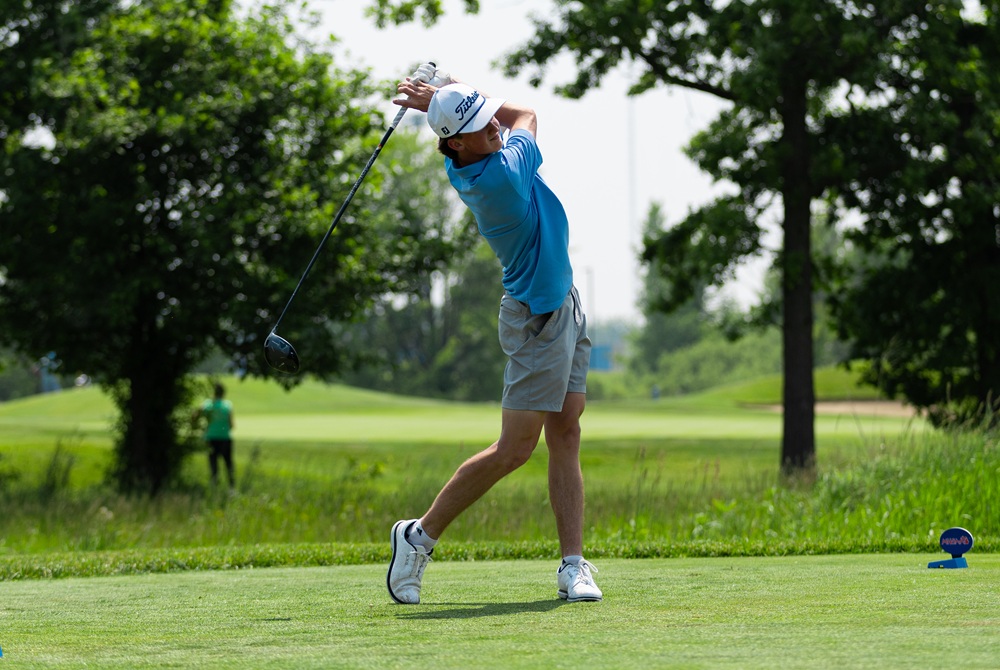
PHOTO Essexville Garber’s Devin Dueweke tees off during last season’s Lower Peninsula Division 3 Final. (Click for more from High School Sports Scene.)