

Powerful Voice for High School Sports
December 19, 2014
By Geoff Kimmerly
Second Half editor
Paul Carey was home from the U.S. Army only a few months and just shy of 25 years old when Beal City embarked on its first trip deep into the MHSAA boys basketball tournament.
On the call for local radio station WCEN from gyms at Saginaw Arthur Hill and Lansing Sexton, Carey served as the voice of the previously “laughable” Aggies as they reached the Class D Semifinals before falling just six points short of playing for the title.
“All of Beal City emptied out. They’d never had anything before,” Carey recalled during his annual Thanksgiving weekend visit to the MHSAA Football Finals at Ford Field. “When I got home, within the next two weeks I got a letter from every citizen of Beal City thanking me for broadcasting their games. That’s the kind of appreciation that meant so much.”
During 42 years on the airwaves, Carey was best known as a voice of the Detroit Tigers bounding out of transistor radios all over Michigan, thanks to WJR’s powerful signal.
But for the state’s high school sports community, his legacy is similarly memorable as the voice of the longtime football and basketball scoreboard show and a voter for various all-state teams and wire polls over the decades.
Now 86 and retired since 1991, Carey remains a regular during the first day of the Football Finals, taking in games he broadcast for the MHSAA during the late 1970s and that continue to hold his eye as they have for more than a half-century.
“It was a passion of mine. High school sports always has been,” Carey said. “I think because my dad was a high school coach, and teacher initially, and my brother was a high school coach and teacher, I just grew up in families that appreciated coaching and athletics. I was not a great athlete, but it kept my hand in following sports that way.”
Now, the scores
Carey partnered with Ernie Harwell for Tigers radio broadcasts from 1973-91, including during the march to the 1984 World Series championship. He was named Michigan Sportscaster of the Year six times and to the Michigan Sports Hall of Fame in 1992.
But Carey’s early career included sitting on top of a car, plugged into a phone pole, for a Sacred Heart football game at old Fancher Field just a few blocks from his family’s Mount Pleasant home. Among many more accolades are a Distinguished Service Award from the Michigan High School Coaches Association and a place in the Basketball Coaches Association of Michigan Hall of Fame.
In fact, the start of his weekly announcing of statewide football and basketball scores preceded his baseball career by 16 years and ended two months after he announced his final professional out.
The Michigan High School Scoreboard show was a staple of WJR’s late Friday nights from 1957-91. Carey would read every score he could collect from a variety of sources, often organized by league and with state rankings and context mixed in.
His idea came from something similar read by Len Colby for Kalamazoo’s WKZO. Carey’s brother Terry was coaching at Niles during the second half of the 1950s, and he and other coaches would get together to listen to the Friday night scores from the southwestern part of the state.
Carey, who left WKNX in Saginaw for WJR in 1956, explained to then-sports director Bob Reynolds that the station’s strong signal could provide for a truly statewide scoreboard experience.
Carey then connected with Edgar Hayes of the former Detroit Times, who gave the OK for Carey to call the paper on Friday nights to get scores from the Detroit metro area. For the rest, Carey relied on wire services – there were three at the time – who relied on newspapers from all over Michigan to call in scores over the course of an evening.
Before every Friday during high school football season – and later Tuesdays and Fridays during boys basketball season – Carey typed up lists of games based on schedules in the newspaper, with spaces to add scores. More than a few times, Carey raced down a back ramp at Tiger Stadium after a Friday night game, back to the WJR studio, with 15 minutes to prep for the show’s 11:30 p.m. start.
“If the Flint Journal, the Grand Rapids Press, the Traverse City paper didn’t call in scores to the AP, then I was out of luck too. And that happened all the time,” Carey said. “I would call back occasionally, say, ‘Did you get anything more?’ It was a rat race.”
The show originally was set for 10 minutes and then extended to 15. American Airlines sponsored a record show that followed, and Carey’s scoreboard show had a sponsor only once in 35 years. Finishing up on time was expected, even with more than 200 scores to read.
But Carey said he always went 20 minutes, sometimes 25.
“Because I wasn’t done. I just kept right on going,” Carey said. “Jay Roberts did the all-night show most of the time, and he was patient with me. He didn’t say too much on the air about ‘that guy ahead of me took all of my time.’”
Carey continued the “rat race” until his final scoreboard show, Dec. 20, 1991. He retired from WJR at the end of that calendar year. And it's important to note: Carey was never paid a dime extra for doing the program. .
“I think Paul is really just a sports fan, and that came across to the listener on his broadcasts,” MHSAA historian Ron Pesch said. “Paul would gather as much as possible off the wire. He'd interject if scores were missing from sections of the state. Press polls from the Free Press, News, AP and UPI were big, so he could point out close calls and upsets.
“He provided immediacy, or the closest thing to it in the days before cable TV and the Internet, and because of his scoreboard show, you could get the results before the morning paper. For listeners, he brought life to something as simple as game scores.”
First team all the way
Carey, who resides in Rochester, also served as the engineer on Tigers broadcasts for 16 years, through 1990. He broadcast Pistons games on the radio for six seasons and did the first broadcast of a Central Michigan University football game, in 1949.
Harry Atkins, covering Detroit’s teams while with The Associated Press for 29 years including the last 21 as its sports editor for Detroit, took note of his colleague's hard work – and especially that Carey was one of few broadcasters who was a journalist in addition to a voice.
That made Carey's other major role in high school sports a natural fit.
Atkins split The Associated Press all-state selection panels for football and basketball into 11 regions, and Carey represented the Detroit area for a number of years. He also was a longtime voter in those sports' weekly polls.
“Paul is just that kind of guy. He thought it was important and he made time in his busy schedule to do it,” Atkins said “And it had an impact on the other 10 voters on the All-State panels, too.
“Some of them were from small out-state newspapers or radio or TV stations. Yet every one of them knew who Paul Carey was. And when he spoke, of course, with what often is called "The Voice of God," those voters paid attention.”
And he still does, as well.
At the end of each fall, Carey still puts together a compilation of the three high school all-state football teams – Associated Press, Detroit Free Press and Detroit News – and files them with years of research and results.
“It’s important to me. Nobody sees it but me, but I get a certain kick,” Carey said. “Once in a while I’ll see a kid playing at Central, Western or (Michigan) State or Michigan, and they’ll say he came from Clawson. I’ll go into my all-state collections, say that would’ve been 2009 he played, and I find a name.”
In addition to the Football Finals on WJR, Carey was part of the Baseball Finals broadcasts into the early 1990s, continuing to contribute even after his retirement from his fulltime gig.
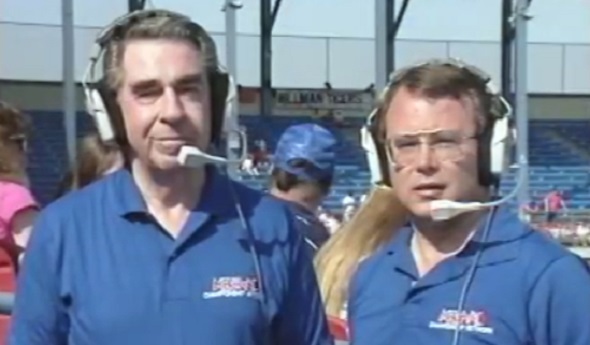
He spent high school games over the years sitting next to legends like the Free Press’ Hal Schram and remembers when current Free Press longtime scribe Mick McCabe was just a rookie. One of Carey's final broadcasts was a 1992 Baseball Final with his nephew Mike Carey, who continues to broadcast MHSAA championship games to this day.
“I am eternally grateful to Paul Carey. His contribution to high school sports in Michigan has been great and significant,” Atkins said.
“We are lucky to have him.”
PHOTO: Paul Carey (left) and nephew Mike Carey broadcast the MHSAA 1992 Class D Baseball Final between Hillman and Athens for PASS.
Marathon, Redemption Make Franklin's 1986 Softball Run Eternally Unforgettable
By
Ron Pesch
MHSAA historian
May 14, 2026
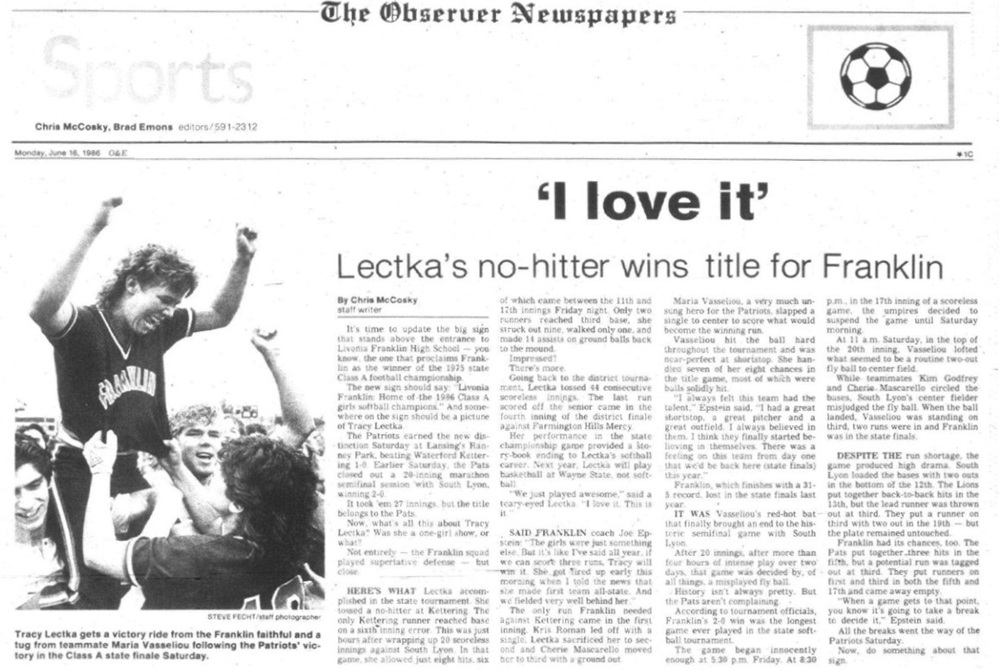
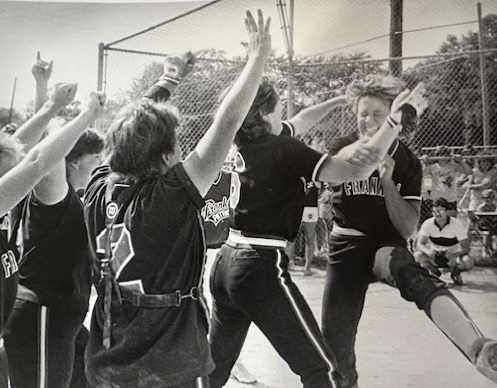
Tracy Lectka is celebrating a victory.
In Steve Fecht’s image found on the front page of the June 1986 Observer newspaper’s sports section, she is riding on the shoulders of ecstatic Livonia Franklin fans. Lectka’s arms are raised, and teammate Maria Vasseliou grabs at her jersey. The shot radiates the postgame celebration that came with the Patriots’ 1986 MHSAA Class A softball state championship – an honor that had slipped away a year previous.
Just as powerful is a photograph from the Observer’s Dan Dean from the 1985 run to the title game. Within, Lectka’s father Ron embraced his daughter, comforting the pain of what might have been.
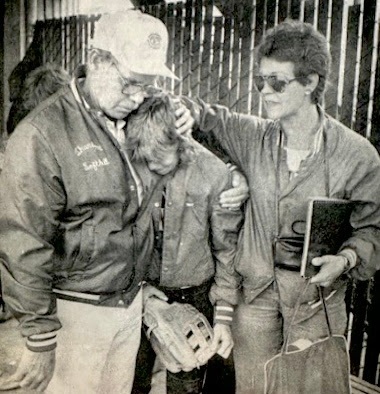 “My Dad was a huge part of my life and taught me everything I knew,” recalled Tracy. “He coached girls softball for Redford Thurston for years. … That was the most hits and runs I had given up all year. That picture speaks volumes to say the least.
“The woman next to me was our outfielder Cherie Mascarello’s mom. She was a huge supporter of the team. Never missed a game, like my mom.”
The Spring of 1985
In just his second year of coaching Livonia Franklin, Joe Epstein had built confidence among his players stressing focus and fundamentals. Lectka, a junior, emerged as an outstanding pitcher, and Epstein featured her constantly as she tossed more than 200 innings. Among Franklin’s victories were three over cross-town rival Livonia Stevenson and the state’s top pitcher, all-state senior Lisa Bokovoy. Franklin finished fourth in the Michigan High School Softball Coaches Association (MHSSCA) weekly Class A regular-season rankings.
During the tournament, Lectka tossed three consecutive four-hit shutouts, but, according to Observer staff writer Brad Emons, “was roughed up for 11 hits” in a 5-0 loss to Mount Clemens L’Anse Creuse North in the 1985 state title game. Played at Lansing’s Ranney Park, North’s star pitcher – right-hander Chris Harms (21-5) – twirled her sixth shutout of the tournament. During that Saturday lockdown, she had allowed seven hits but was “tough in pressure situations.” The Patriots had loaded the bases in the second and fifth innings but could not score.
“We just didn’t hit in the clutch,” Epstein told the Observer, “and they made it count when they had people on.”
North, 22-6 on the year, had opened the season among the state’s top-ranked teams. Harms earned second team all-state honors from MHSSCA, while Lectka was an honorable mention all-state selection. She finished the season with a 22-3 mark.
With an impressive 25-4 record, and one of the state’s top pitchers returning the following spring, Epstein vowed the team would be back.
A Shot at Redemption
With Lectka – one of three seniors – and top players Vasseliou, Cherie Mascarello, Rose Obey, Sue Ritz, Patty Wixson and Karen Schoeninger, the team was the MHSSCA’s Class A preseason favorite entering 1986. That quickly changed within the rankings when the Patriots lost their second game, 12-3, to Walled Lake Central, then dropped a double header to Garden City. A year earlier, Franklin had defeated the Cougars three times, including in a 21-inning pitching duel between Lectka and sophomore Shelly Malone, which Franklin won 1–0.
 After some experimenting with the lineup, Epstein was able to right the ship. From there, things progressed with relative ease, as his team dropped just two more games against quality opponents, splitting a double header with Westland John Glenn, then dropping one of three games with a solid Plymouth Salem squad, a conference rival. The Patriots finished the regular season fifth in the final Class A rankings and eased their way through the District. They shut out both John Glenn and Belleville in the Regional to earn a trip back to Lansing for the final rounds.
Speaking just prior to their MHSAA Semifinal game with South Lyon, Coach Epstein was asked by the Observer about his squad’s chances.
The Lions, one of nine teams earning honorable mention in the MHSSCA’s rankings, were led by junior ace Andrea Nelson. They had trounced Salem, 19-4, beneath sweltering heat in their District Final. Following that win, Franklin upset fourth-ranked East Kentwood and then downed Lansing Eastern to continue the postseason run.
“I feel confident that if we beat South Lyon, we can go all the way,” said Epstein, “and I don’t go on a limb very often. … I understand there were a bunch of walks and errors (in Salem’s game with the Lions). I’ve seen some good teams have bad days.”
On the opposite side of the Class A bracket stood Waterford Kettering, a scrappy unranked squad Franklin had beat, “in an invitational tournament, 10-5,” and Grosse Pointe South, which, behind the pitching of University of Michigan-bound Lynn Vismara, had shocked both top-ranked Utica Ford and No. 2-ranked Fraser in Regional play.
“(We’re) a better hitting team than last year,” said Epstein, convinced strong pitching from other teams would not deter his crew from their quest. “And I’ve got some other kids who can swing the bat.”
Epstein’s belief would be severely tested.
The Marathon
“The game began innocently enough at 5:30 p.m.,” wrote the Observer’s Chris McCosky about Franklin’s battle with the Lions. “At 8:30 p.m. in the 17th inning, it was still scoreless. Despite the run shortage, the game (had) produced high drama. South Lyon loaded the bases with two outs in the bottom of the 12th. The Lions put together back-to-back hits in the 13th, but the lead runner was thrown out at third …
“Franklin had its chances, too,” continued McCosky. “The Pats put together three hits in the fifth, but a potential run was tagged out at third. They put runners on first and third in both the fifth and 17th and came away empty.”
 Drew Sharp, writing for the Detroit Free Press, covered what happened next.
“… Amid growing darkness at Michigan State, the umpires asked South Lyon coach Jeff Gale and Franklin coach Joe Epstein whether they wanted to continue playing at nearby Ranney Park, which (had) lights or wait until 10 a.m. Saturday.”
Epstein stated he had three players scheduled to take the ACT college entrance exam the next morning and requested the game be moved and continued. Gale wanted to wait. Because the coaches couldn’t come to a solution, the umpires were put on the spot. While the choice wasn’t an easy one, they decided play would resume at MSU in the morning.
Earlier in the day, Kettering sophomore Julie Vachon ripped a long line drive just beyond the reach of the left fielder for a game-winning grand slam, sealing a 4-3 comeback win over Grosse Pointe South.
Title Time
Come daylight, all three test-takers were ready, having skipped their scheduled appointment back home. With two outs in the top of the 20th inning, Vasseliou, the Patriots’ junior shortstop. tripled in a pair of runs to end the deadlock, sealing a 2-0 victory and sending Franklin back to the title game played later in the day at Ranney.
The Lansing State Journal’s Tom Gantert beautifully summarized the Patriots’ weekend in the paper’s Sunday edition. “Livonia Franklin High softball pitcher Tracy Lectka doesn’t ask much from her teammates. Just that they score …”
Kettering’s Vachon allowed two walks, struck out a pair, and gave up just three hits during the championship game. But Vasseliou, again facing two outs, drove in Kris Roman who had led off the first inning with a single. That gave the Patriots a 1-0 lead they would not increase or relinquish.
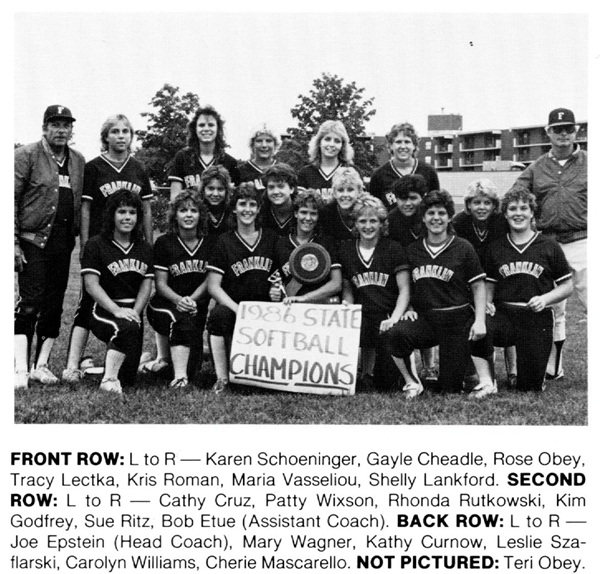 Lectka notched just a single strikeout, but, defensively, her teammates were nearly perfect. Outside a single error, her infield scooped up everything it faced from the Captains. Only three balls tossed by the senior left the infield during the title game. She finished the day with a no-hitter, extending her streak of scoreless innings allowed to 44. Franklin ended the season with a 31-5 record and the school’s second MHSAA state championship in any sport. Ten years previous, the Patriots had won the 1975 Class A football trophy.
“‘We played awesome. I love it,” a teary-eyed Lectka told the Observer. “This is it.” It was her final game on the diamond. A year earlier, she had accepted a college scholarship to play basketball – not softball – at Wayne State.
Soon after, Sports Illustrated visited the family to snap a photo of Tracy for publication in their weekly sidebar, “Faces in the Crowd.” Over 35 years later, in mid-September 2023, the softball squad, along with that football team, were inducted into Franklin’s inaugural Athletics Hall of Fame.
Epstein, who had passed away in 2012, was also honored individually that evening. He had taught in the Detroit Public Schools from 1957 to 1966 before moving to Franklin. A long-time physical education teacher, he also led Franklin’s softball team to a runner-up finish in 1990. His wife Linda joined three others to cut the honorary ribbon for the Hall.
The induction celebration brought back wonderful memories. But it was noted that a few of the team’s achievements during their runs to the Finals were missing from the MHSAA state record book.
Happily, that has now been corrected.
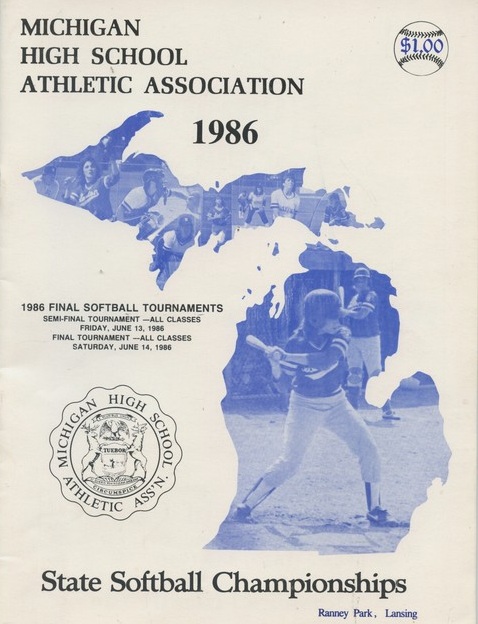
PHOTOS (Top) The Observer reported on Livonia Franklin’s 1986 Class A championship, including a memorable photo. (2) Ron Lectka, far left, comforts his daughter Tracy after her team’s 1985 title game loss. (3) The cover of the 1986 MHSAA Softball Finals program sets the scene for the weekend to come. (4) The Patriots celebrate. (5) Franklin poses for a team photo after the 1986 win. (Photos gathered by Ron Pesch from Observer archives and Tracy Lectka.)