

Powerful Voice for High School Sports
December 19, 2014
By Geoff Kimmerly
Second Half editor
Paul Carey was home from the U.S. Army only a few months and just shy of 25 years old when Beal City embarked on its first trip deep into the MHSAA boys basketball tournament.
On the call for local radio station WCEN from gyms at Saginaw Arthur Hill and Lansing Sexton, Carey served as the voice of the previously “laughable” Aggies as they reached the Class D Semifinals before falling just six points short of playing for the title.
“All of Beal City emptied out. They’d never had anything before,” Carey recalled during his annual Thanksgiving weekend visit to the MHSAA Football Finals at Ford Field. “When I got home, within the next two weeks I got a letter from every citizen of Beal City thanking me for broadcasting their games. That’s the kind of appreciation that meant so much.”
During 42 years on the airwaves, Carey was best known as a voice of the Detroit Tigers bounding out of transistor radios all over Michigan, thanks to WJR’s powerful signal.
But for the state’s high school sports community, his legacy is similarly memorable as the voice of the longtime football and basketball scoreboard show and a voter for various all-state teams and wire polls over the decades.
Now 86 and retired since 1991, Carey remains a regular during the first day of the Football Finals, taking in games he broadcast for the MHSAA during the late 1970s and that continue to hold his eye as they have for more than a half-century.
“It was a passion of mine. High school sports always has been,” Carey said. “I think because my dad was a high school coach, and teacher initially, and my brother was a high school coach and teacher, I just grew up in families that appreciated coaching and athletics. I was not a great athlete, but it kept my hand in following sports that way.”
Now, the scores
Carey partnered with Ernie Harwell for Tigers radio broadcasts from 1973-91, including during the march to the 1984 World Series championship. He was named Michigan Sportscaster of the Year six times and to the Michigan Sports Hall of Fame in 1992.
But Carey’s early career included sitting on top of a car, plugged into a phone pole, for a Sacred Heart football game at old Fancher Field just a few blocks from his family’s Mount Pleasant home. Among many more accolades are a Distinguished Service Award from the Michigan High School Coaches Association and a place in the Basketball Coaches Association of Michigan Hall of Fame.
In fact, the start of his weekly announcing of statewide football and basketball scores preceded his baseball career by 16 years and ended two months after he announced his final professional out.
The Michigan High School Scoreboard show was a staple of WJR’s late Friday nights from 1957-91. Carey would read every score he could collect from a variety of sources, often organized by league and with state rankings and context mixed in.
His idea came from something similar read by Len Colby for Kalamazoo’s WKZO. Carey’s brother Terry was coaching at Niles during the second half of the 1950s, and he and other coaches would get together to listen to the Friday night scores from the southwestern part of the state.
Carey, who left WKNX in Saginaw for WJR in 1956, explained to then-sports director Bob Reynolds that the station’s strong signal could provide for a truly statewide scoreboard experience.
Carey then connected with Edgar Hayes of the former Detroit Times, who gave the OK for Carey to call the paper on Friday nights to get scores from the Detroit metro area. For the rest, Carey relied on wire services – there were three at the time – who relied on newspapers from all over Michigan to call in scores over the course of an evening.
Before every Friday during high school football season – and later Tuesdays and Fridays during boys basketball season – Carey typed up lists of games based on schedules in the newspaper, with spaces to add scores. More than a few times, Carey raced down a back ramp at Tiger Stadium after a Friday night game, back to the WJR studio, with 15 minutes to prep for the show’s 11:30 p.m. start.
“If the Flint Journal, the Grand Rapids Press, the Traverse City paper didn’t call in scores to the AP, then I was out of luck too. And that happened all the time,” Carey said. “I would call back occasionally, say, ‘Did you get anything more?’ It was a rat race.”
The show originally was set for 10 minutes and then extended to 15. American Airlines sponsored a record show that followed, and Carey’s scoreboard show had a sponsor only once in 35 years. Finishing up on time was expected, even with more than 200 scores to read.
But Carey said he always went 20 minutes, sometimes 25.
“Because I wasn’t done. I just kept right on going,” Carey said. “Jay Roberts did the all-night show most of the time, and he was patient with me. He didn’t say too much on the air about ‘that guy ahead of me took all of my time.’”
Carey continued the “rat race” until his final scoreboard show, Dec. 20, 1991. He retired from WJR at the end of that calendar year. And it's important to note: Carey was never paid a dime extra for doing the program. .
“I think Paul is really just a sports fan, and that came across to the listener on his broadcasts,” MHSAA historian Ron Pesch said. “Paul would gather as much as possible off the wire. He'd interject if scores were missing from sections of the state. Press polls from the Free Press, News, AP and UPI were big, so he could point out close calls and upsets.
“He provided immediacy, or the closest thing to it in the days before cable TV and the Internet, and because of his scoreboard show, you could get the results before the morning paper. For listeners, he brought life to something as simple as game scores.”
First team all the way
Carey, who resides in Rochester, also served as the engineer on Tigers broadcasts for 16 years, through 1990. He broadcast Pistons games on the radio for six seasons and did the first broadcast of a Central Michigan University football game, in 1949.
Harry Atkins, covering Detroit’s teams while with The Associated Press for 29 years including the last 21 as its sports editor for Detroit, took note of his colleague's hard work – and especially that Carey was one of few broadcasters who was a journalist in addition to a voice.
That made Carey's other major role in high school sports a natural fit.
Atkins split The Associated Press all-state selection panels for football and basketball into 11 regions, and Carey represented the Detroit area for a number of years. He also was a longtime voter in those sports' weekly polls.
“Paul is just that kind of guy. He thought it was important and he made time in his busy schedule to do it,” Atkins said “And it had an impact on the other 10 voters on the All-State panels, too.
“Some of them were from small out-state newspapers or radio or TV stations. Yet every one of them knew who Paul Carey was. And when he spoke, of course, with what often is called "The Voice of God," those voters paid attention.”
And he still does, as well.
At the end of each fall, Carey still puts together a compilation of the three high school all-state football teams – Associated Press, Detroit Free Press and Detroit News – and files them with years of research and results.
“It’s important to me. Nobody sees it but me, but I get a certain kick,” Carey said. “Once in a while I’ll see a kid playing at Central, Western or (Michigan) State or Michigan, and they’ll say he came from Clawson. I’ll go into my all-state collections, say that would’ve been 2009 he played, and I find a name.”
In addition to the Football Finals on WJR, Carey was part of the Baseball Finals broadcasts into the early 1990s, continuing to contribute even after his retirement from his fulltime gig.
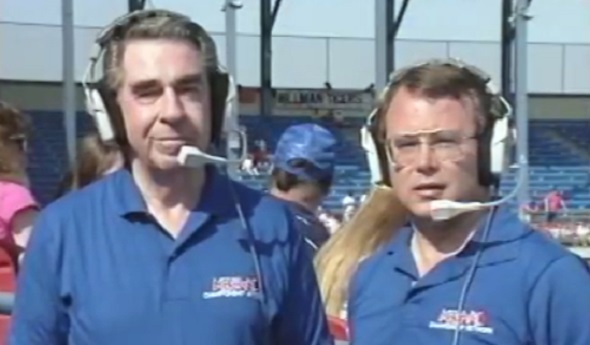
He spent high school games over the years sitting next to legends like the Free Press’ Hal Schram and remembers when current Free Press longtime scribe Mick McCabe was just a rookie. One of Carey's final broadcasts was a 1992 Baseball Final with his nephew Mike Carey, who continues to broadcast MHSAA championship games to this day.
“I am eternally grateful to Paul Carey. His contribution to high school sports in Michigan has been great and significant,” Atkins said.
“We are lucky to have him.”
PHOTO: Paul Carey (left) and nephew Mike Carey broadcast the MHSAA 1992 Class D Baseball Final between Hillman and Athens for PASS.

Michigan's Minor Leaguers Making Up for Lost Season
By
Steve Vedder
Special for MHSAA.com
June 28, 2021
Nick Plummer doesn’t necessarily view this summer as a make-or-break season, but he does realize the clock is ticking in his bid to make The Show.
Now in his fifth season in the St. Louis Cardinals chain, the former Bloomfield Hills Brother Rice star, like all minor league baseball players, suffered a setback when the 2020 minor league season was cancelled by the COVID-19 pandemic. While some were called into alternate-site camps during the abbreviated Major League Baseball season, the majority simply sat out a year. The loss means players this summer are scrambling to recapture lost momentum and get careers back on track.
 In a sport where development is the key to climbing the competitive minor league ladder, Plummer, one of a number of former Michigan high school standouts striving this summer in professional baseball, admits he needs to make significant progress playing for the Cards' Double-A affiliate in Springfield, Mo.
“Not playing in 2020 was a big deal for everyone,” said Plummer, the state’s 2016 Mr. Baseball Award honoree. “But I feel good about this season. Each year you need to develop and learn leadership and maturity.
“I worked on the mental side of baseball as well as working out (in Rochester). I tried to make the best of things, but it was tough.”
The season could mark a significant turning point in Plummer’s career. The center fielder had never hit over .228 during his four seasons, but is off to a quick start at Springfield, batting a career-high .283 with four home runs and 18 RBI over 145 at bats with a .386 on-base percentage.
Plummer, now 24, was drafted by the Cardinals in the first round, 23rd overall, during the 2015 amateur draft. He's part of an intriguing group of former Michigan prep stars trying to progress this summer.
South Haven’s Ryan Dorow is playing at Triple-A Round Rock in the Texas Rangers chain, located about 180 miles south of the parent club’s home in Arlington. A former baseball, basketball and soccer star in high school who helped those teams to a combined eight District championships, Dorow went on to become one of the greatest players in Michigan Intercollegiate Athletic Association history at Adrian College where he hit .395 with 95 extra base hits while driving in 188 runs over 179 career games.
 Dorow, a first-team all-MIAA pick all four seasons, said his goal is to simply improve each year as a pro. This season he’s hitting a combined .336 in 31 games across two levels, with six homers, 17 RBI and a .414 on-base percentage.
“You need to prove something to the organization and stay true to yourself,” said Dorow, who never hit less than .383 in any season at Adrian. “As a player you want to develop quickly, but everyone has their own timeline. You have to go out and have fun and improve.
“Coming out of high school and college, it was always in the back of my mind to play professional baseball, but you also have to understand that whatever happens, happens. I was just looking for another opportunity to play.”
Another former state prep star is making a radical switch in his opportunity in pro baseball. Grosse Pointe South’s Carmen Benedetti was the state’s 2013 Mr. Baseball, setting school records in average (.492), homers (22) and RBI (143). He became a 12th-round pick (367th overall) of the Houston Astros after batting .323 with 10 homers and 56 RBI in three years as a first baseman/outfielder at Michigan.
By his own admission, Benedetti, a three-time all-stater as a position player, was a less-than-stellar pitcher at South before throwing fewer than 30 innings for the Wolverines. But while an arm injury two years ago ended his hopes of playing in the field as a pro, the now 26-year-old Benedetti has turned to pitching this season with the High-A Ashville Tourists in North Carolina. He’s currently on the minor league injured list but was anticipating a mid-June return.
“Every year in baseball is a challenge, and I’ve just had to take (the switch) in stride,” said Benedetti, now in his fifth year in the Astros chain. “We all had 2020 off, and now we need to get the ball rolling. You still have to perform, and I’m going to do what I do. It’s a new road, but I feel like I’m lucky to get this far and now I’m just going to see another part of the game.”
Two more standouts who’ll be trying to make the most of their summers are brothers Chris and Mike Mokma of Holland Christian. Chris was taken in the 12th round of the 2019 draft by Miami while Mike – who threw a four-hitter with 14 strikeouts in an 8-5 win over Linden in the 2016 Division 2 championship game — signed as a free agent with the Los Angeles Dodgers after serving as the staff ace at Michigan State.
Mike is playing with the High-Class A Great Lakes Loons of the Midwest League. Chris is pitching with the Low-A Jupiter Hammerheads, who play in Palm Beach County, Fla., about 80 miles north of Miami. Chris has made eight starts, striking out 32 over just more than 41 innings. Mike started this season strong and is striking out a batter per inning over his first 10, all in relief, but has navigated some tough outings after returning from the injured list at the start of this month for the Midland-based Loons.
 “The biggest goal is always development,” Chris Mokma said. “I’m still only 20, and it’ll be my first year of playing with older guys. I want to develop my pitching and my command and be able to throw any pitch in any count for a strike.
“Professional baseball has changed baseball for me a little, and now you’re just trying to evolve. If you pitch well, you move up. That’s still baseball. You can’t let the fun go away. At the end of the day you are playing a sport, but your goal is to get to the big leagues.”
There are several other former Michigan prep stars scattered throughout the minors this summer. Infielder Werner Blakely of Detroit Edison was taken in the fourth round (111th overall) of the 2020 draft by the Los Angeles Angels, the highest Detroit player taken since Northwestern’s Marc Washington was selected by the Tigers in the fourth round of the 1982 draft.
Blakely, who will play in the Arizona Rookie League in Tempe, was ranked as the country’s 260th best high school player by Perfect Game. The 6-foot-3, 180-pound shortstop batted .467 with five homers and 38 RBI in 96 at-bats his junior year before losing his senior year to COVID.
Also among notable Michigan players in the minors are five from the 2015 and 2016 Michigan High School Baseball Coaches Association Dream Teams, including four pitchers who helped the Wolverines to the 2019 College World Series finals. Tommy Henry (Portage Northern), Karl Kauffman (Bloomfield Hills Brother Rice), Jeff Criswell (Portage Central) and Jack Weisenburger (Rockford) are all in pro ball.
Oakland took Criswell in the second round (58th overall) of the 2020 draft after Weisenburger was taken by the A’s in the 20th round the year before. Criswell has made one scoreless two-inning appearance for High-A Lansing (Mich.) and is on the injured list, while Weisenburger is 1-1 with a 2.53 ERA and 35 strikeouts over 21 1/3 relief innings at Double-A Midland in Texas.
Henry was the 74th player taken in the 2019 draft and pitching for the Double-A Amarillo Sod Poodles (Texas) of the Arizona Diamondbacks organization; he’s 1-3 in 10 starts with a 4.93 ERA and 59 strikeouts over just under 46 innings pitched this season. Kauffman was the 77th overall pick in the same draft by the Colorado Rockies. He is pitching for the Hartford Yard Goats (Conn.) in Double-A, where he’s made nine starts.
Also on the Wolverines’ World Series club was outfielder Jordan Nwogu, previously a second-team all-stater from Ann Arbor Pioneer who was taken by the Chicago Cubs in the third round (88th overall) of the 2019 draft. He’s playing with the Low-A Myrtle Beach Pelicans (S.C.) and is off to a slow start at the plate but has stolen six bases.

 Hamilton’s Grant Wolfram was nabbed by Texas in the 18th round of the 2018 draft. A pitcher, Wolfram will be spending his fourth year in pro ball with the High-A Hickory Crawdads (N.C.). He won 19 games with Davenport University and later pitched at Central Michigan. As a high school tennis player at Hamilton, Wolfram was 30-1 as a senior and named all-state. In all, he earned 10 varsity letters in tennis, basketball and baseball. He’s made eight starts with 43 strikeouts over just less than 31 innings pitched.
Pitcher Garrett Schilling had a remarkable prep career at Bishop Foley and also is playing this summer in Double-A with Hartford after being taken in the 18th round of the 2017 draft by Colorado. Schilling was an outstanding three-sport star in high school; he amassed a 36-0 record as a pitcher, was a two-year letter winner in hockey and made 7-of-11 field goal attempts as a kicker on the football team.
He helped Bishop Foley to three Division 3 baseball championships over his first three seasons from 2011-13 and a combined 146-12-1 record over four years until a line drive off his face at the end of his senior spring required season-ending surgery. Schilling went a combined 4-for-9 with five RBI in Finals wins over Bridgman, Lansing Catholic and Grandville Calvin Christian.
He wound up attending Xavier where he went from pitching seven innings as a freshman to earning 14 saves with a 1.91 ERA as a sophomore, to 15 starts and a 6-4 record and 3.57 ERA his junior year. He was a two-time all-Big East second-team selection. Schilling is carrying a 4.63 ERA with nearly a strikeout per inning in nine starts.
Sam Weatherly of Howell is pitching for the Low-Class A Fresno Grizzlies (Calif.). A first team all-stater in 2016, Weatherly was taken by Colorado in the third round (81st overall) of the 2020 draft after pitching collegiately at Clemson. He’s 2-3 with a 4.38 ERA – with 61 strikeouts in 37 innings pitched – over nine starts this season.
Former Detroit U-D Jesuit and U-M catcher Harrison Wenson is playing for his third minor league team and second organization this season, having begun in the Angels system, receiving his release from High-A Tri-City (Wash.) and signing with the Cubs’ High-A in South Bend, Ind.
A rare three-time draftee, Wenson was selected by the Tigers in the 38th round in 2013, in the 39th round by Pittsburgh three years later and then by the Angels in the 24th round of the 2017 draft. He was a member of the MHSBCA’s Dream Team as a junior and senior.
PHOTOS: (Top) Former Brother Rice standout Nick Plummer hauls his gear at Hammons Field in Springfield, Mo., as a member of the Double-A Cardinals this season. (2) Plummer follows one of his drives. (3) South Haven’s Ryan Dorow awaits a pitch for his Triple-A team in the Texas Rangers chain. (4) Holland Christian’s Chris Mokma begins his delivery for the Jupiter Hammerheads. (5) Brother Mike Mokma fires a pitch for the Great Lakes Loons. (Photos courtesy of the Springfield Cardinals, Round Rock Express, Jupiter Hammerheads and the Mokma family.)