

Powerful Voice for High School Sports
December 19, 2014
By Geoff Kimmerly
Second Half editor
Paul Carey was home from the U.S. Army only a few months and just shy of 25 years old when Beal City embarked on its first trip deep into the MHSAA boys basketball tournament.
On the call for local radio station WCEN from gyms at Saginaw Arthur Hill and Lansing Sexton, Carey served as the voice of the previously “laughable” Aggies as they reached the Class D Semifinals before falling just six points short of playing for the title.
“All of Beal City emptied out. They’d never had anything before,” Carey recalled during his annual Thanksgiving weekend visit to the MHSAA Football Finals at Ford Field. “When I got home, within the next two weeks I got a letter from every citizen of Beal City thanking me for broadcasting their games. That’s the kind of appreciation that meant so much.”
During 42 years on the airwaves, Carey was best known as a voice of the Detroit Tigers bounding out of transistor radios all over Michigan, thanks to WJR’s powerful signal.
But for the state’s high school sports community, his legacy is similarly memorable as the voice of the longtime football and basketball scoreboard show and a voter for various all-state teams and wire polls over the decades.
Now 86 and retired since 1991, Carey remains a regular during the first day of the Football Finals, taking in games he broadcast for the MHSAA during the late 1970s and that continue to hold his eye as they have for more than a half-century.
“It was a passion of mine. High school sports always has been,” Carey said. “I think because my dad was a high school coach, and teacher initially, and my brother was a high school coach and teacher, I just grew up in families that appreciated coaching and athletics. I was not a great athlete, but it kept my hand in following sports that way.”
Now, the scores
Carey partnered with Ernie Harwell for Tigers radio broadcasts from 1973-91, including during the march to the 1984 World Series championship. He was named Michigan Sportscaster of the Year six times and to the Michigan Sports Hall of Fame in 1992.
But Carey’s early career included sitting on top of a car, plugged into a phone pole, for a Sacred Heart football game at old Fancher Field just a few blocks from his family’s Mount Pleasant home. Among many more accolades are a Distinguished Service Award from the Michigan High School Coaches Association and a place in the Basketball Coaches Association of Michigan Hall of Fame.
In fact, the start of his weekly announcing of statewide football and basketball scores preceded his baseball career by 16 years and ended two months after he announced his final professional out.
The Michigan High School Scoreboard show was a staple of WJR’s late Friday nights from 1957-91. Carey would read every score he could collect from a variety of sources, often organized by league and with state rankings and context mixed in.
His idea came from something similar read by Len Colby for Kalamazoo’s WKZO. Carey’s brother Terry was coaching at Niles during the second half of the 1950s, and he and other coaches would get together to listen to the Friday night scores from the southwestern part of the state.
Carey, who left WKNX in Saginaw for WJR in 1956, explained to then-sports director Bob Reynolds that the station’s strong signal could provide for a truly statewide scoreboard experience.
Carey then connected with Edgar Hayes of the former Detroit Times, who gave the OK for Carey to call the paper on Friday nights to get scores from the Detroit metro area. For the rest, Carey relied on wire services – there were three at the time – who relied on newspapers from all over Michigan to call in scores over the course of an evening.
Before every Friday during high school football season – and later Tuesdays and Fridays during boys basketball season – Carey typed up lists of games based on schedules in the newspaper, with spaces to add scores. More than a few times, Carey raced down a back ramp at Tiger Stadium after a Friday night game, back to the WJR studio, with 15 minutes to prep for the show’s 11:30 p.m. start.
“If the Flint Journal, the Grand Rapids Press, the Traverse City paper didn’t call in scores to the AP, then I was out of luck too. And that happened all the time,” Carey said. “I would call back occasionally, say, ‘Did you get anything more?’ It was a rat race.”
The show originally was set for 10 minutes and then extended to 15. American Airlines sponsored a record show that followed, and Carey’s scoreboard show had a sponsor only once in 35 years. Finishing up on time was expected, even with more than 200 scores to read.
But Carey said he always went 20 minutes, sometimes 25.
“Because I wasn’t done. I just kept right on going,” Carey said. “Jay Roberts did the all-night show most of the time, and he was patient with me. He didn’t say too much on the air about ‘that guy ahead of me took all of my time.’”
Carey continued the “rat race” until his final scoreboard show, Dec. 20, 1991. He retired from WJR at the end of that calendar year. And it's important to note: Carey was never paid a dime extra for doing the program. .
“I think Paul is really just a sports fan, and that came across to the listener on his broadcasts,” MHSAA historian Ron Pesch said. “Paul would gather as much as possible off the wire. He'd interject if scores were missing from sections of the state. Press polls from the Free Press, News, AP and UPI were big, so he could point out close calls and upsets.
“He provided immediacy, or the closest thing to it in the days before cable TV and the Internet, and because of his scoreboard show, you could get the results before the morning paper. For listeners, he brought life to something as simple as game scores.”
First team all the way
Carey, who resides in Rochester, also served as the engineer on Tigers broadcasts for 16 years, through 1990. He broadcast Pistons games on the radio for six seasons and did the first broadcast of a Central Michigan University football game, in 1949.
Harry Atkins, covering Detroit’s teams while with The Associated Press for 29 years including the last 21 as its sports editor for Detroit, took note of his colleague's hard work – and especially that Carey was one of few broadcasters who was a journalist in addition to a voice.
That made Carey's other major role in high school sports a natural fit.
Atkins split The Associated Press all-state selection panels for football and basketball into 11 regions, and Carey represented the Detroit area for a number of years. He also was a longtime voter in those sports' weekly polls.
“Paul is just that kind of guy. He thought it was important and he made time in his busy schedule to do it,” Atkins said “And it had an impact on the other 10 voters on the All-State panels, too.
“Some of them were from small out-state newspapers or radio or TV stations. Yet every one of them knew who Paul Carey was. And when he spoke, of course, with what often is called "The Voice of God," those voters paid attention.”
And he still does, as well.
At the end of each fall, Carey still puts together a compilation of the three high school all-state football teams – Associated Press, Detroit Free Press and Detroit News – and files them with years of research and results.
“It’s important to me. Nobody sees it but me, but I get a certain kick,” Carey said. “Once in a while I’ll see a kid playing at Central, Western or (Michigan) State or Michigan, and they’ll say he came from Clawson. I’ll go into my all-state collections, say that would’ve been 2009 he played, and I find a name.”
In addition to the Football Finals on WJR, Carey was part of the Baseball Finals broadcasts into the early 1990s, continuing to contribute even after his retirement from his fulltime gig.
He spent high school games over the years sitting next to legends like the Free Press’ Hal Schram and remembers when current Free Press longtime scribe Mick McCabe was just a rookie. One of Carey's final broadcasts was a 1992 Baseball Final with his nephew Mike Carey, who continues to broadcast MHSAA championship games to this day.
“I am eternally grateful to Paul Carey. His contribution to high school sports in Michigan has been great and significant,” Atkins said.
“We are lucky to have him.”
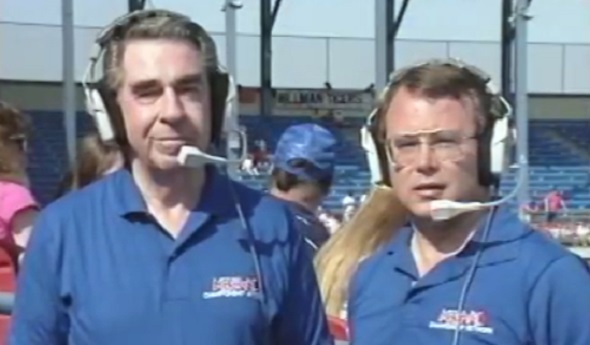
PHOTO: Paul Carey (left) and nephew Mike Carey broadcast the MHSAA 1992 Class D Baseball Final between Hillman and Athens for PASS.
Heritage's Hawk Nest Taking Charge
By
Geoff Kimmerly
MHSAA.com senior editor
February 11, 2020
SAGINAW – Braeden Dinninger was so stoked before Friday’s Saginaw Heritage boys basketball game against Midland Dow, it felt like he might bounce right out of his neon green headband and hot pink arm sleeve.
A year ago, Heritage’s Hawk Nest became a bona fide all-star student section, even reaching the MHSAA’s Battle of the Fans VIII finals. A year later, Dinninger is a product of what he and his classmates have created on the way back to the championship round for BOTF IX.
“The environment – it's electrifying when you're in there,” said Dinninger, a senior football player and track sprinter who was elected a Nest leader this winter. “Everyone's talking, having a good time. So it's a time when you can come in, cheer, see your friends – talk to people you don't know, meet new friends – and it's an experience that we want people to come out and get more.”
We received our share of that electricity during the MHSAA’s BOTF visit Friday, the first on this year’s finalists tour that will include stops in Buchanan on Tuesday and Zeeland East on Friday.
At Heritage, we met with Dinninger, juniors Sophia Spradlin and Nikki Ambas and sophomore Charlie Davis to find out how the Hawk Nest had changed things up and taken another step this school year.
Two years ago, there was nothing like this. A year ago, thanks to the leadership of a dedicated teacher who made the student section part of her curriculum for the school’s Leadership class, the Hawk Nest was born.
The Hawks received a BOTF finalist banner last March on the floor at Breslin Center, and on the way home then-sophomore Sophia Spradlin brainstormed ways for the section to make a run at the championship this time.
She’s now one of the leaders of the “Battle of the Fans Club” – borne out of but separate from the school’s Leadership class – as the Hawk Next this winter has become fully student-organized and directed.
“We liked the student section how it was, but I feel like a lot of people could agree that it just wasn’t where it could be,” Spradlin said.
Dinninger added: “We wanted to take that step and also include more things that we thought could be fun, not just what we did last year.”
Hence, Hawk Nest version 2.0. Prepare for landing.
Game Time
They’re the Hawks of Saginaw. If you don’t get that by the time you leave a Saginaw Heritage game, you just haven’t been listening.
Over eight years of Battle of the Fans tour stops, some cheers simply have stuck in our heads. Heritage’s “We’re the Hawks of Saginaw” is one of them – “We do it ... any time in the game. It’s just a blast,” Davis said.
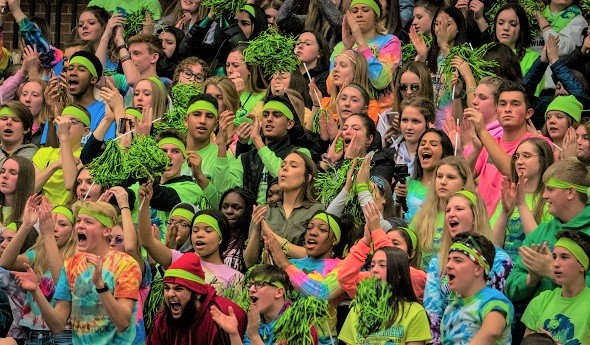
Also recognizable from our 2019 visit was a baseline bleachers filled with students in some mix of neon, mostly green again this time with a side of tie dye. But there were many more new features on the Hawk Nest playlist
Before every home game, a different pair of students enjoys the responsibility of providing the “light show” during pregame introductions – which is more or less a pair of flashlights racing around the domed arena, with parents and other fans along the sidelines using their cell phones to add to the mystique. Simple perhaps, but proof it doesn’t take much to add a touch of coolness to something otherwise ordinary at most places.
Introductions end with a Heritage player firing an imaginary arrow into the stands, sending the section falling backward. This is actually a common theme – the Hawks look for any number of opportunities to topple over, including leaders throwing a classmate into the stands like an airborne bowling ball.
What follows is a lot of chants, a lot of “We’re the Hawks of Saginaw” and generally just a lot of fun.
The Nest always has some interactive activity set up for halftime, and this time it was a relay race that included hula hoops and 3-point shots. It took a little while to set up, and to be honest was pretty tough to follow – but who cares? It got a bunch of students moving around, yelling and laughing instead of sitting with their heads in their hands until the game got rolling again.
Like at most places, basketball is the big show during winters at Heritage – and here it’s following the girls team, winners of two straight Class A/Division 1 championships. But the section also follows the boys hoops team, the highly-ranked hockey team and has come together for swim meets, volleyball matches and the Heritage-hosted pompon regional. (See the Challenge Round video below showing the section cheering on a variety of teams.)
“The big thing,” Spradlin said, “is we’re so excited for every single game.”
Be like Heritage
Take some of these tips from the Hawk Nest:
Take ownership: As noted above, Heritage students made a point of taking the baton by becoming the directors of their section this season, and almost everything they do is rooted in that sense they're working on something that belongs to them. That adds a level of meaningfulness. The Battle of the Fans Club meets at least once a week and often more, with about 30 students at many meetings – and Spradlin said every meeting sees someone new show up. Each grade is represented by elected representatives who are counted on to be part of setup and takedown on game nights. All of that leads to that feeling of ownership – and the pride that goes along with it.
Spread the wealth: Heritage has roughly 1,500 students, and while not all of them participate in the Nest, it’s still common – as Dinninger mentioned above – to see classmates in the stands he’s never met. How do Nest leaders make them all feel welcome? By making sure to include them in as many ways as possible. The Challenge Round allowed the Hawks to include a wide variety of students in the BOTF competition, and activities like the pregame light show and halftime games provide more opportunities to get students from various grades involved.
Set expectations: This goes back to ownership a bit. A handful of Heritage leaders have attended MHSAA Sportsmanship Summits, where they learned chants like “Air ball” and the like just aren’t a cool way to go. That and just having a little bit of empathy – of course it’s awful to be the player people are chanting about – have helped the section set some standards. And working hard to develop a positive reputation makes section leaders work even harder to make sure everyone is taking part in keeping it.
Word of mouth works: It’s always smart for student sections to connect with classmates on social media, with posters and daily announcements and even more one-on-one with class visits and all-school assemblies. But at the end of the day, one of the most effective ways to grow a student section is by word of mouth – one friend tells another, who tells another, and so on. Heritage hasn’t put it into practice yet, but is considering something of a buddy program where an upperclassmen recruits an underclassmen to a game. Similar invites bring a personal touch to recruiting efforts.
They said it best
Take a chance: “I think the only thing you have to do is be open-minded,” Spradlin said. “I was always kinda nervous to get involved, and I think the biggest step for me was being the Hawk (mascot) last year. I did it a few different times, and even though I wasn’t in the student section, I could be part of it. You have to push past your comfort zone. I met some of my best friends from the student section; through this club I’ve met so many new people. If (students) just knew what comes out of (getting involved), they would be more open to it.”
 Buzz is contagious: “The best part is when it’s a new school week and we’re just talking about the game,” Davis said. “At lunchtime, it’s ‘Are you going to the game?’ or ‘Can I get a ride to the game?’ or ‘Will I see you at the game?’ It’s so much fun. You talk about it at school, and it really hypes it up when you get here and it just brings all the positive energy to one place.”
Be brave: “Everyone’s cheering and no one’s afraid to start a cheer,” Ambas said. “I’m always timid to start a cheer, but everyone’s so inviting. They’re open to when you want to start anything, no matter who you are.”
Don’t miss out: “I think the next step is trying to get a lot of kids out of their comfort zones, to come out and get that experience,” Dinninger said. “Like me personally, I didn't come out until my junior year to the games, and I totally regret it. I wish I would've come out here my freshman and sophomore year. And there's been plenty of kids who said that: They wish they would've come out to the games and had that experience, because you only get this high school experience four times.”
Next stop on BOTF: We will visit Buchanan for its boys basketball game tonight against Watervliet, and finish the 2020 BOTF tour at Zeeland East for Friday’s boys basketball game against Hamilton.
The Battle of the Fans is sponsored in part by the United Dairy Industry of Michigan.
PHOTOS: (Top) Fans filled Saginaw Heritage’s “Nest” for Friday’s boys basketball game against Midland Dow. (Middle) Students light the way for pregame introductions. (Photos by Josh Frank.)