

Powerful Voice for High School Sports
December 19, 2014
By Geoff Kimmerly
Second Half editor
Paul Carey was home from the U.S. Army only a few months and just shy of 25 years old when Beal City embarked on its first trip deep into the MHSAA boys basketball tournament.
On the call for local radio station WCEN from gyms at Saginaw Arthur Hill and Lansing Sexton, Carey served as the voice of the previously “laughable” Aggies as they reached the Class D Semifinals before falling just six points short of playing for the title.
“All of Beal City emptied out. They’d never had anything before,” Carey recalled during his annual Thanksgiving weekend visit to the MHSAA Football Finals at Ford Field. “When I got home, within the next two weeks I got a letter from every citizen of Beal City thanking me for broadcasting their games. That’s the kind of appreciation that meant so much.”
During 42 years on the airwaves, Carey was best known as a voice of the Detroit Tigers bounding out of transistor radios all over Michigan, thanks to WJR’s powerful signal.
But for the state’s high school sports community, his legacy is similarly memorable as the voice of the longtime football and basketball scoreboard show and a voter for various all-state teams and wire polls over the decades.
Now 86 and retired since 1991, Carey remains a regular during the first day of the Football Finals, taking in games he broadcast for the MHSAA during the late 1970s and that continue to hold his eye as they have for more than a half-century.
“It was a passion of mine. High school sports always has been,” Carey said. “I think because my dad was a high school coach, and teacher initially, and my brother was a high school coach and teacher, I just grew up in families that appreciated coaching and athletics. I was not a great athlete, but it kept my hand in following sports that way.”
Now, the scores
Carey partnered with Ernie Harwell for Tigers radio broadcasts from 1973-91, including during the march to the 1984 World Series championship. He was named Michigan Sportscaster of the Year six times and to the Michigan Sports Hall of Fame in 1992.
But Carey’s early career included sitting on top of a car, plugged into a phone pole, for a Sacred Heart football game at old Fancher Field just a few blocks from his family’s Mount Pleasant home. Among many more accolades are a Distinguished Service Award from the Michigan High School Coaches Association and a place in the Basketball Coaches Association of Michigan Hall of Fame.
In fact, the start of his weekly announcing of statewide football and basketball scores preceded his baseball career by 16 years and ended two months after he announced his final professional out.
The Michigan High School Scoreboard show was a staple of WJR’s late Friday nights from 1957-91. Carey would read every score he could collect from a variety of sources, often organized by league and with state rankings and context mixed in.
His idea came from something similar read by Len Colby for Kalamazoo’s WKZO. Carey’s brother Terry was coaching at Niles during the second half of the 1950s, and he and other coaches would get together to listen to the Friday night scores from the southwestern part of the state.
Carey, who left WKNX in Saginaw for WJR in 1956, explained to then-sports director Bob Reynolds that the station’s strong signal could provide for a truly statewide scoreboard experience.
Carey then connected with Edgar Hayes of the former Detroit Times, who gave the OK for Carey to call the paper on Friday nights to get scores from the Detroit metro area. For the rest, Carey relied on wire services – there were three at the time – who relied on newspapers from all over Michigan to call in scores over the course of an evening.
Before every Friday during high school football season – and later Tuesdays and Fridays during boys basketball season – Carey typed up lists of games based on schedules in the newspaper, with spaces to add scores. More than a few times, Carey raced down a back ramp at Tiger Stadium after a Friday night game, back to the WJR studio, with 15 minutes to prep for the show’s 11:30 p.m. start.
“If the Flint Journal, the Grand Rapids Press, the Traverse City paper didn’t call in scores to the AP, then I was out of luck too. And that happened all the time,” Carey said. “I would call back occasionally, say, ‘Did you get anything more?’ It was a rat race.”
The show originally was set for 10 minutes and then extended to 15. American Airlines sponsored a record show that followed, and Carey’s scoreboard show had a sponsor only once in 35 years. Finishing up on time was expected, even with more than 200 scores to read.
But Carey said he always went 20 minutes, sometimes 25.
“Because I wasn’t done. I just kept right on going,” Carey said. “Jay Roberts did the all-night show most of the time, and he was patient with me. He didn’t say too much on the air about ‘that guy ahead of me took all of my time.’”
Carey continued the “rat race” until his final scoreboard show, Dec. 20, 1991. He retired from WJR at the end of that calendar year. And it's important to note: Carey was never paid a dime extra for doing the program. .
“I think Paul is really just a sports fan, and that came across to the listener on his broadcasts,” MHSAA historian Ron Pesch said. “Paul would gather as much as possible off the wire. He'd interject if scores were missing from sections of the state. Press polls from the Free Press, News, AP and UPI were big, so he could point out close calls and upsets.
“He provided immediacy, or the closest thing to it in the days before cable TV and the Internet, and because of his scoreboard show, you could get the results before the morning paper. For listeners, he brought life to something as simple as game scores.”
First team all the way
Carey, who resides in Rochester, also served as the engineer on Tigers broadcasts for 16 years, through 1990. He broadcast Pistons games on the radio for six seasons and did the first broadcast of a Central Michigan University football game, in 1949.
Harry Atkins, covering Detroit’s teams while with The Associated Press for 29 years including the last 21 as its sports editor for Detroit, took note of his colleague's hard work – and especially that Carey was one of few broadcasters who was a journalist in addition to a voice.
That made Carey's other major role in high school sports a natural fit.
Atkins split The Associated Press all-state selection panels for football and basketball into 11 regions, and Carey represented the Detroit area for a number of years. He also was a longtime voter in those sports' weekly polls.
“Paul is just that kind of guy. He thought it was important and he made time in his busy schedule to do it,” Atkins said “And it had an impact on the other 10 voters on the All-State panels, too.
“Some of them were from small out-state newspapers or radio or TV stations. Yet every one of them knew who Paul Carey was. And when he spoke, of course, with what often is called "The Voice of God," those voters paid attention.”
And he still does, as well.
At the end of each fall, Carey still puts together a compilation of the three high school all-state football teams – Associated Press, Detroit Free Press and Detroit News – and files them with years of research and results.
“It’s important to me. Nobody sees it but me, but I get a certain kick,” Carey said. “Once in a while I’ll see a kid playing at Central, Western or (Michigan) State or Michigan, and they’ll say he came from Clawson. I’ll go into my all-state collections, say that would’ve been 2009 he played, and I find a name.”
In addition to the Football Finals on WJR, Carey was part of the Baseball Finals broadcasts into the early 1990s, continuing to contribute even after his retirement from his fulltime gig.
He spent high school games over the years sitting next to legends like the Free Press’ Hal Schram and remembers when current Free Press longtime scribe Mick McCabe was just a rookie. One of Carey's final broadcasts was a 1992 Baseball Final with his nephew Mike Carey, who continues to broadcast MHSAA championship games to this day.
“I am eternally grateful to Paul Carey. His contribution to high school sports in Michigan has been great and significant,” Atkins said.
“We are lucky to have him.”
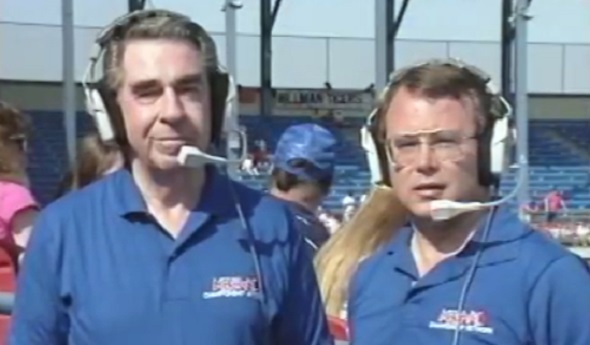
PHOTO: Paul Carey (left) and nephew Mike Carey broadcast the MHSAA 1992 Class D Baseball Final between Hillman and Athens for PASS.

Gall Makes Most of Last Finals Run
By
Tom Markowski
Special for Second Half
June 1, 2019
JENISON – Shepherd senior Amber Gall withstood the elements and pressure to end her tremendous career the way she hoped it would.
Gall won the 800-meter run and the 1,600 on Saturday, and began the day helping her team to a first-place finish in the 3,200 relay (9:33.89) at the MHSAA Division 3 Track & Field Finals at Jenison High School.
Three weather delays – one that delayed the start of the finals until 3 p.m.; the second, a 30-minutes delay, halfway through the meet; and the last one just before the start of the final event (1,600 relay) that pushed the conclusion deeper into the night – caused athletes and officials to pack and unpack throughout much of the day.
The rain, wind and hail didn’t seem to bother Gall, who will attend University of Michigan in the fall on a track scholarship. She won the 800 run as a sophomore and also ran on the winning 3,200 relay that season. Gall finished second in the 800 last season, one hundredth of a second behind Judy Rector of Hanover-Horton, and she and her teammates also placed sixth in the 3,200 relay in 2018.
“I’m excited,” Gall said after crossing the finish line in the 800 with a time of 2:12.72. Lauren Freeland of Kent City was second with a time of 2:13.97. “Last year I lost by .01 to one of my best friends.
“Mentally, it takes a toll. Last year I had a good year, not my best. I couldn’t be happier with the way this year has gone. The 800 is probably the toughest to run. It’s the gutsiest. You have to find another gear. For me, my blood pressure drops really fast so I have to do a lot of prerace work.”
As far as strategy, Gall said it all depends on how the race is run. She trailed Freeland at the halfway point before making her move.
Gall spent two minutes immediately following the race talking and consoling her teammate, Amelia Gouin, a sophomore, who finished ninth in the 800.
“I told her she has some big races ahead of her,” Gall said.
Pirates capture title
Pewamo-Westphalia won its first team title since 2015 and fourth overall as it finished with 45 points. Last season’s co-champion, St. Charles, was second with 37.5 points and Shepherd took third with 35. Scottville Mason County Central was fourth with 31, and Quincy placed fifth with 30.
 Kent City won the meet’s final event, taking the 1,600 relay with a time of 4:04.15. Mason County Central, with a time of 4:04.55, placed second, and those eight points moved it past Quincy for fourth place in the team competition.
No Pewamo-Westphalia athlete placed first, but two of its relays, in the 800 and 3,200, placed second. The top individual finisher for the Pirates was Sophie Thelen. She placed third in the 100 dash and took fourth in the 200.
Inspired
Motivation comes in many forms. For Elizabeth Gramza, a senior from Perry, it came from a fellow track athlete on the boys team at Perry.
Gramza did not place in any event last season but took first in the 100-meter hurdles on this afternoon.
She finished second in the Regional and was seeded ninth entering the finals. Seeded No. 1 was Brittany Bowman of Kingsley.
“I was perfectly getting over the hurdles,” Gramza said. “I was going against the top seed in the prelims and I beat her (with a time of 15.90. Bowman ran a 15.91). I felt really comfortable in the prelims. That gave me confidence.”
Gramza’s best finish last season was ninth in the 300 hurdles. Not only did she not score a point in 2018, but Perry as a team did not score.
“We came in to compete,” Gramza said. “I’m not sure what the difference was this year. I was with a very good hurdler (on the boys team) and he’s short. He said he works hard in practice day after day without getting much results. He said he watched me come out (last season) and saw that I just started running well. That flipped my switch. I started working a lot harder, every day in practice.”
Bowman did place second in the 100 hurdles with a time of 16.04.
Gramza was also scheduled to compete in the pole vault, 300 hurdles and 400 relay. She did well in the pole vault finishing third with a vault of 10 feet, 3 inches. Jael Wood of Scottville Mason County Central took first in that event at 11 feet, 6 inches.
Youth is served
It’s not supposed to be this easy, particularly when one considers Lexus Bargesser of Grass Lake is a freshman.
Bargesser won the sprint double, the 100 and 200 dashes, with times of 12.56 and 25.43, respectively. The time in the 100 is a personal best. She won the 200 by more than half a second.
“That’s my favorite race,” she said of the 200. “I love the energy. You feel yourself, on the run, having all that energy. It’s one of those races, a long sprint that I love. The energy of this meet made me better. I was hoping (to win both). Anything can happen. I was thinking this morning, I can win this.”
Jayden Humphrey of Manchester placed second in both (12.82 in the 100, 26.04 in the 200).
Sprint relays go to reigning co-champ
St. Charles won both the 400 and 800 relays last season on its way to the school’s first Finals team title, which it shared with Hart. On Saturday, St. Charles won both again – and there were some familiar faces leading the charges.
Celine Whiren, a junior, ran on both relay teams each of the last two years, and this time she ran anchor on the 800.
“Pewamo-Westphalia was winning when I got the baton,” she said. “Oh, it must have been four or five strides and I just ran my normal race.”
St. Charles won the 400 relay with a time of 49.95 seconds and the 800 with a time of 1:46.05.
Well worth the wait
Mikayla Williams of St. Charles competed in three field events and in the last one, the long jump, she recorded a personal best of 17 feet, 2 inches to place first. Last year she placed second in the long jump.
“It actually came on my first jump of the (event),” she said. “I jump three events (high jump, pole vault and long jump), and lately I’ve been babying my (left) knee. I jump off my left knee, and today it felt great.”
Williams will attend Wayne State next season and expects to compete in the triple jump and the long jump.
She also played volleyball in the fall. So why risk injuring your knee playing two sports?
“I jump off two knees in volleyball,” she said.
Makes sense.
Repeat champion
Renae Kutcha of Jackson Lumen Christi said she felt the pressure of winning the 400 dash as a freshman last season. To offset this she decided to work harder, a regiment that included running the 800, to improve her leg strength. It worked.
Kutcha’s time of 57.81 in the 400 on Saturday was good enough to get her past Josee Behling of Boyne City, who placed second in 58.04.
“Doing the (800) helped me,” Kutcha said. “I wasn’t running well early in the season, and then I remembered that this was my event. So I got my legs stronger, and my times started to go down.”
Winners all
Byron sophomore thrower Sarah Marvin won both the shot put and discus Saturday, ahead of Caro's runner-up Sheridan Dinsmore in both events. Marvin had taken third in both as a freshman.
Muskegon Western Michigan Christian freshman Abby Vanderkooi won the 3,200 in 10:36.17, clearing the field by more than 21 seconds.
Onsted junior McKenna Russell repeated as champion in the 300 hurdles. Hillsdale junior Bailey Morgret won a close competition in the high jump.
PHOTOS: (Top) Shepherd's 3,200 relay, including Amber Gall (second from left), celebrate a win Saturday at Jenison. (Middle) Pewamo-Westphalia breaks past the finish line for more points on the way to winning the team title. (Photos by Annette Tipton. Click to see more from RunMichigan.com.)