

Powerful Voice for High School Sports
December 19, 2014
By Geoff Kimmerly
Second Half editor
Paul Carey was home from the U.S. Army only a few months and just shy of 25 years old when Beal City embarked on its first trip deep into the MHSAA boys basketball tournament.
On the call for local radio station WCEN from gyms at Saginaw Arthur Hill and Lansing Sexton, Carey served as the voice of the previously “laughable” Aggies as they reached the Class D Semifinals before falling just six points short of playing for the title.
“All of Beal City emptied out. They’d never had anything before,” Carey recalled during his annual Thanksgiving weekend visit to the MHSAA Football Finals at Ford Field. “When I got home, within the next two weeks I got a letter from every citizen of Beal City thanking me for broadcasting their games. That’s the kind of appreciation that meant so much.”
During 42 years on the airwaves, Carey was best known as a voice of the Detroit Tigers bounding out of transistor radios all over Michigan, thanks to WJR’s powerful signal.
But for the state’s high school sports community, his legacy is similarly memorable as the voice of the longtime football and basketball scoreboard show and a voter for various all-state teams and wire polls over the decades.
Now 86 and retired since 1991, Carey remains a regular during the first day of the Football Finals, taking in games he broadcast for the MHSAA during the late 1970s and that continue to hold his eye as they have for more than a half-century.
“It was a passion of mine. High school sports always has been,” Carey said. “I think because my dad was a high school coach, and teacher initially, and my brother was a high school coach and teacher, I just grew up in families that appreciated coaching and athletics. I was not a great athlete, but it kept my hand in following sports that way.”
Now, the scores
Carey partnered with Ernie Harwell for Tigers radio broadcasts from 1973-91, including during the march to the 1984 World Series championship. He was named Michigan Sportscaster of the Year six times and to the Michigan Sports Hall of Fame in 1992.
But Carey’s early career included sitting on top of a car, plugged into a phone pole, for a Sacred Heart football game at old Fancher Field just a few blocks from his family’s Mount Pleasant home. Among many more accolades are a Distinguished Service Award from the Michigan High School Coaches Association and a place in the Basketball Coaches Association of Michigan Hall of Fame.
In fact, the start of his weekly announcing of statewide football and basketball scores preceded his baseball career by 16 years and ended two months after he announced his final professional out.
The Michigan High School Scoreboard show was a staple of WJR’s late Friday nights from 1957-91. Carey would read every score he could collect from a variety of sources, often organized by league and with state rankings and context mixed in.
His idea came from something similar read by Len Colby for Kalamazoo’s WKZO. Carey’s brother Terry was coaching at Niles during the second half of the 1950s, and he and other coaches would get together to listen to the Friday night scores from the southwestern part of the state.
Carey, who left WKNX in Saginaw for WJR in 1956, explained to then-sports director Bob Reynolds that the station’s strong signal could provide for a truly statewide scoreboard experience.
Carey then connected with Edgar Hayes of the former Detroit Times, who gave the OK for Carey to call the paper on Friday nights to get scores from the Detroit metro area. For the rest, Carey relied on wire services – there were three at the time – who relied on newspapers from all over Michigan to call in scores over the course of an evening.
Before every Friday during high school football season – and later Tuesdays and Fridays during boys basketball season – Carey typed up lists of games based on schedules in the newspaper, with spaces to add scores. More than a few times, Carey raced down a back ramp at Tiger Stadium after a Friday night game, back to the WJR studio, with 15 minutes to prep for the show’s 11:30 p.m. start.
“If the Flint Journal, the Grand Rapids Press, the Traverse City paper didn’t call in scores to the AP, then I was out of luck too. And that happened all the time,” Carey said. “I would call back occasionally, say, ‘Did you get anything more?’ It was a rat race.”
The show originally was set for 10 minutes and then extended to 15. American Airlines sponsored a record show that followed, and Carey’s scoreboard show had a sponsor only once in 35 years. Finishing up on time was expected, even with more than 200 scores to read.
But Carey said he always went 20 minutes, sometimes 25.
“Because I wasn’t done. I just kept right on going,” Carey said. “Jay Roberts did the all-night show most of the time, and he was patient with me. He didn’t say too much on the air about ‘that guy ahead of me took all of my time.’”
Carey continued the “rat race” until his final scoreboard show, Dec. 20, 1991. He retired from WJR at the end of that calendar year. And it's important to note: Carey was never paid a dime extra for doing the program. .
“I think Paul is really just a sports fan, and that came across to the listener on his broadcasts,” MHSAA historian Ron Pesch said. “Paul would gather as much as possible off the wire. He'd interject if scores were missing from sections of the state. Press polls from the Free Press, News, AP and UPI were big, so he could point out close calls and upsets.
“He provided immediacy, or the closest thing to it in the days before cable TV and the Internet, and because of his scoreboard show, you could get the results before the morning paper. For listeners, he brought life to something as simple as game scores.”
First team all the way
Carey, who resides in Rochester, also served as the engineer on Tigers broadcasts for 16 years, through 1990. He broadcast Pistons games on the radio for six seasons and did the first broadcast of a Central Michigan University football game, in 1949.
Harry Atkins, covering Detroit’s teams while with The Associated Press for 29 years including the last 21 as its sports editor for Detroit, took note of his colleague's hard work – and especially that Carey was one of few broadcasters who was a journalist in addition to a voice.
That made Carey's other major role in high school sports a natural fit.
Atkins split The Associated Press all-state selection panels for football and basketball into 11 regions, and Carey represented the Detroit area for a number of years. He also was a longtime voter in those sports' weekly polls.
“Paul is just that kind of guy. He thought it was important and he made time in his busy schedule to do it,” Atkins said “And it had an impact on the other 10 voters on the All-State panels, too.
“Some of them were from small out-state newspapers or radio or TV stations. Yet every one of them knew who Paul Carey was. And when he spoke, of course, with what often is called "The Voice of God," those voters paid attention.”
And he still does, as well.
At the end of each fall, Carey still puts together a compilation of the three high school all-state football teams – Associated Press, Detroit Free Press and Detroit News – and files them with years of research and results.
“It’s important to me. Nobody sees it but me, but I get a certain kick,” Carey said. “Once in a while I’ll see a kid playing at Central, Western or (Michigan) State or Michigan, and they’ll say he came from Clawson. I’ll go into my all-state collections, say that would’ve been 2009 he played, and I find a name.”
In addition to the Football Finals on WJR, Carey was part of the Baseball Finals broadcasts into the early 1990s, continuing to contribute even after his retirement from his fulltime gig.
He spent high school games over the years sitting next to legends like the Free Press’ Hal Schram and remembers when current Free Press longtime scribe Mick McCabe was just a rookie. One of Carey's final broadcasts was a 1992 Baseball Final with his nephew Mike Carey, who continues to broadcast MHSAA championship games to this day.
“I am eternally grateful to Paul Carey. His contribution to high school sports in Michigan has been great and significant,” Atkins said.
“We are lucky to have him.”
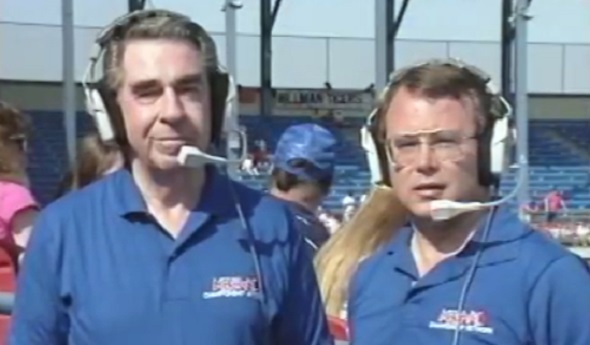
PHOTO: Paul Carey (left) and nephew Mike Carey broadcast the MHSAA 1992 Class D Baseball Final between Hillman and Athens for PASS.
'Field & Track' Earns Falcons' Latest Title
By
Paul Costanzo
Special for MHSAA.com
June 2, 2018
EAST KENTWOOD – Dave Emeott is making some changes to his East Kentwood boys track & field team this summer.
After the Falcons’ field events put on a dominant display Saturday to lead the team to a second straight Lower Peninsula Division 1 championship, Emeott feels it’s time for a new name.
“Officially now, for at least one year, we’re going to be East Kentwood Field & Track from now on,” Emeott said. “Everything changes, the Twitter page, the Facebook page, T-shirts will be made. The field events guys took a lot of pride, and it was fun because those were the first events of the morning. We came out of the morning with 40 points, or whatever they ended up scoring.”
East Kentwood finished with 61 points, well ahead of second-place Ann Arbor Pioneer, which had 39. Saline and Grand Blanc tied for third with 37 points, while Rockford was fifth with 35.
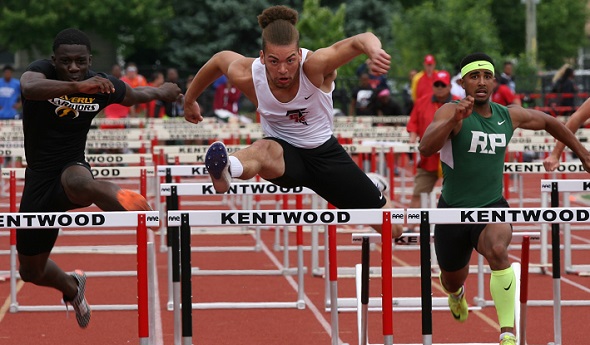
Logan Brown (shot put), Trevor Stephenson (pole vault) and Job Mayhue (110-meter hurdles) won individual titles for the Falcons, who have won seven of the last 10 team championships in the division. By the time Mayhue won the hurdles, the third running final of the day, his team already had 46 points, which would prove enough to clinch the title.
“When you look at where we won, it wasn’t just that we were overwhelmingly more talented than everybody; where the points were scored was in the technical events – shot put, long jump, pole vault – those three events alone we scored with seven guys in those events,” Emeott said. “Then the hurdles and the relays, that was really our day. It’s cool to do it in a different way.”
Stephenson’s pole vault title came after a head-to-head battle with Saline’s Eric Harris that featured multiple MHSAA Finals records. Stephenson won with a height of 16 feet, 9½ inches, a new all-division meet record. Harris took second at 16-6½, which also broke the previous record.
“I was surprised that I cleared that,” Stephenson said. “I was coming in thinking 16 feet might be the winning height, then Eric Harris from Saline just kept pushing the bar up and I just kept going with him. Eventually it got to 16-9½, and I just didn’t feel like it was there, and I got over and it was an amazing feeling.”
Mayhue won the hurdles with a time of 13.99 seconds, while Brown won the shot put with a throw of 57-1½.
Rockford’s Cole Johnson pulled off an impressive double in the 800 and 1,600, winning both with strong finishes. In the 800, he ran past a tight pack in the final 50 meters to win in 1:53.11, edging out Ann Arbor Pioneer’s Netunji Paige who finished in 1:53.41.
In the 1,600, Johnson took an early lead, then had to surge over the final lap to overtake a strong field and win in 4:08.47, less than two tenths of a second ahead of Pioneer’s Nick Foster who was second in 4:08.64.
 “My race plan in the beginning (of the 1,600) was to try and push the pace to try and beat our school record held by Dathan Ritzenhein, a 4:05.9,” Johnson said. “The first lap, I knew I was going to go out fast, and I just tried to keep pushing it the second and third lap, but I fell off a little bit. Then the race plan was just kind of holding form a little bit that last lap to try and get the win. I found a lot of energy from all the people supporting me and all the fans; it is packed here today. Winning the mile in Michigan is very prestigious, so that’s kind of what kept me going as I got passed on that last lap.”
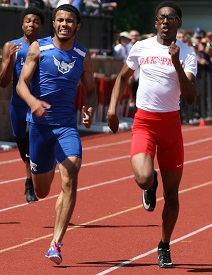
Oak Park’s Donnie James pulled off a double of his own, and was four hundredths of a second away from pulling off a triple. James ran 47.14 to hold off a strong field in the 400 meters, and 21.2 to squeak out a win in the 200. He finished second in the 100 with a time of 10.7, just edged by Eric Labonte of Traverse City West, who won in 10.66 seconds.
In the 400, James won from an outside lane, holding off charges from Saginaw Heritage’s Marcus Montgomery (47.65) and Ypsilanti Lincoln’s Matthew Moorer (47.79), who were chasing him from the inside.
“I had that mentality that I know I had to run at full speed because I had Matthew Moorer and Montgomery (behind me),” James said. “It was a lot of competition during that time, so I had to get my head geeked because I knew I had to run this to get first place for our team. My coach said catch the dude off the turn and to just run it like you did indoors.”
Lansing Waverly’s Keshaun Harris won the 300 hurdles in 37.81 seconds. Pioneer’s Foster won the 3,200 in 9:07.93. Grand Blanc’s Aidan Martini won the discus with a throw of 167-2. Traverse City Central’s Cassidy Henshaw won the high jump with a height of 6-9. West Bloomfield’s AJ Abbott won the long jump with a distance of 23-7¼.
Ann Arbor Pioneer (Foster, Paige, Aldo Pando-Girard and John Florence) won the 3,200 relay in 7:45.64. Detroit Martin Luther King (Jaeveyon Morton, Dylan Brown, Dequan Finn and Jalen McGaughy) won the 800 relay in 1:26.74. Farmington Hills Harrison (Moet Andrews, Alfred Hollie, Joe Stevens and Ben Williams) won the 400 relay out of the second heat with a time of 42.39. Grand Blanc (Austin Rippee, Victor Zarour, Jo Coleman and Jeronn Body) won the 1,600 relay in 3:20.48.
PHOTOS: (Top) East Kentwood’s Job Mayhue, middle, hurdles to the lead on the way to winning the 110 race. (Middle) Oak Park’s Donnie James, right, holds off Ypsilanti Lincoln’s Matthew Moorer in the 200. (Click for more from RunMichigan.com.)