


Rivaling for a Cause
January 25, 2013
It’s impossible to include all the perspective we gain from every “Battle of the Fans” visit.
But this anecdote, although it didn't make Tuesday’s story about our Frankenmuth trip, tells of another great example for what student cheering sections can accomplish.
Frankenmuth and Millington are heated rivals, to say the least, separated by 13 miles and made more competitive by plenty of championship-deciding matchups over the years.
But for their boys basketball game Jan. 10 at Frankenmuth, student section leaders from both schools almost completely on their own set up the game as a cancer awareness night, complete with Frankenmuth students in black shirts and Millington’s wearing pink.
The idea was the brainchild of a of Frankenmuth section leader, who then received help from a local bank and contacted Millington to get the ball rolling.
Battle of the Fans has shown us the obvious – these student sections need strong leaders – but also the special things they can accomplish with additional initiative.
“Never Forgotten”
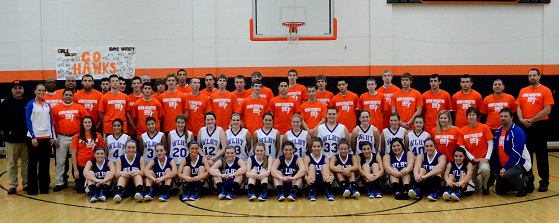 Two more rivals, Fennville and Saugatuck, met late last month for their second “Never Forgotten” boys and girls basketball games with proceeds going to the Wes Leonard Heart Team for the purchase of AEDs.
Players wore jerseys with names on the backs of friends and family members who had died, and those jerseys were then given to family members after the games. Officials Ace Cover, Chris Dennie and Kyle Bowen also donated their game checks to the Heart Team, as did the winner of that night’s 50-50 raffle.
Leonard died from sudden cardiac arrest after making the game-winning shot in a basketball game March 3, 2011. The two schools played their first “Never Forgotten” games last season.
More support for less specialization
I’m asked once a year at least about sport specialization – that is, athletes focusing on just one sport, often from an early age, and if it pays off some way down the road.
Most of my evidence to support my belief in the well-rounded athlete has been anecdotal, based on conversations with people at the high school and college levels over the years. But a British study published this fall in the Journal of Sport Sciences by University of Birmingham researchers provides some interesting empirical findings.
The study of 1,006 people from the United Kingdom showed that those who participated in three sports at ages 11, 13 and 15 were “significantly more likely to compete at a national rather than club standard” between ages 16-18 than those who had practiced only one sport.
In other words, the study found that those who played more sports at earlier ages played at a higher level during their high school-age years, which seems to contradict the one-sport focus philosophy.
Click for more perspective on the study from Chris Kennedy, the Superintendent of Schools in West Vancouver, British Columbia.
PHOTO: The boys and girls teams for Fennville and Saugatuck pose together after their "Never Forgotten" games Dec. 21 at Fennville High. (Photo courtesy of Al LaShell.)
Amrhein's Pin Run Highlights Another Record-Setting Finals for Dundee
By
Drew Ellis
Special for MHSAA.com
March 1, 2025
DETROIT – The Dundee wrestling program had another statement night at the 2025 MHSAA Individual Wrestling Finals.
The Vikings tied the MHSAA record for most individual champions in a single year with eight, matching their 2021 effort.
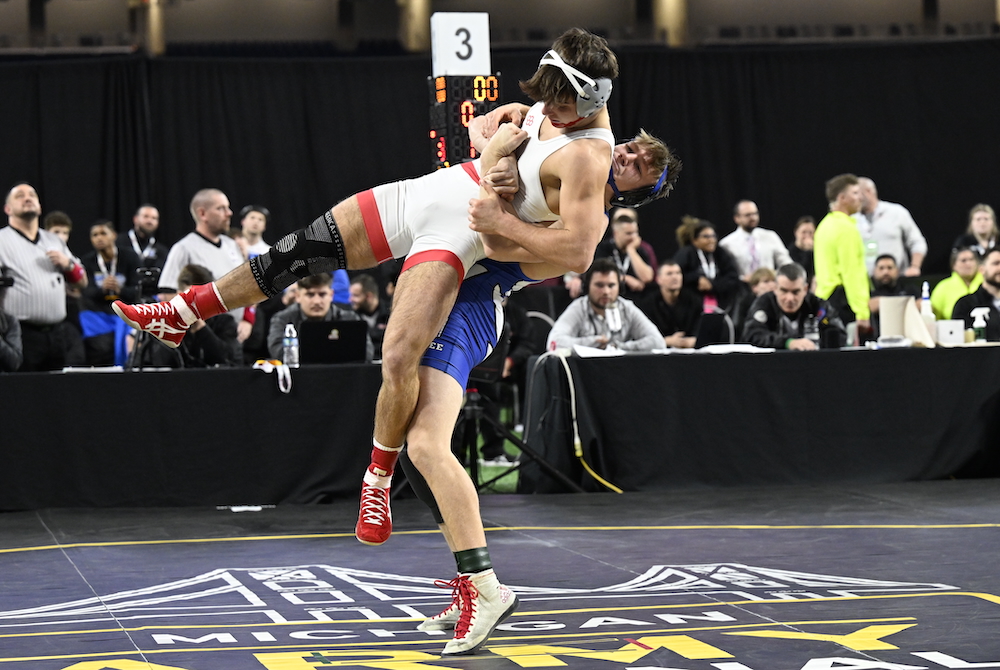
Of the eight champions, none was more impressive than junior Jeremy Amrhein, who won his first title at 157 pounds.
The junior ran through the competition all weekend, winning all of his four matches by pinfall during the first period.
The longest bout was Saturday’s championship, where Amrhein (45-6) defeated Constantine senior Brody Jones (55-2) in 1:17.
“I was just going out there and trying my best. It was my first time winning the state final, so I was nervous, but I just had to go out there and give it my all,” Amrhein said. “I think my cardio was where it needed to be this weekend. It has allowed me to become stronger and more dominant. I was expecting three periods for this final, but I will take the early night.”
Adding to the victory for Amrhein is that it also marked his 100th win of his high school career.
106
Champion: Danny Vaneeckhoutte, Erie-Mason, Soph. (46-2)
Decision, 5-3, over Branlun Simon, Portland, Soph. (45-5)
Vaneeckhoutte took a 5-0 lead midway through the final and held off a game Simon.
“I knew I had to dig deep,” Vaneeckhoutte said. “I knew the match was getting late and (Simon) got two, but I wasn’t going to give up. It felt great to hear that final whistle and be a champion.”
Vaneeckhoutte scored takedowns in each of the first two rounds. Simon threatened with a reversal in the third to make it 5-3, but couldn’t get any closer.
113
Champion: Mason Katschor, Dundee, Soph. (34-5)
Fall (3:45), over Mackey McClelland, Yale, Fr. (44-4)
Katschor won his second championship in as many years, as the sophomore pinned McClelland in the second period.
“It was on my mind all the time,” Katschor said of winning a second title. “I work hard all year for these moments.”
Katschor had an 8-1 lead after the first period and got a reversal to open the second, which eventually led to the pinfall.
120
Champion: Mason Haines, Dundee, Jr. (37-5)
Decision, 4-2, over Haydn Nutt, Dundee, Jr. (31-7)
After being forced to forfeit in the District Final and Regional Final, Haines finally got his match with Dundee teammate Nutt.
With things tied 1-1 in the third period after each scored an escape, it was Haines that managed a takedown that pushed him to the victory.
“After having to forfeit the last two tournaments, I was going to leave it all on the mat today,” Haines said. “I got what I wanted, a state title.”
126
Champion: Dale Gant, Grand Rapids Catholic Central, Jr. (40-1)
Technical Fall (5:02), 21-6, over Logan Whidden, Comstock Park, Sr. (33-4)
Gant cleared his third hurdle toward becoming the next four-time individual champion.
After winning the 113-pound title as a freshman in 2023, Gant won the 120-pound title as a sophomore in 2024.
This year, Gant scored seven takedowns to earn the technical fall and put his focus toward his senior season.
“That is everyone’s goal, to be a four-time state champion. Now that I have three, that is where my focus is,” Gant said. “It’s a lot of work, but it’s definitely a goal I have set for myself.”
132
Champion: Braden Broderick, Dundee, Jr. (35-10)
Decision, 1-0, over Lucky Gartin, Algonac, Sr. (53-6)
After finishing runner-up at 120 pounds last year, Broderick dug deep to win a low-scoring match in the 132-pound final Saturday.
After a scoreless first period, Broderick executed an escape to start the second, then rode Gartin for two minutes in the third to win, 1-0.
“We do these situations all the time in the practice room. I was tired, but I knew that was all that stood between me and a state title,” Broderick said of the third period. “I just wanted it more and got it done. Last year really stung, so it drove me each day and in that third period.”
138
Champion: Wyatt Burns, Dundee, Soph. (38-9)
Decision, 7-2, over Jacob Fink, Richmond, Sr. (39-9)
In a rematch from last week’s Regional Final that went to an ultimate tie-breaker, Burns made sure he left no doubt in Saturday’s championship match.
He scored a quick takedown in the opening period and then added another one late in the third to claim his first title.
“I just made sure to stay on my offense. I didn’t attack like I needed to last week. I think that was the difference this time,” Burns said. “I knew I had the speed and the takedowns to win. I just needed to believe in my abilities.”
144
Champion: Mikey Wilson, Grand Rapids Catholic Central, Sr. (46-1)
Technical Fall (5:14), 15-0, over Stone Redmon, Dundee, Fr. (43-14)
Wilson won his second consecutive championship in dominant fashion, not giving up a point.
He had a pair of takedowns that were followed by numerous near-fall points to earn the tech fall in the third.
His 144-pound title came a year after he won the 138-pound championship.
“If you put this tournament on too much of a pedestal, it’s going to impact how you wrestle, so I tried not to let the focus be on this match or winning another title, just going out and wrestling to the best of my ability,” Wilson said.
150
Champion: Blake Cosby, Dundee, Jr. (37-0)
Technical Fall (1:56), 19-4, over Bryson Boucher, Lakewood, Soph. (46-7)
Cosby completed an unbeaten season and won his second-consecutive championship with an impressive tech fall in the first period.
Cosby had five takedowns in the first and used some near-fall points to secure the win. Last year, he was the champion at 144 pounds.
“I wanted to go out and dominate. I knew I could do it; the training has been there,” Cosby said. “I know nobody is working as hard as me, so if I just go out and wrestle, I will get positive results.”
165
Champion: Donny Beaufait, Dundee, Jr. (47-1)
Fall (4:42), over Julian Walker, Algonac, Jr. (53-6)
Losing in the 2024 150-pound Final in an ultimate tie-breaker stuck with Beaufait throughout this season.
In Saturday’s 165-pound Final, he was going to leave no doubt.
With the match trending toward a technical fall in the third period, Beaufait managed to get Walker’s shoulders on the mat to close out his junior year with his first championship.
“The match last year affected how I approached this season in every way. From the summer, to lifting, to practices, to each match of the season, it drove me,” Beaufait said. “This year, I was going to make sure nobody but me decided how things were going to go.”
175
Champion: Kole Katschor, Dundee, Sr. (44-4)
Major Decision, 10-2, over Alex Hicks, Hart, Sr. (53-3)
Katschor secured his third-consecutive championship thanks to a pair of early takedowns that gave him a sizable lead.
“There was a little bit of pressure coming into this, but I am just glad I could end my career with a third state title,” Katschor said.
After winning the 150-pound championship as a sophomore and the 157-pound title as a junior, Katschor was the eighth and final champion on the night for the Vikings.
“It’s a great program with a lot of great wrestlers that do things the right way,” Katschor said of Dundee. “I am very proud to be able to be part of the success that Dundee has had.”
190
Champion: Gavin Craner, Whitehall, Sr. (58-0)
Major Decision, 11-0, over Rocco Redmon, Dundee, Jr. (27-5)
Craner concluded a second-consecutive unbeaten season with a dominant 11-0 victory.
He won the 175-pound title as a junior and went 112-0 over the last two years.
“I just had the mindset that nobody could touch me this weekend,” Craner said. “It’s been a tough season, but it’s all about keeping that positive mindset. If I am scoring points, I don’t think anyone can beat me.”
Craner got points in all three periods, scoring takedowns in the first and third, along with near-fall points in the second.
215
Champion: Wyatt Jenkins, Whitehall, Sr. (53-3)
Decision, 4-3, over Josh Petersen, Hillsdale, Sr. (50-4)
Jenkins had scored three first-round pins this weekend coming into Saturday’s Final.
However, Petersen gave him a championship-worthy match.
After Jenkins established a 4-0 lead in the first period, Petersen fought back to cut the deficit to one point. But Jenkins managed to hold on, driven by the motivation of his ailing grandfather.
“My grandfather is at home and not sure how much time he has left, so that was what was on my mind today and what was pushing me in that third round,” Jenkins said. “I am proud to be a state champion, but I really just wanted to do it for him more than myself. It feels good to get this for him.”
285
Champion: Reid Hiltunen, Algonac, Sr. (55-1)
Major Decision, 11-1, over Joel Simon, Lake Odessa Lakewood, Sr. (49-5)
Hiltunen stormed out to an 11-0 lead after one period and then did his part to keep Simon from getting back in the match, securing his first championship.
“I felt like I could dominate on my feet and on top,” Hiltunen said. “The first period was great, being able to put up 11 points. My mindset all year had been to win this, and it feels amazing to have it all come together.
Hiltunen scored a takedown in the first period and then had two near-fall attempts score four points each. Simon wasn’t able to mount much offense from there, as Hiltunen proved to be elusive.
PHOTO Dundee’s Jeremy Amrhein, in blue, hoists his opponent into the air during their Division 3 championship match. (Click for more from High School Sports Scene.)