


Rivaling for a Cause
January 25, 2013
It’s impossible to include all the perspective we gain from every “Battle of the Fans” visit.
But this anecdote, although it didn't make Tuesday’s story about our Frankenmuth trip, tells of another great example for what student cheering sections can accomplish.
Frankenmuth and Millington are heated rivals, to say the least, separated by 13 miles and made more competitive by plenty of championship-deciding matchups over the years.
But for their boys basketball game Jan. 10 at Frankenmuth, student section leaders from both schools almost completely on their own set up the game as a cancer awareness night, complete with Frankenmuth students in black shirts and Millington’s wearing pink.
The idea was the brainchild of a of Frankenmuth section leader, who then received help from a local bank and contacted Millington to get the ball rolling.
Battle of the Fans has shown us the obvious – these student sections need strong leaders – but also the special things they can accomplish with additional initiative.
“Never Forgotten”
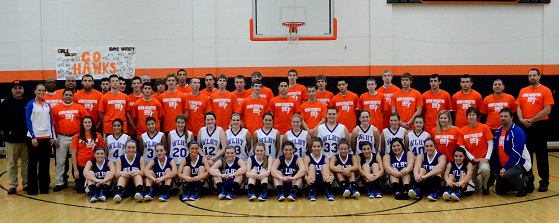 Two more rivals, Fennville and Saugatuck, met late last month for their second “Never Forgotten” boys and girls basketball games with proceeds going to the Wes Leonard Heart Team for the purchase of AEDs.
Players wore jerseys with names on the backs of friends and family members who had died, and those jerseys were then given to family members after the games. Officials Ace Cover, Chris Dennie and Kyle Bowen also donated their game checks to the Heart Team, as did the winner of that night’s 50-50 raffle.
Leonard died from sudden cardiac arrest after making the game-winning shot in a basketball game March 3, 2011. The two schools played their first “Never Forgotten” games last season.
More support for less specialization
I’m asked once a year at least about sport specialization – that is, athletes focusing on just one sport, often from an early age, and if it pays off some way down the road.
Most of my evidence to support my belief in the well-rounded athlete has been anecdotal, based on conversations with people at the high school and college levels over the years. But a British study published this fall in the Journal of Sport Sciences by University of Birmingham researchers provides some interesting empirical findings.
The study of 1,006 people from the United Kingdom showed that those who participated in three sports at ages 11, 13 and 15 were “significantly more likely to compete at a national rather than club standard” between ages 16-18 than those who had practiced only one sport.
In other words, the study found that those who played more sports at earlier ages played at a higher level during their high school-age years, which seems to contradict the one-sport focus philosophy.
Click for more perspective on the study from Chris Kennedy, the Superintendent of Schools in West Vancouver, British Columbia.
PHOTO: The boys and girls teams for Fennville and Saugatuck pose together after their "Never Forgotten" games Dec. 21 at Fennville High. (Photo courtesy of Al LaShell.)
Block Party: 2026 Girls Volleyball Week 7 Report
By
Geoff Kimmerly
MHSAA.com senior editor
October 7, 2026
Just as the girls volleyball regular season begins speeding toward its conclusion, clicks on our Michigan Power Ratings (MPR) page are sure to accelerate over the next three weeks.
District play begins Nov. 2, and brackets will be announced eight days earlier on Oct. 25. MPR is used to seed the top two teams in every District, and although there’s only one example below, references to how teams stack up on those lists will become more prevalent in our weekly reports as we close in on the start of the playoffs.
Records below are those reported and tracked on this website, and rankings referred to below reflect the latest polls posted by the Michigan Interscholastic Volleyball Coaches Association (MIVCA).
Week in Review
The countdown of last week’s five most intriguing results:
1. Saginaw Valley Lutheran d. Plymouth Christian Academy (25-21, 25-17) The Division 3 top-ranked Chargers (36-4-1) finished 6-0 at the D3/D4 Showcase, with this win arguably the most notable as Valley Lutheran remains No. 1 statewide this week but PCA (21-6-4) bumped up from honorable mention to No. 2.
2. Grand Rapids Christian d. Hudsonville (25-19, 25-19) Division 2 top-ranked Christian (22-3) avenged a pool play loss to Division 1 No. 5 Hudsonville (26-3) at the Jenison Invitational to win this rematch in the championship round.
3. Orchard Lake St. Mary’s d. Detroit Country Day (25-19, 25-16, 25-23) The Division 1 honorable mention Eaglets (13-8-1) continued their climb with a sweep of the two-time reigning Division 2 champion and current No. 2 Yellowjackets (12-6-1).
4. Kingsley d. Elk Rapids (25-15, 25-17, 25-11) This Northern Shores Conference matchup saw a pair of ranked teams face off and the Division 2 No. 5 Stags (29-3-1) prevail over the Division 3 No. 5 Elks (13-7-3).
5. Muskegon Western Michigan Christian d. Hart (24-26, 27-25, 25-18) While Division 3 No. 3 WMC went on to defeat Fruitport and Muskegon Mona Shores to win the latter’s Best of the West tournament, this win over No. 10 Hart (19-10-3) sticks out as well as the Warriors (23-2) came back after losing the first set.
Watch List
With an eye toward November, here are two teams in each division making sparks:
DIVISION 1
Grand Rapids Forest Hills Northern (22-8) The honorable mention Huskies opened this week with a notable four-set victory over honorable mention East Grand Rapids, which is listed ahead of FHN in Division 1 MPR. Six of Forest Hills Northern’s losses have come against top-10 teams in Division 1, and six wins have come against opponents ranked or honorable mentions in Divisions 1 or 2, including Division 1 No. 4 Byron Center.
Hudsonville (26-3) The No. 5 Eagles were runners-up at the Jenison Invitational thanks to a split with Division 2 top-ranked Grand Rapids Christian, but that championship match defeat broke a 13-match winning streak. The Eagles’ only other losses have come versus Brighton and Division 1 No. 2 Bloomfield Hills Marian, and Hudsonville has defeated No. 8 Lowell, honorable mention Forest Hills Northern twice, No. 4 Byron Center, No. 9 Grand Haven, No. 7 South Lyon East, honorable mention South Lyon twice and GR Christian another time as well.
DIVISION 2
Ann Arbor Father Gabriel Richard (25-3-2) The Irish are an honorable mention in Division 2 and finished second in the Catholic High School League AA to Dearborn Divine Child, thanks to early-September back-to-back league losses to the Falcons and Jackson Lumen Christi. FGR’s only other defeat came to No. 3 Parma Western during opening weekend, and the Irish have won 16 straight matches and their last three tournaments.
Edwardsburg (21-5) The No. 7 Eddies defeated honorable mention Marshall and Division 1 honorable mention Zeeland East over four wins to claim the Portage Central Tournament title on Saturday, and their win over the host Mustangs also avenged Edwardsburg’s most recent loss from Sept. 19. A championship at the Gull Lake Invitational to start this season included a win over Niles, which ended the Eddies’ 2025.
DIVISION 3
Calumet (14-9-1) After opening the season 0-4 at the Cadillac Invitational – which included defeats against Division 1 honorable mention Zeeland East, Division 3 No. 8 Cass City and honorable mention Manton – the honorable mention Copper Kings are 8-2-1 against in-state opponents. They’ve defeated Division 4 No. 7 Crystal Falls Forest Park and went five sets before losing to Division 4 No. 9 Hancock, and they saw more of the state’s best taking a loss but also tying Division 3 No. 2 Plymouth Christian Academy at the D3/D4 Showdown.
Plymouth Christian Academy (21-6-4) The Eagles returned to the Quarterfinals a year ago and are in the midst of an 8-1-1 surge this fall that’s sent them back up to No. 2 in the weekly coaches poll. Their D3/D4 Showdown weekend included the above-noted loss to No. 1 Valley Lutheran but also wins over No. 5 Clinton, No. 8 Cass City and honorable mention Calumet among others. Only two other losses this season came to Division 3 or 4 opponents.
DIVISION 4
Crystal Falls Forest Park (26-3-1) The Trojans reached the Semifinals last season for the third time in four years and haven’t slowed down, falling only to No. 4 Traverse City Christian, No. 9 Hancock and Division 3 honorable mention Calumet. They’re up to No. 7 in the Division 4 rankings while riding a 14-match winning streak and coming off a 6-0 day at the Escanaba Invitational. An opening-weekend trip downstate included the loss to TC Christian but also a win over No. 10 Onekama and tie versus No. 3 Mount Pleasant Sacred Heart.
Traverse City Christian (23-5) The No. 4-ranked Sabres have strung together two straight trips to the Quarterfinals and won their first 10 matches this fall including a three-setter over Division 3 top-ranked Saginaw Valley Lutheran. The losses are pretty impressive as well, to Division 3 No. 3 Roscommon, twice to Division 3 No. 7 Traverse City St. Francis, and then to Division 4 No. 3 Mount Pleasant Sacred Heart and No. 10 Onekama. A home match against Division 3 No. 5 Elk Rapids on Oct. 15 will be another important test.
Can’t-Miss Contests
Be on the lookout for results of these matches and tournaments coming up:
Thursday – Baraga (19-0) at Hancock (17-2-1) – The undefeated Vikings have an opportunity to establish themselves among Division 4 teams to watch with this trip to meet the No. 9 Bulldogs.
Saturday – Motor City Power Series Championship at UWM Sports Complex – The finale of this season’s series begins with power brackets, and the most intriguing includes Division 1 No. 6 Utica Eisenhower, honorable mention Orchard Lake St. Mary’s, Rochester Adams and Division 2 No. 9 North Branch.
Saturday – Hanover-Horton Invitational – An impressive field of 12 teams includes Division 2 No. 3 Parma Western, Division 3 No. 2 Plymouth Christian Academy, No. 6 Grass Lake, No. 7 Traverse City St. Francis and the honorable mention Comets, and Division 4 top-ranked Adrian Lenawee Christian and No. 2 Battle Creek St. Philip.
Monday – Roscommon Quad – Mount Pleasant (20-8-2), Essexville Garber (22-11-4) and Division 3 No. 7 Traverse City St. Francis (21-9-1) will join the No. 3-ranked Bucks (26-6-5) for a high-powered night.
Monday – Midland Dow Quad – Another impressive group will visit the Chargers (31-4-4), with Bay City Central, Division 2 No. 4 Frankenmuth (17-0) and Division 3 No. 1 Saginaw Valley Lutheran (36-4-1) taking the court.
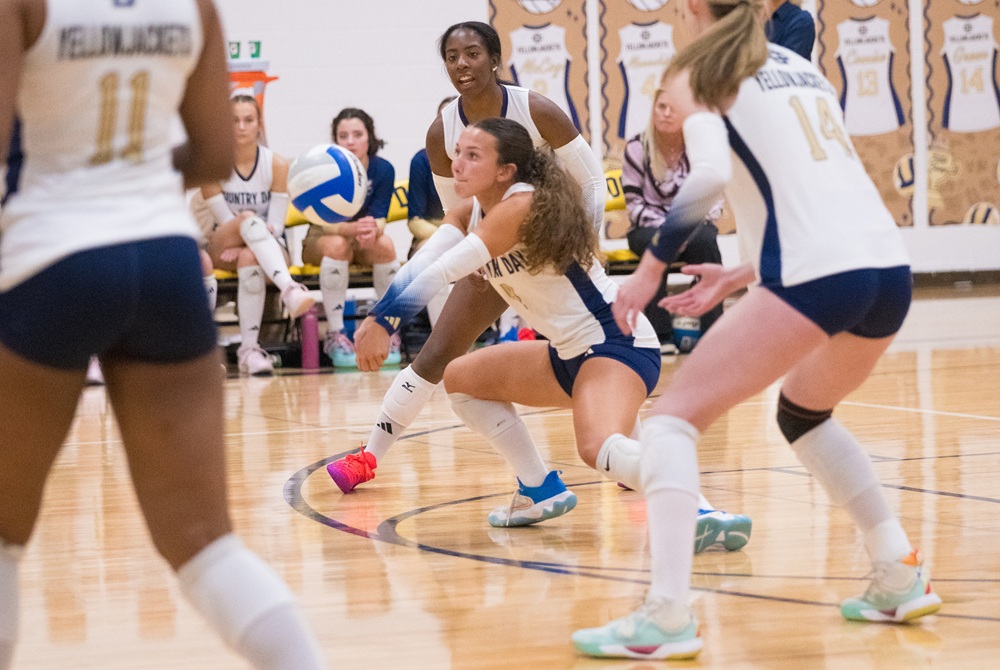
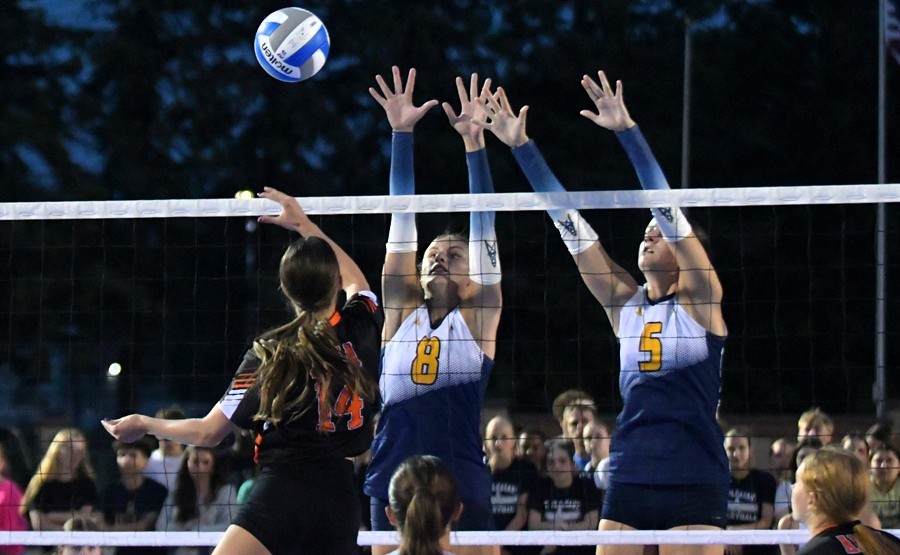
PHOTOS (Top) Detroit Country Day’s Sienna Musachio (14) gets positioned to play the ball during her team’s sweep of Macomb L’Anse Creuse North on Monday. (Middle) A pair of Mount Pleasant blockers rise above the net during an outdoor match against Alma this fall. (Country Day photo by TCP Photography. Mount Pleasant/Alma photo by High School Sports Scene.)