


Rivaling for a Cause
January 25, 2013
It’s impossible to include all the perspective we gain from every “Battle of the Fans” visit.
But this anecdote, although it didn't make Tuesday’s story about our Frankenmuth trip, tells of another great example for what student cheering sections can accomplish.
Frankenmuth and Millington are heated rivals, to say the least, separated by 13 miles and made more competitive by plenty of championship-deciding matchups over the years.
But for their boys basketball game Jan. 10 at Frankenmuth, student section leaders from both schools almost completely on their own set up the game as a cancer awareness night, complete with Frankenmuth students in black shirts and Millington’s wearing pink.
The idea was the brainchild of a of Frankenmuth section leader, who then received help from a local bank and contacted Millington to get the ball rolling.
Battle of the Fans has shown us the obvious – these student sections need strong leaders – but also the special things they can accomplish with additional initiative.
“Never Forgotten”
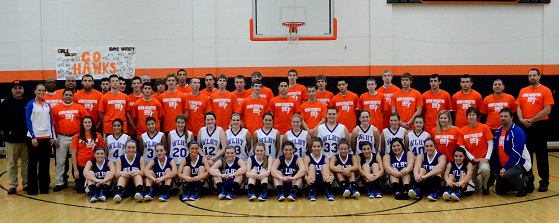 Two more rivals, Fennville and Saugatuck, met late last month for their second “Never Forgotten” boys and girls basketball games with proceeds going to the Wes Leonard Heart Team for the purchase of AEDs.
Players wore jerseys with names on the backs of friends and family members who had died, and those jerseys were then given to family members after the games. Officials Ace Cover, Chris Dennie and Kyle Bowen also donated their game checks to the Heart Team, as did the winner of that night’s 50-50 raffle.
Leonard died from sudden cardiac arrest after making the game-winning shot in a basketball game March 3, 2011. The two schools played their first “Never Forgotten” games last season.
More support for less specialization
I’m asked once a year at least about sport specialization – that is, athletes focusing on just one sport, often from an early age, and if it pays off some way down the road.
Most of my evidence to support my belief in the well-rounded athlete has been anecdotal, based on conversations with people at the high school and college levels over the years. But a British study published this fall in the Journal of Sport Sciences by University of Birmingham researchers provides some interesting empirical findings.
The study of 1,006 people from the United Kingdom showed that those who participated in three sports at ages 11, 13 and 15 were “significantly more likely to compete at a national rather than club standard” between ages 16-18 than those who had practiced only one sport.
In other words, the study found that those who played more sports at earlier ages played at a higher level during their high school-age years, which seems to contradict the one-sport focus philosophy.
Click for more perspective on the study from Chris Kennedy, the Superintendent of Schools in West Vancouver, British Columbia.
PHOTO: The boys and girls teams for Fennville and Saugatuck pose together after their "Never Forgotten" games Dec. 21 at Fennville High. (Photo courtesy of Al LaShell.)
Hartland's Fundich Puts 'Fun' In Finals Championship Run, Ends Career No. 1
By
Brad Emons
Special for MHSAA.com
March 7, 2026
HIGHLAND TOWNSHIP – Hartland’s Alexis Fundich was on a mission during Saturday’s MHSAA Individual Finals at Milford High School.
The senior, who led the Eagles to their second-straight team championship just the night before, captured the Division 1 all-round with a score of 38.625 after placing runner-up a year ago.
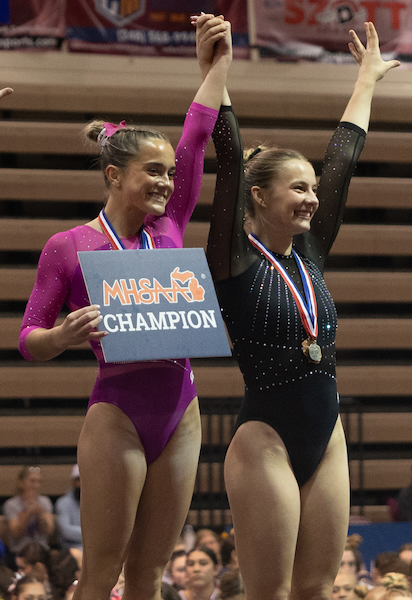
Huron Valley United’s Stella Musialowski was second (36.60), with Farmington United’s Mikayla Dicks (37.25), Tecumseh’s Isabella Janiga (35.875) and Northville’s Michelle Walker (35.85) rounding out the top five.
“Mostly I just tried to have fun and not let the nerves take over, which happened, so it went well,” Fundich said. “I definitely was nervous, but I didn’t want to let it control me throughout the meet. I let fun control me instead.”
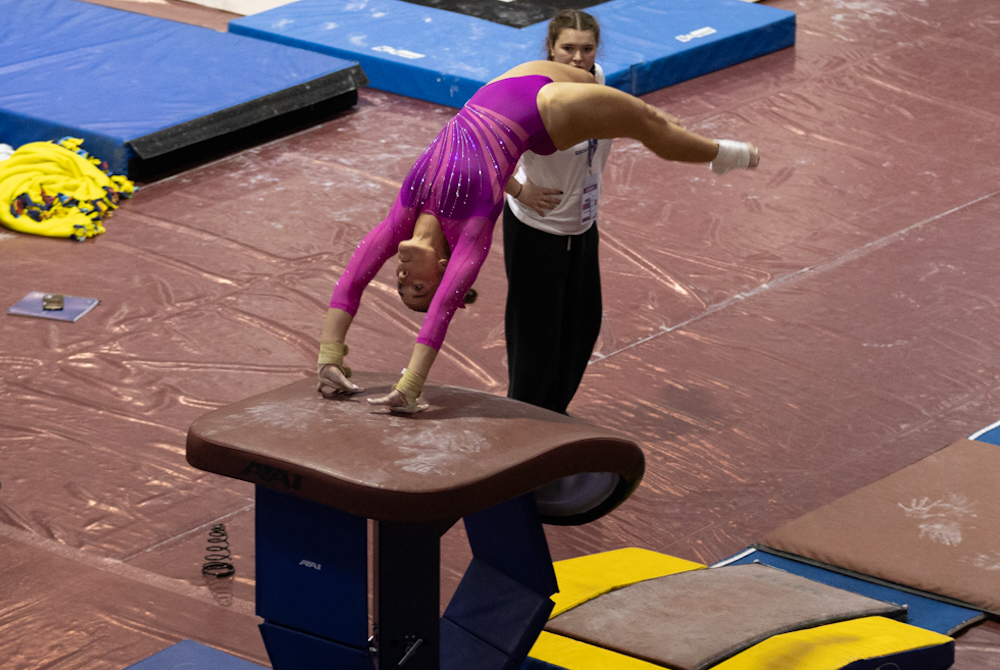
Fundich, who joined the Hartland team her sophomore year, captured three events including the balance beam (9.725), uneven bars (9.4) and floor exercise, while adding a second in the vault (9.8).
 “I was really happy with my floor score,” Fundich said. “I broke the record for floor on my team, so I was really excited about that.”
Fundich hopes to continue her gymnastics career in college, but is undecided about her next destination.
“That’s my goal. I’m still figuring that out,” Fundich said.
Musialowski, competing on her home floor, also turned in a stellar performance to pass Dicks (37.25), who was competing at her first MHSAA Finals.
The Milford gymnast had finished sixth a year ago after taking 15th as a sophomore. This time, she placed runner-up on beam (9.625), tied for third on bars (9.15) and floor (9.425), and fourth on vault (9.4),
“I was just definitely trying to do my best today,” Musialowski said. “I wanted to finish off my last competition well, and I definitely think I did.
“Beam always clicks a little bit more than the others for me. It’s my favorite. I find it really peaceful to do.”
Musialowski, who plans to attend Michigan State and study nursing, also juggled gymnastics during the winter with competitive cheer.
“I helped out our cheer team, but other than that I’ve solely been doing gymnastics my whole life,” said Musialowski, who joined the Huron Valley team her sophomore year. “My freshman year I did cheer, and then I realized I liked gymnastics and came back.”
Musialowski said most likely her competitive gymnastics days are over.
“It’s been a long run – 15 years – I’m definitely starting to get tired of it, but I’m not fully certain on it yet,” she said.
Hartland’s Kate Gostlin was the other D1 individual victor with a 9.8 in the vault.
 “They all went out there, they had a mission and took care of business,” Hartland coach Gavin Kress said. “It’s gymnastics, they’re always nervous. Today coming in strong. They came in knowing what they were doing.”
Meanwhile, the Division 2 all-around title went to Haslett United’s Phoebe Elder, who placed first with a total of 36.675.
She was able to hold off challenges by three Rockford competitors including Lillian Green (36.550), Rae DeFrang (36.025) and Reese DeFrang (35.900). Farmington United’s Aubrey Woodman took fifth (35.625).
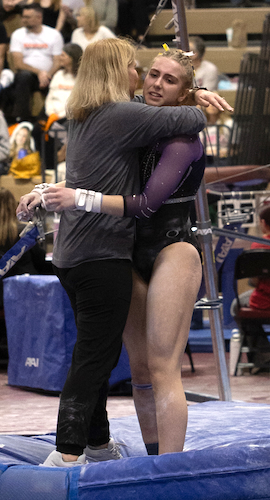
Elder finished runner-up on bars (9.1), third on floor (9.425), fourth on the beam (9.1) and tied for sixth in the vault (9.05).
“Very surprised and very happy for sure,” said Elder, who will attend Northwestern University and study biology. “I stuck a vault, which I don’t think I have all season.”
Other individual D2 winners included Rockford’s Green in vault (9.625), Rae DeFrang on bars (9.125) and Kenzie Todd on beam (9.275). East Lansing Catholic DeWitt’s Taliyah Andrews won the floor exercise (9.555).
PHOTOS (Top) Hartland’s Alexis Fundich vaults during Saturday’s Individual Finals at Milford. (Middle) Fundich, left, and Huron Valley United’s Stella Musialowski hold hands for their salute from the podium. (Below) Haslett United’s Phoebe Elder, right, receives a hug after her bars routine. (Click for more from High School Sports Scene.)