


Rivaling for a Cause
January 25, 2013
It’s impossible to include all the perspective we gain from every “Battle of the Fans” visit.
But this anecdote, although it didn't make Tuesday’s story about our Frankenmuth trip, tells of another great example for what student cheering sections can accomplish.
Frankenmuth and Millington are heated rivals, to say the least, separated by 13 miles and made more competitive by plenty of championship-deciding matchups over the years.
But for their boys basketball game Jan. 10 at Frankenmuth, student section leaders from both schools almost completely on their own set up the game as a cancer awareness night, complete with Frankenmuth students in black shirts and Millington’s wearing pink.
The idea was the brainchild of a of Frankenmuth section leader, who then received help from a local bank and contacted Millington to get the ball rolling.
Battle of the Fans has shown us the obvious – these student sections need strong leaders – but also the special things they can accomplish with additional initiative.
“Never Forgotten”
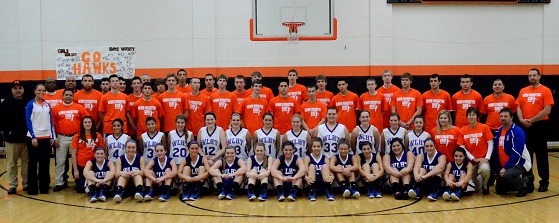 Two more rivals, Fennville and Saugatuck, met late last month for their second “Never Forgotten” boys and girls basketball games with proceeds going to the Wes Leonard Heart Team for the purchase of AEDs.
Players wore jerseys with names on the backs of friends and family members who had died, and those jerseys were then given to family members after the games. Officials Ace Cover, Chris Dennie and Kyle Bowen also donated their game checks to the Heart Team, as did the winner of that night’s 50-50 raffle.
Leonard died from sudden cardiac arrest after making the game-winning shot in a basketball game March 3, 2011. The two schools played their first “Never Forgotten” games last season.
More support for less specialization
I’m asked once a year at least about sport specialization – that is, athletes focusing on just one sport, often from an early age, and if it pays off some way down the road.
Most of my evidence to support my belief in the well-rounded athlete has been anecdotal, based on conversations with people at the high school and college levels over the years. But a British study published this fall in the Journal of Sport Sciences by University of Birmingham researchers provides some interesting empirical findings.
The study of 1,006 people from the United Kingdom showed that those who participated in three sports at ages 11, 13 and 15 were “significantly more likely to compete at a national rather than club standard” between ages 16-18 than those who had practiced only one sport.
In other words, the study found that those who played more sports at earlier ages played at a higher level during their high school-age years, which seems to contradict the one-sport focus philosophy.
Click for more perspective on the study from Chris Kennedy, the Superintendent of Schools in West Vancouver, British Columbia.
PHOTO: The boys and girls teams for Fennville and Saugatuck pose together after their "Never Forgotten" games Dec. 21 at Fennville High. (Photo courtesy of Al LaShell.)
Rep Council Wrap-Up: Fall 2021
By
Geoff Kimmerly
MHSAA.com senior editor
December 9, 2021
The authorization to use digital ticketing for Winter and Spring postseason events, an extension of the waiver for previous academic credit record and an adjustment to regular-season multi-media video regulations were the most notable actions taken by the Representative Council of the Michigan High School Athletic Association during its Fall Meeting on Dec. 3 in East Lansing.
Generally, the Council takes only a few actions during its Fall Meeting, with topics often introduced for additional consideration and action during its meetings in winter and spring. This Fall Meeting saw the Council take only a few actions, while the majority of discussion centered on topics expected to receive more specific consideration at MHSAA sport committee meetings this winter.
The Council approved the continued use of the GoFan digital ticketing system for the MHSAA’s Winter and Spring Tournament events. The MHSAA first began using GoFan digital ticketing during the 2020-21 school year to comply with state contact tracing requirements due to COVID-19, and continued with digital ticketing via that service this fall. Tickets from GoFan are purchased on a phone or other “smart” device, eliminating the exchange of cash and other contact at an event site.
Also due to COVID, and the related challenges of remote learning, the MHSAA had suspended its previous academic credit record rule requiring high school students to pass at least 66 percent of a full credit load during the previous academic term (semester or trimester) in order to be eligible for athletic activity. Middle school and junior high athletes must pass at least 50 percent of a full credit load. Based on member school feedback and input, the Council voted to continue suspension of this rule through the rest of the 2021-22 school year, but reinstate the regulation beginning Aug. 1, 2022. The MHSAA’s previous academic credit record rule serves as a minimum standard; school districts may mandate higher academic requirements for eligibility.
The Council also approved an adjustment to the MHSAA’s video broadcast rules for regular-season events. Previously, those broadcasts could only be delivered to audiences through the National Federation of State High School Associations (NFHS) Network, or via a school-controlled webpage or social media page. The Council approved a change to provide an opportunity for schools, for regular-season events only, to allow MHSAA Tournament-credentialed media to broadcast their home events live, as long as a school is a member of the NFHS Network – which includes more than 520 of the MHSAA’s 750 member high schools. Postseason rights continue to belong to the MHSAA and its media partners.
A number of remaining discussions focused on results from this fall’s Update Meeting survey completed by administrators during the MHSAA’s annual presentations across the state. The Council considered survey data on a number of questions including whether the 11 and 8-Player Football Playoffs should be expanded to include nearly all schools. The Council also discussed questions on sports physicals, classification for postseason tournaments, sports-related summer transportation and contact days for coaches from teams not in season to work with their athletes, among other topics.
The Fall Meeting saw the addition of Ann Arbor Greenhills athletic director Meg Seng and Westland John Glenn athletic director Jason Malloy to the 19-person Council. Seng was appointed to a two-year term, and Malloy was appointed to finish the two-year term of former Romulus Summit Academy North athletic director William McCoy, who became part of the MHSAA staff in July. Also, Kris Isom, athletic director at Adrian Madison High School, was appointed to a second two-year term.
The Council reelected Scott Grimes, deputy superintendent for Grand Haven Area Public Schools, as its president; and Vic Michaels, director of physical education and athletics for the Archdiocese of Detroit, as secretary-treasurer. Novi High School principal Nicole Carter was elected Council vice president. (Grimes will become Grand Haven Schools’ superintendent Jan. 1.)
The Representative Council is the legislative body of the MHSAA. All but five members are elected by member schools. Four members are appointed by the Council to facilitate representation of females and minorities, and the 19th position is occupied by the Superintendent of Public Instruction or designee.
The MHSAA is a private, not-for-profit corporation of voluntary membership by more than 1,500 public and private senior high schools and junior high/middle schools which exists to develop common rules for athletic eligibility and competition. No government funds or tax dollars support the MHSAA, which was the first such association nationally to not accept membership dues or tournament entry fees from schools. Member schools which enforce these rules are permitted to participate in MHSAA tournaments, which attract more than 1.4 million spectators each year.