


Rivaling for a Cause
January 25, 2013
It’s impossible to include all the perspective we gain from every “Battle of the Fans” visit.
But this anecdote, although it didn't make Tuesday’s story about our Frankenmuth trip, tells of another great example for what student cheering sections can accomplish.
Frankenmuth and Millington are heated rivals, to say the least, separated by 13 miles and made more competitive by plenty of championship-deciding matchups over the years.
But for their boys basketball game Jan. 10 at Frankenmuth, student section leaders from both schools almost completely on their own set up the game as a cancer awareness night, complete with Frankenmuth students in black shirts and Millington’s wearing pink.
The idea was the brainchild of a of Frankenmuth section leader, who then received help from a local bank and contacted Millington to get the ball rolling.
Battle of the Fans has shown us the obvious – these student sections need strong leaders – but also the special things they can accomplish with additional initiative.
“Never Forgotten”
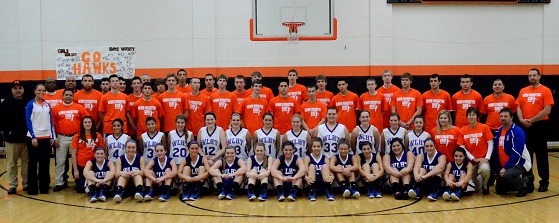 Two more rivals, Fennville and Saugatuck, met late last month for their second “Never Forgotten” boys and girls basketball games with proceeds going to the Wes Leonard Heart Team for the purchase of AEDs.
Players wore jerseys with names on the backs of friends and family members who had died, and those jerseys were then given to family members after the games. Officials Ace Cover, Chris Dennie and Kyle Bowen also donated their game checks to the Heart Team, as did the winner of that night’s 50-50 raffle.
Leonard died from sudden cardiac arrest after making the game-winning shot in a basketball game March 3, 2011. The two schools played their first “Never Forgotten” games last season.
More support for less specialization
I’m asked once a year at least about sport specialization – that is, athletes focusing on just one sport, often from an early age, and if it pays off some way down the road.
Most of my evidence to support my belief in the well-rounded athlete has been anecdotal, based on conversations with people at the high school and college levels over the years. But a British study published this fall in the Journal of Sport Sciences by University of Birmingham researchers provides some interesting empirical findings.
The study of 1,006 people from the United Kingdom showed that those who participated in three sports at ages 11, 13 and 15 were “significantly more likely to compete at a national rather than club standard” between ages 16-18 than those who had practiced only one sport.
In other words, the study found that those who played more sports at earlier ages played at a higher level during their high school-age years, which seems to contradict the one-sport focus philosophy.
Click for more perspective on the study from Chris Kennedy, the Superintendent of Schools in West Vancouver, British Columbia.
PHOTO: The boys and girls teams for Fennville and Saugatuck pose together after their "Never Forgotten" games Dec. 21 at Fennville High. (Photo courtesy of Al LaShell.)

NFHS Voice: Planning with Patience
May 30, 2020
By Karissa Niehoff
NFHS Executive Director
For several weeks, Americans have been awaiting answers to several questions. When will restaurants restart dine-in services? When will hair salons and gyms be open? When will people be able to congregate for worship services? And, of course, when will education-based sports and performing arts programs return?
And the answer to the all-important last question is the same as the first three – it varies from state to state.
If there was ever any doubt about the popularity and interest in high school sports and performing arts – and how much these programs have been missed during the past three months – it was erased last week as the NFHS released its Guidance for Opening Up High School Athletics and Activities document.
The response was non-stop through the mainstream media as well as our social media platforms as the first nationwide discussion about the return of high school sports and other activities was in full swing.
Since that disappointing week in mid-March when it seemed like all of life came to a halt, millions of people – from high school students, coaches, parents, administrators, officials and fans – have been looking forward to the return of school-based sports and other activity programs. And the guidance document offered some hope that soon the light at the end of tunnel will not be the oncoming train we have felt for many weeks.
Now, state high school associations are developing timetables and protocols for return of activities in their states. And those guidelines will be different from state to state. This is not a one-size-fits-all plan. Depending on the specific circumstances of a state with respect to the containment of the virus, its progression through the various phases of returning to activities could be much different than another state.
As the guidance document developed by the NFHS Sports Medicine Advisory Committee noted, our hope is that students can return to school-based athletics and activities in any and all situations where it can be done smartly. When it comes to education-based sports and performing arts within our nation’s schools, nothing is more important than the health and safety of the participants AND the individuals conducting those programs.
Some individuals have expressed concern that our guidance document is too cautious, noting that some non-school youth programs have already restarted in some areas.
In one state this past week, a non-school sports program was allowed to restart because the “data shows children are less affected by the coronavirus.” While the preponderance of evidence shows that to be true, plans in education-based activities will include also protection for adults who coach, officiate and administer those events, which may be seen as a more conservative approach.
Within high school sports, the drive of coaches and dreams of parents cannot run ahead of player safety. Last week, a successful high school football coach with three previous state titles was suspended for allegedly holding practices. And there have been reports of parents considering moving to another state with fewer COVID-19 cases to enhance the chance of their son playing football and earning a college scholarship.
The NFHS, through its Sports Medicine Advisory Committee, took action in developing its Guidance for Opening Up High School Athletics and Activities document. The various state high school associations are taking action in the coming weeks in developing plans for a return to activities at the state level.
Now, we would ask parents and other fans to take action – and that action is patience. The urge to return to normal is understandable, but the path back to where we were three months ago will take time, and that “time” will not happen at the expense of the safety and well-being of everyone involved in high school sports and performing arts programs.
Dr. Karissa L. Niehoff is in her second year as executive director of the National Federation of State High School Associations (NFHS) in Indianapolis, Indiana. She is the first female to head the national leadership organization for high school athletics and performing arts activities and the sixth full-time executive director of the NFHS, which celebrated its 100th year of service during the 2018-19 school year. She previously was executive director of the Connecticut Association of Schools-Connecticut Interscholastic Athletic Conference for seven years.