

Special Year Thanks to No Specialization
August 7, 2015
By Geoff Kimmerly
Second Half editor
As we embark on another sports-filled school year Monday, we can look to a recent Monroe St. Mary Catholic Central grad for the value of a school year filled with sports.
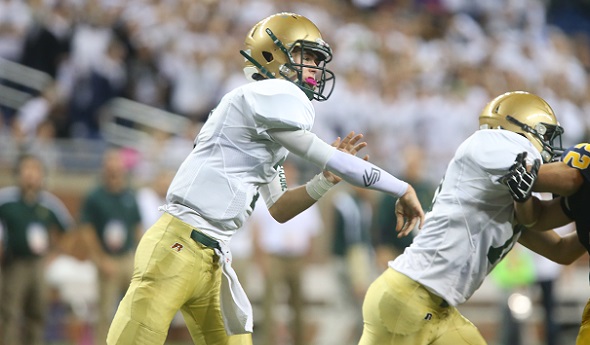
As specialization at the highs school level continues to be debated, Bryce Windham will start his college baseball career this fall at Division I Old Dominion University – after playing baseball but also football and basketball for the Falcons.
 The MHSAA has long advocated athletes taking on as many sports as they have interest instead of focusing on just one in pursuit of a college scholarship – a position that’s received plenty of public backing of late, be it from stars of the U.S. women’s soccer team after their World Cup championship run or former Lansing Waverly multi-sport athlete John Smoltz during his enshrinement in the Major League Baseball Hall of Fame.
Enter Windham – who easily could’ve been excused for focusing on baseball, or even basketball as his dad is the St. Mary’s varsity boys coach. Instead, Bryce quarterbacked the football team to last season’s Division 6 championship – breaking Ithaca’s national-best 69-game winning streak in the Final – before being named Class C Player of the Year by The Associated Press in basketball and earning a Most Valuable Player honor at the baseball state coaches association all-star game at Comerica Park this spring.
All three of Windham's teams reached at least the MHSAA Quarterfinals.
“His participation in football and basketball helped land a Division 1 baseball scholarship to Old Dominion. They were able to see his athleticism in basketball and toughness in football, and ODU’s coach loved it,” dad and hoops coach Randy Windham said.
“He probably would’ve given up football, and that ended up his greatest memory by winning a state championship.”
Click to read about Windham’s multitude of accomplishments as reported last month by the Monroe Evening News.
Honors Abound
National coaching honors were bestowed on a trio of Michigan coaches over the summer:
- Retired Trenton ice hockey coach Mike Turner – the winningest hockey coach in MHSAA history with a record of 629-126-52 from 1974-81 and then 1995-2014 – was named National Coach of the Year in Special Sports by the National High School Athletic Coaches Association. His teams won 11 MHSAA titles and finished runner-up four times. “I was there when the MHSAA added hockey as one of their sanctioned sports and crowned their first MHSAA state championships in 1975. At that time there were 60-70 high school teams participating, and now there are 170,” Turner said. “It has been great to be a part of the advancements made in the sport of high school hockey, with more teams participating, more player development, and more opportunities that exist for players after high school.”
- Traverse City Central boys track and field and cross country coach John Lober won his second national coaching honor of the 2014-15 school year, named the NHSACA Coach of the Year for track and field to go with a previous honor earned in January from the National Federation of State High School Associations. He has coached the Traverse City Central boys track and field team since 1977 and also the boys cross country team since 1989. His 1992 track team won the Class A championship, and he has coached 17 individual MHSAA Finals champions. He was inducted into the Michigan Interscholastic Track Coaches Association Hall of Fame in 2006.
- Ann Arbor Pioneer assistant girls swimming and diving coach Liz Hill was named the Assistant Coach of the Year for all girls sports by the NHSACA. Hill, a former All-American at the University of Michigan and standout sprinter at Pioneer, began assisting her husband Denny Hill in 1983 before becoming his fulltime assistant a few seasons later. Together they’ve led the Pioneers girls to 15 MHSAA team titles, the last two as co-head coaches.
Michigan Mourns
Fremont and the high school athletic community statewide mourned the death July 21 of longtime coach Rich Tompkins, who led Fremont’s boys cross country teams to six MHSAA cross country championships including three and a runner-up finish during his last decade of coaching before retiring in 1997.
The Muskegon Chronicle reported that his boys and girls cross country teams and boys track and field team combined for 45 league championships, with his boys cross country team winning 116 straight duals from 1977-88. Tompkins was executive director of the Michigan High School Coaches Association for more than a decade and served on its board for more than two decades.
Click to read more from the Chronicle on Tompkins’ legacy.
Officials in the News
The Monroe County Officials Association took to the county fair to encourage passers-by to “Be the Referee” – and received 47 sign-ups from people interested in the avocation. Visitors to an MCOA booth at the fair were told in some detail what is involved with being an MHSAA official, and those who then signed up to find out more about officiating football, basketball, baseball or softball (sports the MCOA trains for and schedules) will be invited to an orientation session where they will become eligible for one of 20 complimentary registration fees for this school year.
 The West Michigan Officials Association marked a decade of support at the start of this summer for the Visually Impaired Sports and Activity Day, sponsored by the Helen DeVos Children’s Foundation. The WMOA has contributed nearly $18,000 to the event over the last 10 years as well as taking part in the event, which includes a number of sports and other activities.
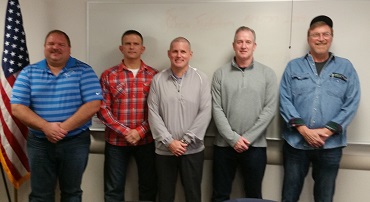
The Saginaw Athletic Officials Association sent along this photo of five members who worked 2013-14 MHSAA Finals, from left: Mark Jarlock (baseball), Tom Behmlander (softball), Scott Helmka (football), Dale Brown (softball and football) and Mark Schoenow (football). The Baseball Final was Jarlock’s first; the other officials had worked Finals in the past.
PHOTO: (Top) Monroe St. Mary quarterback Bryce Windham unloads a pass during last season's Division 6 Final win over Ithaca at Ford Field.
Returning with Full Lineup, Bark River-Harris Capitalizes Fully with Finals Sweep
By
Jason Juno
Special for MHSAA.com
May 27, 2026
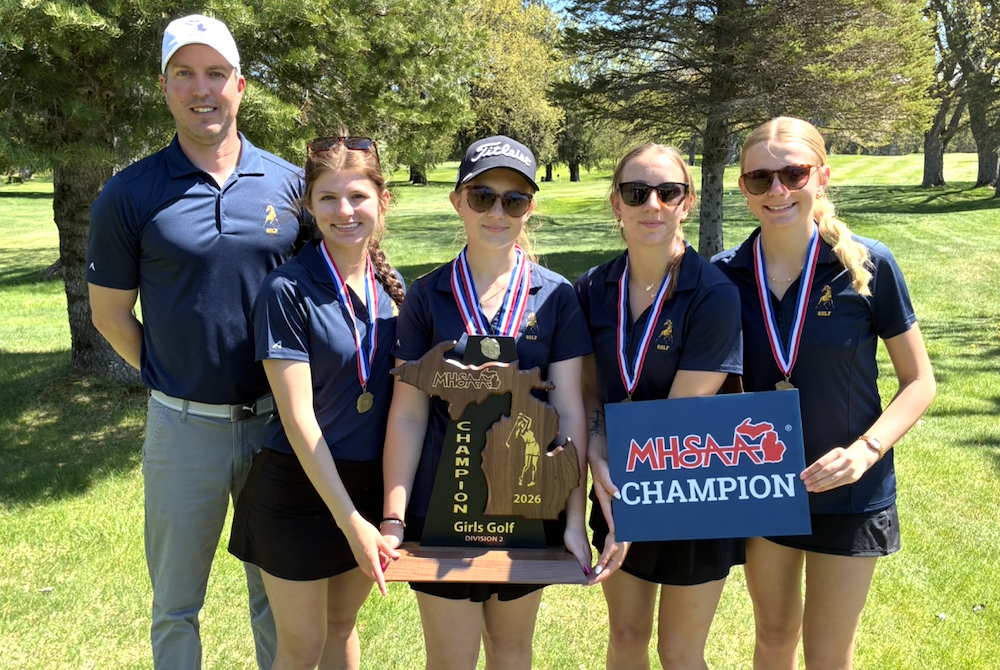
HOUGHTON — When Bark River-Harris has enough golfers for a team, they’ve become pretty tough to beat in the Upper Peninsula.
The Broncos won a U.P. Finals title two years ago but didn’t have enough golfers for a team score at last year’s championship tournament. This year, they did – and they made it two Division 2 championship trophies earned in three years.
They won convincingly; their score of 416 was 12 strokes better than runner-up Cedarville on Wednesday at Portage Lake Golf Course. Hancock was third, Ironwood fourth, and last year’s champion, Newberry, fifth.
“We had high expectations this year. We had a good team last year,” Bark River-Harris coach Matt Sly said. “The three players that played this year — that was part of our core team — last year we didn’t have enough players. They came back this year, we were able to recruit our fourth player and she was a vital part of our team.
“So we knew we had a pretty good chance, and it does feel really great to win.”
Bark River-Harris sophomore Makayla Hyslop won the individual U.P. Division 2 title, carding a 91, which was three strokes better than Hancock’s Kaelyn Rouleau. Ironwood’s Cristina Braucher took third with a 96. Last year’s U.P. medalist, Cedarville/DeTour’s Makenna Smith, finished in fourth with a 97, and Newberry’s Blair Maki was fifth, shooting a 98.
 “I think I really focused on hitting solid, straight drives because it’s a little narrow out there,” Hyslop said. “And I remember I was just trying to get the most distance I could out of all of my shots and to play smart and to stay out of trouble.
“All of the work I’ve put in the last two years kind of feels like I’m being rewarded for the long hours and practice rounds and all of the stuff I did got me to where I am, so it feels nice,” Hyslop added.
Her goal was to place in the top three herself, but to win as a team.
“I really didn’t expect to do as well as I did,” she said. “But I am very glad that it went the way that it did. My first few holes started off really strong. I parred my first, so that gave me a good confidence boost. And probably around six holes in, I realized I was doing pretty well. When it came down to the last few holes, I realized I really could win if I just stayed focused and control what I can.”
The team title was a big deal as well.
The three golfers who were on last year’s team at the Finals all placed among the top 10 Wednesday. In addition to Hyslop, sophomore Alana Nault was sixth with a 99 and senior Dakota Bridges ninth with a 103.
Senior Julia Nault tied for 25th from that integral fourth spot to round out the lineup.
“It was really special to win because we’re losing two seniors, so to win it with them feels really special, especially because we could have won it last year with one of our seniors (Dakota Bridges) if we had another girl,” Hyslop said. “So to be able to get a title as a sophomore and experience it with one of my favorite seniors was really special.”
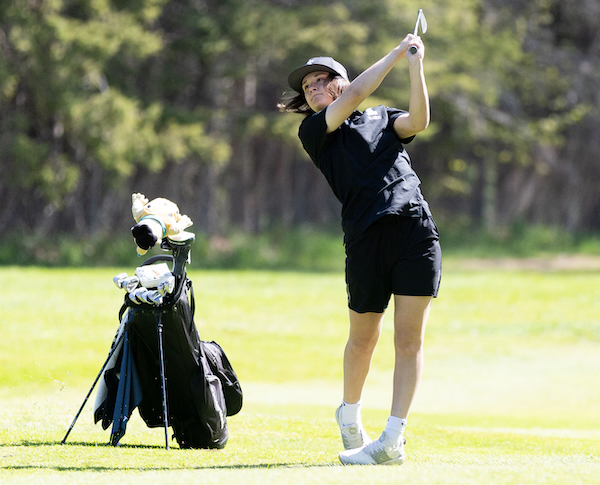
PHOTOS (Top) The Bark River-Harris girls golf team poses for a photo Wednesday with its latest championship trophy. (Middle) Cedarville/DeTour's McKenna Smith follows an approach shot. (Top photo courtesy of Painesdale Jeffers’ athletic department. Action photo by Jason Juno.)