

Special Year Thanks to No Specialization
August 7, 2015
By Geoff Kimmerly
Second Half editor
As we embark on another sports-filled school year Monday, we can look to a recent Monroe St. Mary Catholic Central grad for the value of a school year filled with sports.
As specialization at the highs school level continues to be debated, Bryce Windham will start his college baseball career this fall at Division I Old Dominion University – after playing baseball but also football and basketball for the Falcons.
 The MHSAA has long advocated athletes taking on as many sports as they have interest instead of focusing on just one in pursuit of a college scholarship – a position that’s received plenty of public backing of late, be it from stars of the U.S. women’s soccer team after their World Cup championship run or former Lansing Waverly multi-sport athlete John Smoltz during his enshrinement in the Major League Baseball Hall of Fame.
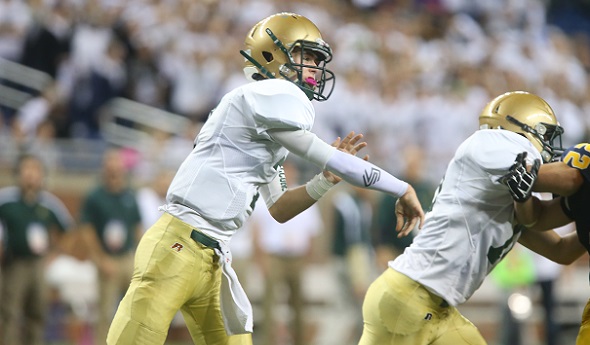
Enter Windham – who easily could’ve been excused for focusing on baseball, or even basketball as his dad is the St. Mary’s varsity boys coach. Instead, Bryce quarterbacked the football team to last season’s Division 6 championship – breaking Ithaca’s national-best 69-game winning streak in the Final – before being named Class C Player of the Year by The Associated Press in basketball and earning a Most Valuable Player honor at the baseball state coaches association all-star game at Comerica Park this spring.
All three of Windham's teams reached at least the MHSAA Quarterfinals.
“His participation in football and basketball helped land a Division 1 baseball scholarship to Old Dominion. They were able to see his athleticism in basketball and toughness in football, and ODU’s coach loved it,” dad and hoops coach Randy Windham said.
“He probably would’ve given up football, and that ended up his greatest memory by winning a state championship.”
Click to read about Windham’s multitude of accomplishments as reported last month by the Monroe Evening News.
Honors Abound
National coaching honors were bestowed on a trio of Michigan coaches over the summer:
- Retired Trenton ice hockey coach Mike Turner – the winningest hockey coach in MHSAA history with a record of 629-126-52 from 1974-81 and then 1995-2014 – was named National Coach of the Year in Special Sports by the National High School Athletic Coaches Association. His teams won 11 MHSAA titles and finished runner-up four times. “I was there when the MHSAA added hockey as one of their sanctioned sports and crowned their first MHSAA state championships in 1975. At that time there were 60-70 high school teams participating, and now there are 170,” Turner said. “It has been great to be a part of the advancements made in the sport of high school hockey, with more teams participating, more player development, and more opportunities that exist for players after high school.”
- Traverse City Central boys track and field and cross country coach John Lober won his second national coaching honor of the 2014-15 school year, named the NHSACA Coach of the Year for track and field to go with a previous honor earned in January from the National Federation of State High School Associations. He has coached the Traverse City Central boys track and field team since 1977 and also the boys cross country team since 1989. His 1992 track team won the Class A championship, and he has coached 17 individual MHSAA Finals champions. He was inducted into the Michigan Interscholastic Track Coaches Association Hall of Fame in 2006.
- Ann Arbor Pioneer assistant girls swimming and diving coach Liz Hill was named the Assistant Coach of the Year for all girls sports by the NHSACA. Hill, a former All-American at the University of Michigan and standout sprinter at Pioneer, began assisting her husband Denny Hill in 1983 before becoming his fulltime assistant a few seasons later. Together they’ve led the Pioneers girls to 15 MHSAA team titles, the last two as co-head coaches.
Michigan Mourns
Fremont and the high school athletic community statewide mourned the death July 21 of longtime coach Rich Tompkins, who led Fremont’s boys cross country teams to six MHSAA cross country championships including three and a runner-up finish during his last decade of coaching before retiring in 1997.
The Muskegon Chronicle reported that his boys and girls cross country teams and boys track and field team combined for 45 league championships, with his boys cross country team winning 116 straight duals from 1977-88. Tompkins was executive director of the Michigan High School Coaches Association for more than a decade and served on its board for more than two decades.
Click to read more from the Chronicle on Tompkins’ legacy.
Officials in the News
The Monroe County Officials Association took to the county fair to encourage passers-by to “Be the Referee” – and received 47 sign-ups from people interested in the avocation. Visitors to an MCOA booth at the fair were told in some detail what is involved with being an MHSAA official, and those who then signed up to find out more about officiating football, basketball, baseball or softball (sports the MCOA trains for and schedules) will be invited to an orientation session where they will become eligible for one of 20 complimentary registration fees for this school year.
 The West Michigan Officials Association marked a decade of support at the start of this summer for the Visually Impaired Sports and Activity Day, sponsored by the Helen DeVos Children’s Foundation. The WMOA has contributed nearly $18,000 to the event over the last 10 years as well as taking part in the event, which includes a number of sports and other activities.
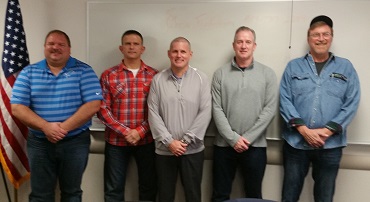
The Saginaw Athletic Officials Association sent along this photo of five members who worked 2013-14 MHSAA Finals, from left: Mark Jarlock (baseball), Tom Behmlander (softball), Scott Helmka (football), Dale Brown (softball and football) and Mark Schoenow (football). The Baseball Final was Jarlock’s first; the other officials had worked Finals in the past.
PHOTO: (Top) Monroe St. Mary quarterback Bryce Windham unloads a pass during last season's Division 6 Final win over Ithaca at Ford Field.
Longtime Coach Researches Photos to Tell Story of Grand Rapids Sports' Past
By
Steve Vedder
Special for MHSAA.com
September 16, 2022
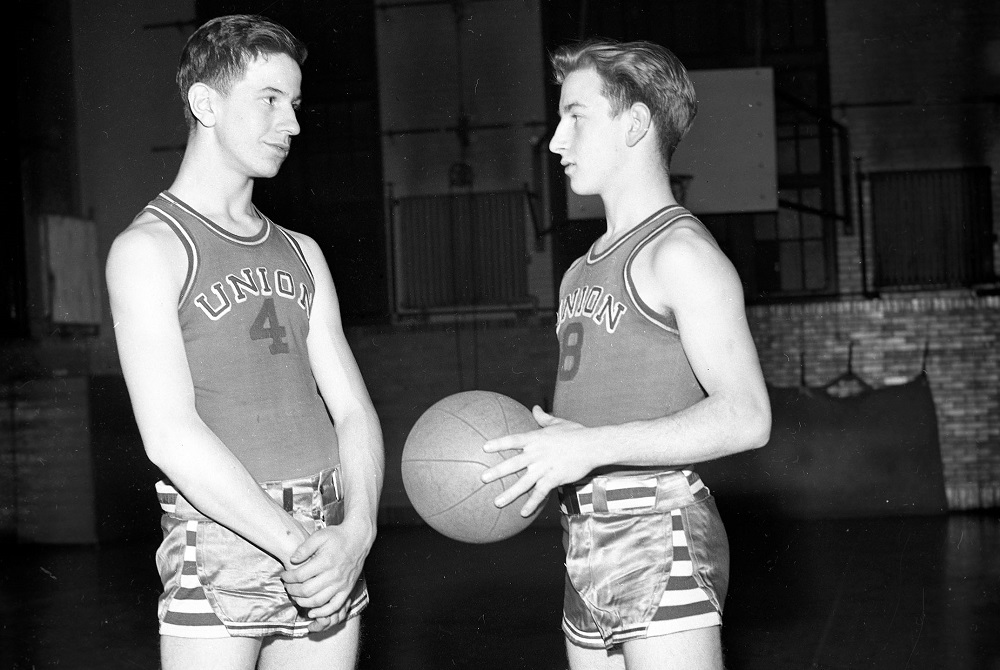
GRAND RAPIDS – Bob Schichtel always pauses when he comes across the ancient black and white photo long enough to ponder whatever became of the two youngsters adorned in Grand Rapids Union basketball uniforms.
The posed shot shows two players facing each other in a local gymnasium in a photo apparently taken four days after the Japanese surprise attack on Pearl Harbor in 1941 that launched the country into World War II. Only a handful of fans today would recognize the players' striped, ultra-short shots and simple sleeveless shirts with "Union" emblazed across the front as recognizable basketball uniforms. One holds a battered-looking basketball, while the other looks on. The two players, whose uniform numbers are "4" and "9," aren't really smiling, but still seem as close as any teammates, whether 81 years ago or today.
In fact, it's the look the youngsters share that intrigues Schichtel, whose thankless, pro bono job it is to identify the two players.
"Once you start," said Schichtel, a former longtime Grand Rapids basketball coach, "it's like looking down a deep rabbit hole."
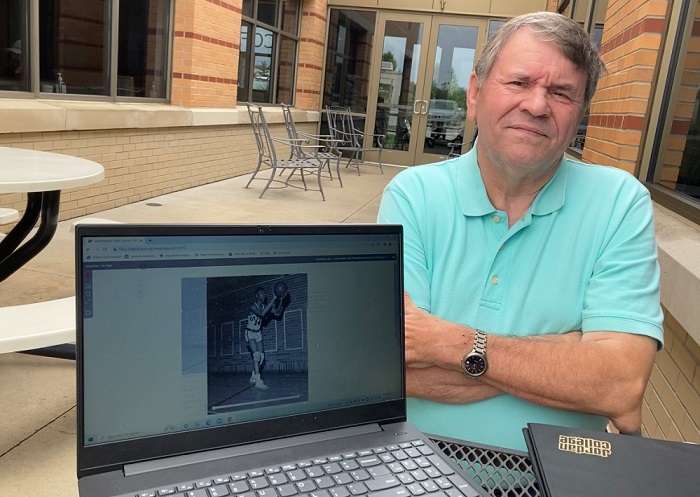 Schichtel works as a volunteer for the Grand Rapids Public Library trying to identify mostly former Grand Rapids City League basketball players from approximately 1938 through the early fifties. The online photos are mostly from the Robinson Photo Studio Collection taken in conjunction with the Grand Rapids Herald newspaper. The library says the unique collection spans some 950 basketball negatives from the entire Robinson/Herald collection that totals well over 900,000 Grand Rapids photos.
While the work – which amounts to a ton of patience combined with a detective ability – can be exhausting, it's still what Schichtel describes as a labor of love. For example, there's the shot of the two still-unidentified Union players. Schichtel looks at the photo and can't help but wonder whatever happened to the kids. Were they exceptional athletes? Did they leave their marks on Grand Rapids history, whether it was in education, politics, business, industry, the arts or another field? He doesn't even know, as in many photos from this era, whether the two entered the military and thus even survived World War II.
Schichtel has searched everywhere for the answers, but has come up short. Too many times, in fact.
Which isn't to say he'll quit looking or chalk up his research as inconsequential. Schichtel said the foremost reason he spends hours on the project is that many of the athletes he identifies deserve the recognition for achievements far beyond basketball. In many cases former City League basketball, football, baseball, track and tennis athletes became the foundation on which Grand Rapids was built. If Schichtel can uncover an old photo which depicts these youngsters during their high school careers, so much the better, he said.
"It's important to recognize Grand Rapids sports history, and I don't know if we've given enough attention to their past," Schichtel said. "They are what got us here, and I'm a firm believer they need to be recognized for it."
Figuring out that history, however, ranges from, at the least, extremely time consuming to – in too many frustrating cases – virtually impossible. The City League was formed in the late 1920s and featured original schools Grand Rapids Central, Creston, South, Union, Ottawa Hills, Catholic Central and Davis Tech. The league was eventually folded into the Ottawa-Kent Conference in 2008.
"It was a long, evolving league," Schichtel said.
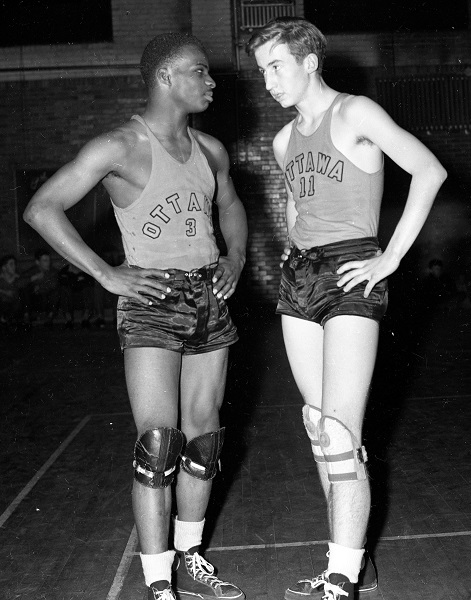 The identification tools available to Schichtel are actually more numerous than most would suspect. For starters, he's formed an impressive database of information by pouring through old City League yearbooks and programs, photos from other collections and microfilm of old newspapers, And then there's also the knowledge gathered by Schichtel himself, a 1968 Grand Rapids Catholic Central graduate. After playing in many old City League gymnasiums, Schichtel went on to compile a 389-197 record in 27 years as the Cougars girls basketball coach. He uses countless City League contacts as both a player and coach to identify athletes. In all, Schichtel taught in the Grand Rapids school system for 34 years.
He also uses the game itself to identify the photos. For instance, he can pinpoint some photos simply by the styles of the uniforms worn by players. He also figures out who is who by other clues such as what the players are doing in the photo. If a player is taking a set shot in the photo, it's likely pre-World War II. The beginnings of the jump shot, or what Schichtel calls "elevation while shooting," is probably mid-1940s. In addition, Schichtel can identify photos through pure basketball athleticism. Players can look a bit awkward in shots from the thirties as compared to players from the late 1940s who were beginning to play with a more obvious flare.
Put all the information together and Schichtel, who has uncovered more than two dozen personal connections to subjects in the photos, believes he has a reasonable shot at identifying them.
Since he signed on with the project, Schichtel figures he's identified about 10 percent of the photos he's viewed. Among the City League athletes he's found shots of Central's John Lavan, who was born in 1890 and played Major League Baseball during the Babe Ruth era and became a military hero who is buried in Arlington National Cemetery; Creston basketball player Roger Wilkins, an assistant United States attorney general during the Watergate hearings; Art Spoelstra of Godwin, a former NBA player and member of the Grand Rapids Hall of Fame; and Grand Rapids native Bill Cutler, who turned a chance post-World War II meeting with then-American League president Will Harridge into a position as commissioner of the Pacific Coast League,
Schichtel said gaining information through photos on the people who became the bedrock of Grand Rapids should be celebrated.
"I think it's a great approach for the community; they shouldn't be forgotten," Schichtel said. "Who else is going to do this? Why do I do it? I see a certain, for lack of a better word, a nobility. These kids played for the love of game, and they became the “Greatest Generation.” These kids did great things. It's not just, 'Well, there's No. 58,’ in a photo.
"You want to know more about them. That's the real intrigue for me."
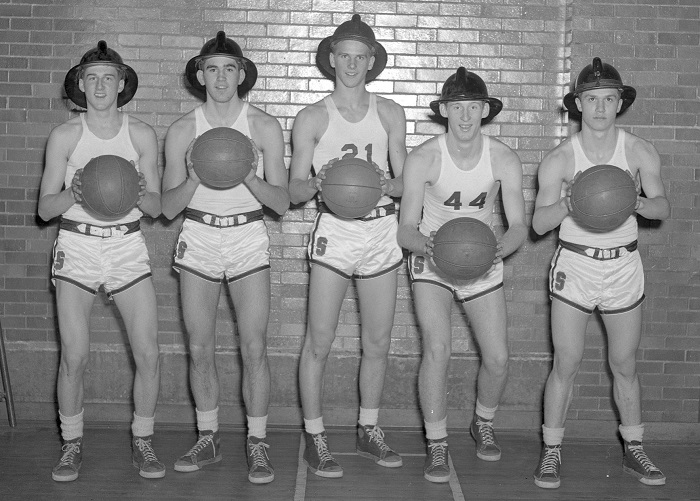 Tim Gloege of the Grand Rapids Public Library said the collection of photos – and their identification – is continually growing. As more people log onto the library's website, more people want to either add to the collection or have information that leads to an identification. The library estimates about 1,200 photos are searched monthly. But as time grows, many of the original photos are disintegrating. The library is in a constant state of preservation, Gloege said.
"It's a massive project, and we're working to get as many photos online as possible," he said. "The numbers (of photos) we have are rising pretty significantly as people post them on social media.
"When you think of the past and now, you need to realize these are people, kids who used to play basketball and did other things. The work is hard and very time-intensive, but it brings a whole new dimension to history."
Schichtel said he's "kind of picked the low-hanging fruit" on many of the easy photos to identify. But the work will continue.
"Yes, it can be frustrating," he said. "There are limitations if you want it to be accurate. Sometimes you look at a photo and you know it's not going to happen, and you move on. But this a chance to learn about people who made Grand Rapids what it is. That's important to me."
PHOTOS (Top) Two Grand Rapids Union basketball players stand for a photo taken Dec. 12, 1941. (2) Longtime area coach Bob Schichtel researches hundreds of photos that are part of the Grand Rapids Public Library archive. (3) Schichtel has identified these 1941 Grand Rapids Ottawa Hills basketball players as James Horn (left) and Chuch Reynier. (4) Schichtel identified Grand Rapids South High’s “Fireman Five” of, from left, Fred Esslair, Lee Morrow, Jack Carroll, Bob Youngberg and Bruce Bigford. (Historic photos courtesy of the Grand Rapids Public Library.)