

Adult Fans: HS Sports' Biggest Challenge
August 27, 2019


By Karissa Niehoff, NFHS Executive Director
and Mark Uyl, MHSAA Executive Director
Inappropriate adult behavior at high school athletic events in Michigan has reached epidemic proportion.
When more than 2,000 high school athletic directors were asked in a recent national survey what they like least about their job, 62.3 percent said it was “dealing with aggressive parents and adult fans.”
And the men and women who wear the black and white stripes agree. In fact, almost 80 percent of officials quit after the first two years on the job, and unruly parents are cited as the reason why. As a result, there is a growing shortage of high school officials here in Michigan, and in some sports like wrestling, swimming & diving and track & field, the shortage is severe. No officials means no more games.
If you are a parent attending a high school athletic event this fall, you can help by following these six guidelines:
1. Act Your Age. You are, after all, an adult. Act in a way that makes your family and school proud.
2. Don’t Live Your Life Vicariously Through Your Children. High school sports are for them, not you. Your family’s reputation is not determined by how well your children perform on the field of play.
3. Let Your Children Talk to the Coach Instead of You Doing It for Them. High school athletes learn how to become more confident, independent and capable — but only when their parents don’t jump in and solve their problems for them.
4. Stay in Your Lane. No coaching or officiating from the sidelines. Your role is to be a responsible, supportive parent — not a coach or official.
5. Remember, Participating in a High School Sport Is Not About Getting a College Scholarship. According to the NCAA, only about two percent of all high school athletes are awarded a sports scholarship, and the total value of the scholarship is only about $18,000.
6. Make Sure Your Children Know You Love Watching Them Play. Do not critique your child’s performance on the car ride home. Participating in high school sports is about character development, learning and having fun — not winning and losing.
Purchasing a ticket to a high school athletic event does not give you the right to be rude, disrespectful or verbally abusive. Cheer loud and be proud, but be responsible and respectful. The future of high school sports in Michigan is dependent on you.
The Michigan High School Athletic Association (MHSAA) is one of 51 members of the National Federation of State High School Associations (NFHS).
Battle of the Fans IX: Meet the Finalists
By
Geoff Kimmerly
MHSAA.com senior editor
January 27, 2020
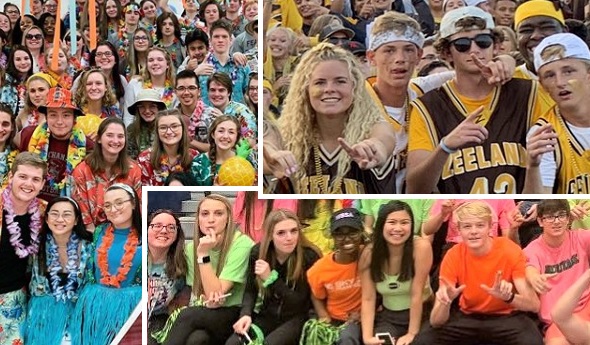
An annual power boasting two title banners, another return finalist that impressed for the first time a year ago, and one of the earliest contenders in contest history have earned opportunities to vie for the MHSAA's “Battle of the Fans IX” championship recognizing the top high school student cheering section in Michigan, as awarded by the MHSAA’s Student Advisory Council.
Buchanan, Saginaw Heritage and Zeeland East were selected as finalists by the Advisory Council from a group of nine semifinalists that took part in a series of social media challenges highlighting their sections over the last two weeks.
Members of the MHSAA staff will visit all three finalists over the next three weeks, producing articles about each section and videos of those sections in action, all to be published on Second Half.
The winner will be selected by another vote by the 16-member Advisory Council, with consideration given to a public vote on the MHSAA’s social media sites. This year’s winner will be announced Feb. 21 and recognized March 27 at the Breslin Center.
Buchanan and Heritage were finalists a year ago. Buchanan is seeking its third BOTF championship to go with those won in 2013 and 2018 and also made the finals in 2014 and 2015. Heritage was a first-time finalist last year, and Zeeland East was a finalist for Battle of the Fans II in 2013.
The MHSAA will visit the finalists for the following home boys basketball games:
Feb. 7: Saginaw Heritage vs. Midland Dow
Feb. 11: Buchanan vs. Watervliet
Feb. 14: Zeeland East vs. Hamilton
Reese and Traverse City West tied for fourth in this round of voting, just missing claiming the third finalist spot. Caro, Frankenmuth, Hart and Petersburg Summerfield also were semifinalists.
“Some real heavyweights are in the final three this year,” said Andy Frushour, MHSAA director of brand management and advisor to the Student Advisory Council.
“Buchanan has been a finalist in six of the last seven years for good reason – The Herd is a genuine part of the school and community culture. Heritage is in the finals for the second straight year after coming up just short of getting the banner in 2019. Zeeland East is a finalist for the first time since 2013, but the west side of the state is known for having great student and community support at games. The Chix think this might be their year.”
Let's meet the finalists:

BUCHANAN - THE HERD
Follow on Twitter and Instagram
The Herd is loud and proud for #BlackoutNight in #TheWoods! Go Lady Bucks! ?????? #BOTF pic.twitter.com/KUcwDFyw1q
— The Herd (@TheHerd_BHS) January 17, 2020
SAGINAW HERITAGE - HAWK NEST
Follow on Twitter and Instagram
 ZEELAND EAST - THE COOP
Follow on Twitter and Instagram
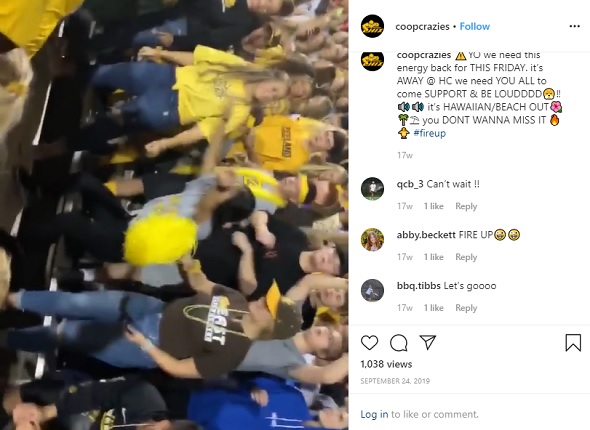
Battle of the Fans is organized by MHSAA staff and the Student Advisory Council. Schools were invited throughout the fall to submit short videos, via YouTube, of their cheering sections in action. The Advisory Council then selected nine semifinalists to accomplish a list of tasks showing off their sections over a 12-day span.
Semifinalists were required to complete 10 challenges via their social media channels. Five mandatory challenges focused on contest criteria: positive sportsmanship, student body participation, school spirit, originality of cheers, organization of the group, student section leadership and overall fun. Semifinalists then selected five elective challenges (taken from a list of 15 opportunities). Descriptions of all 20 challenges are available on the MHSAA Website.
A total of 20 schools applied for this year’s contest – including nine first-time applicants. Three semifinalists each were selected from the Class A, Class B and Class C/D applicants. See below for a playlist of all 20 applicants.
The contest is sponsored in part by the United Dairy Industry of Michigan, which promotes Michigan's locally-produced dairy products and nutrition education. Rules plus links to past years’ coverage of the contest can be found on the MHSAA's BOTF site.
The Student Advisory Council is made up of eight seniors and eight juniors who each serve two-year terms. The Council acts as the voice of Michigan's student-athletes; it serves as a student sounding board for the MHSAA's Representative Council, assists in planning Sportsmanship Summits, Captains Clinics and other student leadership events; participates in a yearly focus group about the state of high school sports for Michigan State University's Institute for the Study of Youth Sports and assists with medal ceremonies at MHSAA championship events.